Dubai is Growing Food in Salt Marshes

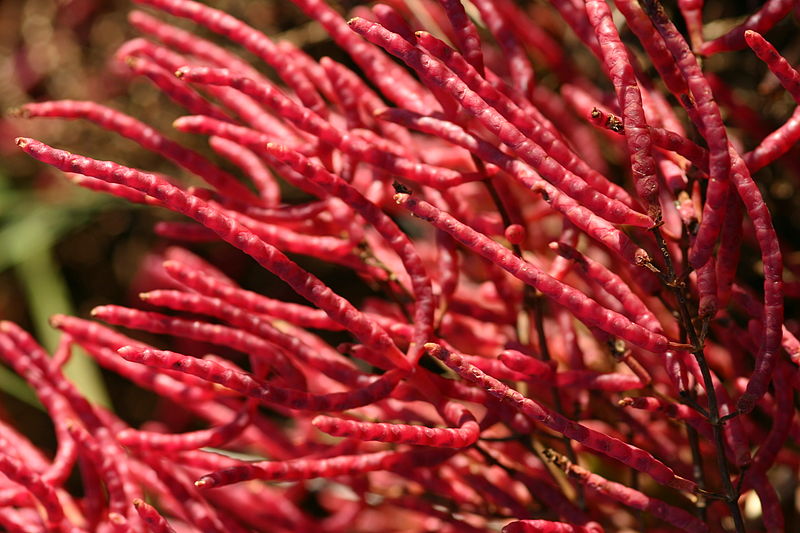
Salicornia, Dubai, growing food in salt marshes, sustainable food production, sea beans, The International Centre for Biosaline Agriculture in DubaiScientists in Dubai are growing a new kind of food crop in salt marshes along the Persian Gulf coast. A variety of salt-resistant succulent, Salicornia are typically sold in gourmet shops in Europe, but they have other uses as well.

Native to North America, Europe, South Africa, and South Asia, Salicornia succulents grow in salt marshes, on beaches and among mangroves – all of which are available along Dubai’s coast.

Scientists with the International Center for Biosaline Agriculture are conducting a trial with 12 different genotypes from the US and elsewhere, saline crop expert Dr Shoaib Ismail told The National.

Their aim is to determine which of the genus’ selected can be produced as food to feed the local population; this will relieve the emirate’s reliance on exporters for 85 percent of its food.

“Salicornia has very high oil content but it was never bred,” the center’s directory general Dr Ismahane Elouafi told the paper.

“We’re starting a new collection of salicornia and we’re setting up a much larger trial in Umm Al Quwain with the Ministry of Environment and Water next year as we will be closer to the coast.”

This allows them to irrigate the plants without using precious resources, although the water they do use has to be flushed back towards the Gulf to avoid contaminating the soil. Dubai already has serious water issues; they can’t afford to compromise what groundwater they do have.

Dr Ismail said that in order for the project to be viable, the Salicornia crops need to have multiple functions.

Depending on what variety they use, the plant can be used to produce seed or as food, and ash from glasswort and saltwort plants can be used to make glass and soap.

Salicornia may also be raised as an alternative biofuel; to explore this possibility, experimental fields have already been planted Saudi Arabia and Eritrea.

:: The National
Tafline Laylin
Tafline Laylinhttp://www.greenprophet.com
As a tour leader who led “eco-friendly” camping trips throughout North America, Tafline soon realized that she was instead leaving behind a trail of gas fumes, plastic bottles and Pringles. In fact, wherever she traveled – whether it was Viet Nam or South Africa or England – it became clear how inefficiently the mandate to re-think our consumer culture is reaching the general public. Born in Iran, raised in South Africa and the United States, she currently splits her time between Africa and the Middle East. Tafline can be reached at tafline (at) greenprophet (dot) com.

Read More

TRENDING

Health Canada approves lab grown milk

Canada's approval of animal-free dairy proteins marks a milestone for precision fermentation and the growing alternative-protein industry. Will consumers embrace milk made without cows?

Can we fly guilt-free with Britain’s new stance on sustainable aviation biofuel?

Virgin Galactic astronauts. Will space travel be sustainable? Sustainable Space Fuels?

Green Polyethylene: The Plant-Based Plastic That’s Replacing Oil

Green PE is produced using ethanol derived from renewable sources—primarily sugarcane in Brazil, but also wheat grain and beet in Europe. It behaves the same as traditional polyethylene: it’s durable, moldable, and recyclable. The difference lies in its feedstock and carbon footprint. While not biodegradable, Green PE is a key player in the circular economy: it sequesters carbon during crop growth and reduces life-cycle emissions when used and recycled responsibly.

How to make camel burgers at home

Where camels are as much a part of the landscape as native trees, people know how tender and tasty camel flesh is.

Visit the Clore Garden of Science in Rehovot for simple, sustainable outdoor fun

This area features a sustainable village with bridges, composting systems, and a living treehouse, educating visitors about sustainability and climate change.

Yerukim Forms a New Green Economy Where the Money is Really Green

The Yerukim members who pick up the recyclables get to keep the monetary reward, the public earns "green" bills that can be used in shops, and business owners get to be associated with environmentalism.

Choosing Riyadh over Dubai? What Investors Should Know

Saudi Arabia is deploying capital at unmatched scale to catalyze tourism and advanced industry while rewiring its power-and-water backbone. The investable frontier is widening—especially in renewables, grid storage, water efficiency/desal retrofits, and hospitality operating platforms. Prudent investors will insist on phased delivery, enforceable KPIs (energy, water, biodiversity), and RHQ/zone compliance—while pricing political-economy and reputational risks alongside growth upside.

Sell your cooking oil for biodiesel money

Want to make money on old french fry oil? Sell it.

Qatar Alternative Energy Summit Pairs Investors And Innovators

Alternative energy investors and innovators can meet n' greet in Doha, Qatar March 16 and 17.

Here’s How To Implement The Four Pillars Of Employee Engagement

If you throw a party for your work team and they are vegans, don't make it a barbecue. Know the sustainability values of your team to boost moral and retain good people.

Locals From Rishon Fight IKEA

Big Box stores are a pretty new concept in Israel, and thank God that not every Israeli city wants them in their backyard. A word from someone who has see the beautiful farmland around her hometown Newmarket, Ontario stripped and converted into vulgar strip malls of big box shops: they have no place in a healthy and sustainable town or city.

The Jewish National Fund Meets An Inconvenient Truth

According to the JNF, it has transformed thousands of acres of barren land into green forests in Israel. They state that each person emits about 23 tons of carbon per year, estimating that each tree planted can absorb one ton of carbon in its lifetime. That's a whole lot of trees you'd need to be planting. Could so many fit in Israel?

How to quiet noise from construction in your office

Streets need to be resurfaced in New York but the humming and grinding noise is unsettling. Noise is environmental pollution. 

Popular Categories