

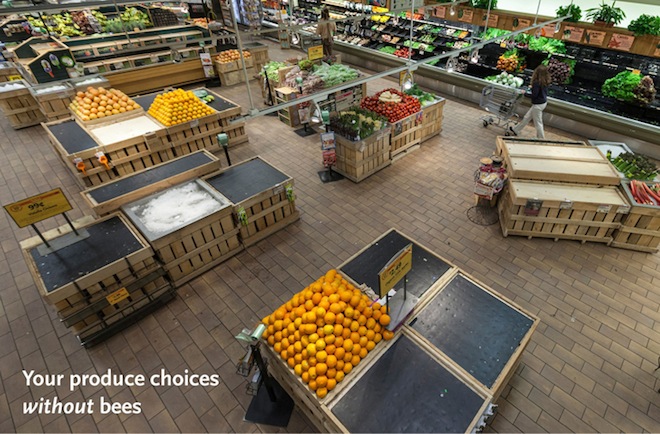
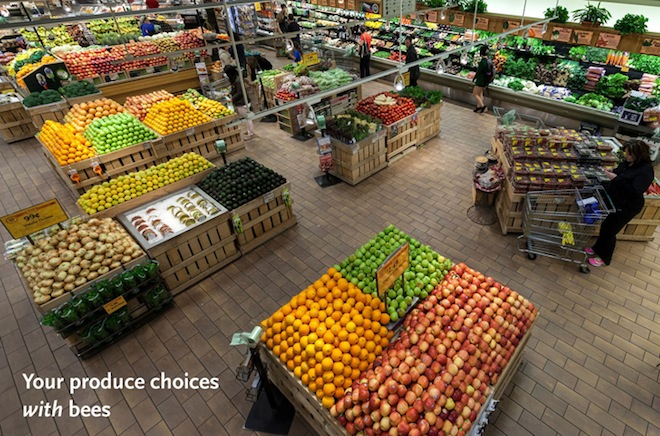
 A corporate natural foods store in the United States has captured a photograph of what their shelves would look like if bee populations completely collapse. Whole Foods teamed up with the Xerces Society, a wildlife conservation group, to illustrate just how important bees are to our food supply in the hopes of raising greater awareness.
At the end of 2006, beekeepers and other agriculturalists began to notice that in certain bee colonies, adult males would disappear, leaving the queen and the remaining hive alone.
Called Colony Collapse Disorder (CCD), this phenomenon has spread around the world, putting global bee populations in serious peril.
The causes for CCD are not yet 100 percent certain, but an increasing number of reports show that neonicotinoids present in certain pesticides may be toxic to pollinators.
“…recent research suggests that neonicotinoids may make honey bees more susceptible to parasites and pathogens, including the intestinal parasite Nosema, which has been implicated as one causative factor in CCD,” writes the Xerces Society.
The European Union recently voted to ban pesticides containing neonicotinoids, but the United States, in bed with companies like Bayer that manufacture the pesticides, continues to permit their sale.
Like most things in nature, bees don’t operate in a vacuum, and nor do we.
Whole Foods claims that one in every three bites of food is pollinated by bees. That’s 100 crops in the United States alone, including apples, onions, avocados, carrots, mangoes, lemons, limes, honeydew, cantaloupe, zucchini, summer squash, eggplant, cucumbers, celery, green onions, cauliflower, leeks, bok choy, kale, broccoli, broccoli rabe, and mustard greens.
Whole Foods is donating 10 cents for every pound of summer squash sold between June 12 and June 25 to raise funds for Share the Buzz – a new initiative designed to get more people interested in restoring bee populations.
Hardly anybody seems to be talking about neonicotinoids in North Africa and the Middle East, where controlling their sale and distribution will be significantly more difficult – especially if products previously slated for the US and EU are “dumped” in Asia.
But there are a small handful of beekeepers throughout the region – from Israel to Lebanon and Turkey – who continue to create safe habitat for bees.
Our future depends on it.
Visit Xerces Society for a complete list of products deemed harmful to bees and other pollinators and join Share the Buzz to learn what you can do to help.
Image via PRNewsFoto/Whole Foods Market


[…] http://www.greenprophet.com/2013/06/whole-foods-market-photo-without-bees/ […]
This is a great illustration of how our planet is affected by the reckless behavior of human beings. Scary.
[…] Chris – The Corporate States of America […]
[…] Chris – The Grocery Store Without Bees […]
You can take the citrus produce away from the 1st photo as well. Bees pollinate citrus trees and also make excellent honey from orange and other citrus blossoms.