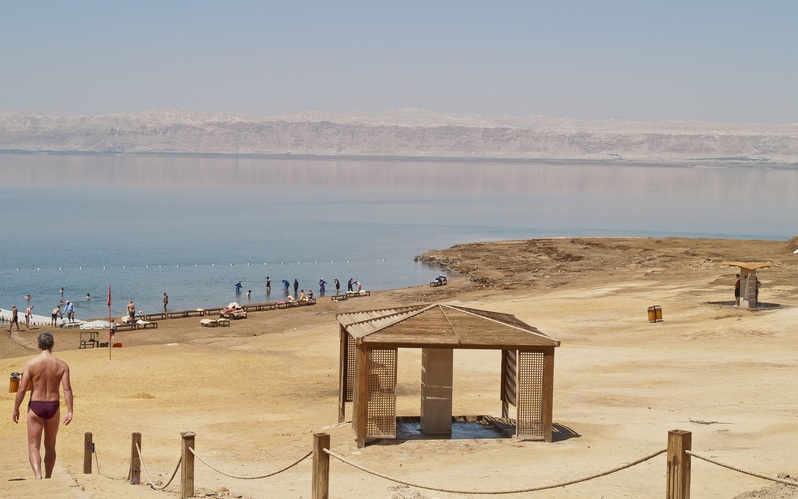
At one of the most famous natural spas in the world, the shores of the Dead Sea, Veronica begins her much-anticipated skin care treatment.The 34-year-old Italian tourist rubs the famous black mud on her pale white skin and waits under the hot sun for nature to do its work.
“Despite the constant itching on my skin, I already feel the benefit of the mud on my skin,” Veronica, a lawyer from Florence told The Media Line as she slathered on more mud. “I am privileged to be among those who can say they swam in the Dead Sea.”
Jordanian tourism officials see the goopy stuff and other Dead Sea projected spa hotel offerings as just the right prescription to cure the ailing tourism industry, which contributes 15% of Jordan’s Gross Domestic Product, according to Finance Ministry figures.
Counting on its long periods of sun and wide array of spa hotels, the government launched an aggressive campaign this year to draw tourists and attract investors. As part of that campaign, it has been organizing several international conferences in the region to market the area and bring in business.
To that end, last month the Jordanian shores of the Dead Sea were full of visitors participating in the World Economic Forum held in Jordan, an event which draws thousands of businessmen and decision makers from around the world.
Occupancy of the 2200 rooms available peaked at 75 percent in April and 100% in May, the Jordan Tourism Board reported. Total investment in Dead Sea area tourism projects is expected to surpass $3 billion by year’s end and would provide 10,000 jobs, the figures showed.
Jordan’s Social Security Corporation (SSC), a pension fund valued at $6 billion, is investing in the Dead Sea. The government hopes to attract investors from the Gulf States and other parts of the Arab world.
Last month, King Abdullah inaugurated the $140 million Crown Plaza Hotel, owned by the SSC, which runs a second five-star hotel in the Dead Sea area.
Tourism Ministry officials hope the promotional campaign will stem the influence of the Arab states’ revolutions and political instability in the region. Those two events drove tourists away and led to many cancellations over the past two years.
Hotel owners are also seeking to draw tourists by offering competitive prices in a cut-throat market where the players include Israel, Dubai, Lebanon and Turkey, according to Yassar al Majali, chairman of Jordan’s Hotel Owners Association. Catering to markets like skin care treatment are a real draw to the region, obviously.
Prices offered at the Dead Sea are 50% less than other hotels in the region, including Dubai and Lebanon.
“Tourists pay $250, while other hotels in Dubai and Lebanon charge at least $500,” Majali told The Media Line.
The Dead Sea, which is full of minerals including bromide, has proved successful in treating skin conditions including psoriasis.
On a recent afternoon, Suzanna, 55, waited patiently for treatment for arthritis that has plagued her for the past two decades. She sat in a wheelchair in the lobby of a Dead Sea hotel, waiting to enter a clinic that overlooks the sparkling waters.
Every year she comes to the Dead Sea clinic for massage therapy aimed at relieving her pain.
“I visit Jordan regularly to get treatment for arthritis. Treatment in the Dead Sea area is proving popular in Europe,” she told The Media Line.
Not even the searing heat and humidity can keep her away. “It is hot and humid, but the place offers a unique feeling of comfort difficult to explain,” she added before being ushered into a massage room.
Nader Amr, director of sales at the Dead Sea Spa, said studies showed that the black mud on the banks of the Sea contains unique properties that helps treat the ski and works as an anti-aging agent, among other benefits.
“The investments are good for everybody as they employ locals and attract more tourists to the region. We expect the number of visitors to rise because there is only one Dead Sea in the world,” said Amr.
Thousands of tourists flock to the Dead Sea to either pamper themselves with five-star treatment, seek unique cures for various ailments, or take part in international conferences on the shores of the lowest point on earth.
The government has been granting investors incentives to build resorts by providing them with cheap land to facilitate the building of top-of-the-line resorts along the Dead Sea shores, an official SSC source said.
In May the Jordanian government approved a mega-project worth $250 million that an Egyptian firm will build. This planned theme park project will include hotels, villas and residential complexes to cater to well-off locals and investors from the Gulf.
For now, however, it’s visitors like Veronica and Suzanna, that are keeping the Dead Sea hotels afloat. The two said they plan to come back to the Dead Sea as often as they can.
This story is reprinted from the Middle East News Source – The Media Line.; Image of Dead Sea, Jordan from Shutterstock