

Refrigeration is perhaps one of the greatest inventions of modern man, but it has come at a price. Not only do they require a great deal of energy to stay cool, but they also rely on ozone-depleting chloro-fluorocarbons (CFCs), or freon, though some countries have phased these out.
As an increasing number of people walk away from the grid to build their homes and villages and seek more sustainable lifestyles, yet keeping food cool and having ice for summer beverages remains one of the most significant challenges. Of course there are root cellars but they can’t keep cooked food cool enough for a few days. For meat hunted in the fall, you have to cure it or find a freezer on the grid. For a potential solution, we look to the Iranians and their ancient domed ice houses.
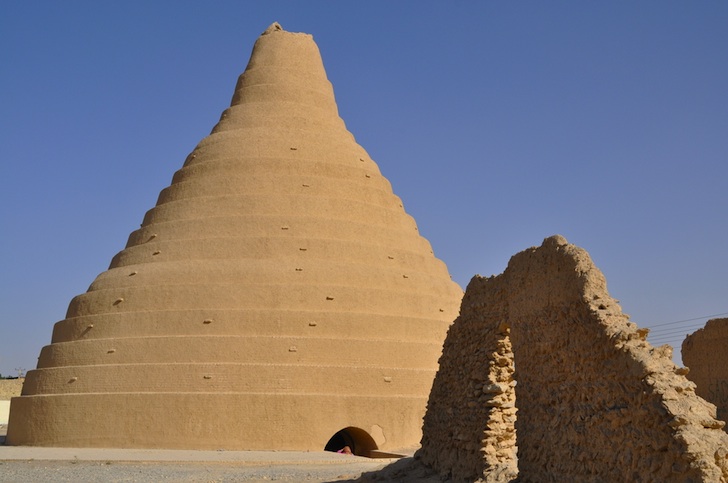
 Used up until about 50 years ago, these ancient ice houses were typically constructed as domes with earth bricks. Others are walled and some contain underground chambers.
Built on the outskirts of desert areas where it’s almost impossible to get ice unless its trucked in from the far north, the ice houses were built with channels at the back.
In winter, these channels were then flooded with water, which was likely derived from the Iranians’ qanat irrigation system that funnelled runoff from mountains to areas at their base, according to Dr. Hemming Jorgensen, who has compiled the first extensive documentation of these structures.

Overnight the water would freeze and custodians of the ice house would wake up early the following day, before sunrise, and break up blocks of ice that they would then relocate to the ice houses.
They would do this for as many nights as necessary to ensure a sufficient supply of ice that would last through the summer.
Jorgensen has documented the existence of 129 such ice houses, which Amusing Planet says are much bigger than similar ice houses built in the United States.

However, remnants of only 104 remain, and Jorgensen expresses concern that the absence of concerted preservation projects could result in their destruction.
Already some of them have been transformed into informal trash dumps. According to Jorgensen, “The traditional Persian ice houses were built at villages on the perimeter of the large deserts on the Central Plateau. Their cone-shaped domes, up to 20 meters high, consisted of mud and mud bricks from the excavation of the deep ice pits protected by the domes.
“The ice houses served as reservoirs that stored blocks of ice in the winter for further use in the summer. The ice was either hauled in from nearby mountains or produced in open basins at the ice house site. Such local ice production plants were typically supplied with fresh water from qanats, the ingenious water supply tunnels, that brought water for human settlements and irrigation from the distant mountains.
“The ice houses, whose origin is believed to go back more than 2000 years, gradually became obsolete with the advent of electricity and the introduction of the refrigerators to the households. Because they were made of perishable materials, most of the ice houses have disappeared and the rest are facing a grim future,” he says.
Ancient Iranians were well attuned to their natural environment and engineered all kinds of coping mechanisms. In addition to well-insulated earth buildings, they pioneered wind catchers that circulated natural cooling during hot winter months.
And although so much of that knowledge has been lost, we are mindful of a small but definite trend to reincorporate ancient wisdom into contemporary developments.

Read more about the qanat water systems here.
Image of ice houses in Iran and Kashan ice house via Shutterstock



[…] Agriculture uses approximately 90 percent of the country’s water, and approximately 70 percent of that is wasted. This is a sad state of affairs for a nation that boasts an impressive history of sustainable water management practices. […]
It worked then – it’ll work now. We can learn much from History. I read some comments and agree with most of them. The big issue here is – no need of electricity at all . The lack and the high of energy is becoming a big problem all over the world. It’s probable that engeneers and architects will try to design and built ‘houses’ – modern ones- having in mind these which were found in Iran.
Due to natural and social and economic circunstances, I believe one must think in the more oppropriate technics and technologies to resolve the challenges, and this imply to consider ancient as well moderns practical
I believe one must consider the natural and social and economic circunstances to resolve well a problem, and for it there is the name of Appropriate Technology (and I add Technics), which involve ancient and modern practical inventions, mainly at the reach of poor people — There are international organizations dedicated to their development and promotion, like: ; and Anyway, fantastic ancient Iranian invention!
Sorry for the hurry — I wil try again to Post the insinuated Links in the previous Post:
– Villageearth.org
– Practicalaction.org
– VITA, Journey tof orever
You can Google them
There were similar European examples involving storing snow in winter in semi underground structures stone or brick vaults with earth on top. I have seen two in the grounds of English country “houses” (mansions) and it was thanks to these that the ice cream industry originated in Italy where winter Appenine snow is more southerly than the Alps. However your adobe conical Iranian example is certainly a striking piece of architecture.
In respect of Iran, the Time- Life Magazine series of books on WW II includes a volume, ” War in the Outposts” (Simon Rigge, CHICAGO, 1980 ) with a chapter on the Allied supply route to Russia through Khorammshar and Basra and then over Iranian and Iraqi railways to Tabriz (or river barges to Baghdad and trucks to Russia). The whole op has not received the publicity of the Arctic convoys but delivered as much in total. It was started by the British with steam locos and drew in 20 000 largely black US logistic troops with diesel engines. 100 000 local Iranian and Arab labourers were also employed in building or transhipment from ships to trains or trucks. On pp 96-97 it mentions a mix of ancient and modern skills in the construction of a cold warehouse of adobe – mud bricks – walls four feet thick (122cms) and modern refrigeration.
There were similar European examples involving storing snow in winter in semi underground structures stone or brick vaults with earth on top. I have seen two in the grounds of English country “houses” (mansions) and it was thanks to these that the ice cream industry originated in Italy where winter Appenine snow is more southerly than the Alps. However your adobe conical Iranian example is certainly a striking piece of architecture.
In respect of Iran, the Time- Life Magazine series of books on WW II includes a volume, ” War in the Outposts” (Simon Rigge, CHICAGO, 1980 ) with a chapter on the Allied supply route to Russia through Khorammshar and Basra and then over Iranian and Iraqi railways to Tabriz (or river barges to Baghdad and trucks to Russia). The whole op has not received the publicity of the Arctic convoys but delivered as much in total. It was started by the British with steam locos and drew in 20 000 largely black US logistic troops with diesel engines. 100 000 local Iranian and Arab labourers were also employed in building or transhippment from ships to trains or trucks. On pp 96-97 it mentions a mix of ancient and modern skills in the construction of a that a cold warehouse of adobe – mud bricks – walls four feet thick (122cms) and modern refrigeration.
Ice houses would work best for a smaller and more stable population, and that requires peaceful family planning programs.
One may not relay on its past.
Future is challenge!
we try hard to conquered deserts
all over the Middle-East.be with us!