Energy Storage Super Capacitors Bottle Energy in New Breakthrough

graphene_supercapacitorUCLA and Egyptian scientist accidentally find a new way to bottle stored energy. This missing link for solar energy, hydro and electric cars could be a fast, tiny, biodegradable battery

Penicillin, Teflon, microwave ovens and superglue were all discovered by accident. And now graphene super-capacitors might be the most important accidental discovery of our time – one that can change the way energy is stored. A team of UCLA researchers led by chemist Richard Kaner used a commercial DVD burner to produce sheets of a carbon-based material known as graphene.

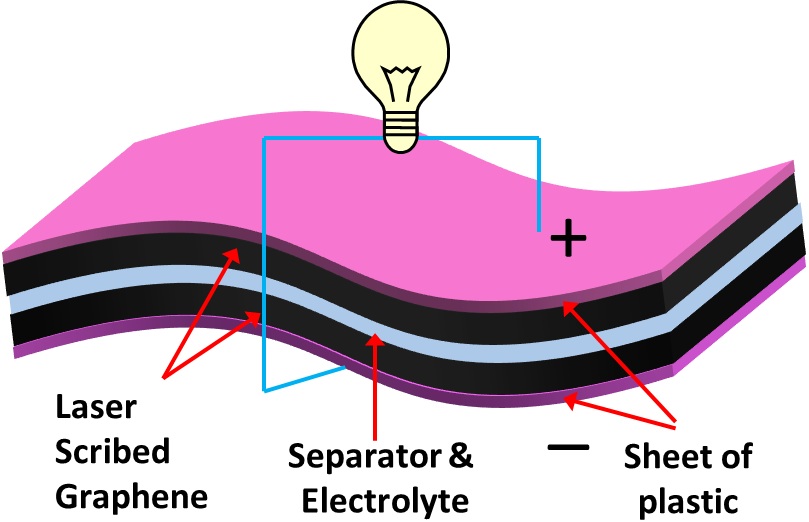
The “accident” occured when Cairo University graduate Maher El-Kady (pictured below) wired a small piece of graphene to an LED and found that it behaved as a super-capacitor, able to store a considerable amount of electricity. Their laser-scribed graphene is ideal as a super capacitor partially because of its enormous surface area, 1520 square meters per gram. Here’s how it works:

The story begins with quirky old kite-flying American, a key and a bolt of lightning. It ends with a jar full of electricity. Benjamin Franklin’s jar of electricity is known as a Leyden jar.

It is a primitive electronic circuit element known as a capacitor. The Leyden jar illustrates some promising characteristics of capacitors. As electrical storage devices, they are extraordinarily simple. You can make one at home with a glass jar and a some aluminum foil.

Capacitors have some advantages over Lithium, Nickle-Metal hydride and other chemical batteries. Batteries convert electrical energy to and from chemical energy. But capacitors store electrical charge by bottling excess electrons on one side of a thin barrier.

So capacitors needn’t contain caustic mixtures of acids, alkalis and toxic metals as batteries do. Capacitors can also be charged many times and they can be charged very fast. Some of the tantalum and electrolytic capacitors inside your computer or iPad are charging and discharging millions of times while you read this.
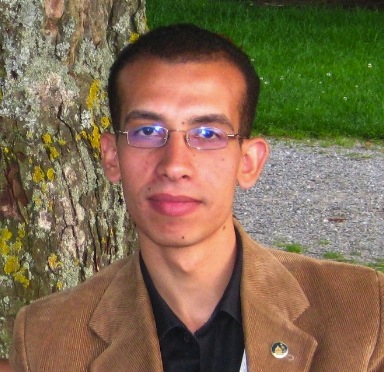
Maher El-Kady egyptIf capacitors are so wonderful, why aren’t they used in place of batteries electric cars to laptops and mobile phones?

The problem is that capacitors aren’t able to store very much energy. A Lithium Ion battery the size of a Leyden jar can store more than 500,000 times more energy.

But capacitors have improved since the Leyden jar. The graphene capacitor these UCLA scientists created has 4 billion times the capacitence of a Leyden jar.

Since its operating voltage is much lower, it might only store about 40,000 times the energy density of a Leyden jar, but this brings it much closer to the energy density of a chemical battery.

And that could change everything.

A film explaining the story of this invention is a finalist in the General Electric focus forward filmmaker competition.

Watch the film and decide for yourself whether a small, efficient, biodegradable energy storage device might revolutionize the future of energy storage.

Image of graphene supercapacitor from the UCLA newsroom

Brian Nitz
Brian Nitzhttp://www.greenprophet.com
Brian remembers when a single tear dredged up a nation's guilt. The tear belonged to an Italian-American actor known as Iron-Eyes Cody, the guilt was displaced from centuries of Native American mistreatment and redirected into a new environmental awareness. A 10-year-old Brian wondered, 'What are they... No, what are we doing to this country?' From a family of engineers, farmers and tinkerers Brian's father was a physics teacher. He remembers the day his father drove up to watch a coal power plant's new scrubbers turn smoke from dirty grey-back to steamy white. Surely technology would solve every problem. But then he noticed that breathing was difficult when the wind blew a certain way. While sailing, he often saw a yellow-brown line on the horizon. The stars were beginning to disappear. Gas mileage peaked when Reagan was still president. Solar panels installed in the 1970s were torn from roofs as they were no longer cost-effective to maintain. Racism, public policy and low oil prices transformed suburban life and cities began to sprawl out and absorb farmland. Brian only began to understand the root causes of "doughnut cities" when he moved to Ireland in 2001 and watched history repeat itself. Brian doesn't think environmentalism is 'rocket science', but understanding how to apply it within a society requires wisdom and education. In his travels through Europe, North America, Asia and the Middle East, Brian has learned that great ideas come from everywhere and that sharing mistakes is just as important as sharing ideas.

Read More

4 COMMENTS
  1. No worry about big oil. These are storage devices. You must add energy to them to get the energy out. Petroleum based products make use of the energy added to them by natural processes. Oil comes out of the ground with the energy already in it. That’s why it is so hard to replace it.

  2. This concept may one day change the entire energy concept. It’s like putting Nikola Tesla’s theories of “free energy” into actual concrete reality. And we must also thank Ben Franklin for his contribution too.

TRENDING

Collecting kinetic energy from roads; REPS turns traffic into a power plant

REPS announced a $23.6M equity financing round to scale...

AI data centers are triggering panic, instead of cleantech opportunities

AI may unintentionally become the economic engine that finally modernizes America’s aging grid. California is experiencing a massive AI data center boom, ranking 3rd in the U.S. with 227 operating centers and 54 more in development as of April 2026, according to Stanford.

Ethiopians are Looking to Somaliland for Red Sea Access as Global Powers Move In

Somaliland, for its part, has operated as a de facto independent state since 1991. It has its own government, elections, currency, and security forces. It’s often described as one of the more stable and democratic political systems in the region, despite never being formally recognized internationally. 

Rent a living Christmas tree in California

You can go to a site or go online, order the tree and pick it up or if if possible have it delivered. A live tree doesn't shed needles after a few weeks and it's obviously the ecological choice to cutting down millions of 7 to 15 year old trees every year.

Egypt building nuclear power

Egypt is building a nuclear energy plant, expected to go online in 2026 when countries like Germany have shut down all its domestic nuclear power. The El Dabaa Nuclear Power Plant is the first nuclear power plant planned for Egypt and will be located at El Dabaa, Matrouh Governorate, Egypt, about 320 kilometers northwest of Cairo. 

Yerukim Forms a New Green Economy Where the Money is Really Green

The Yerukim members who pick up the recyclables get to keep the monetary reward, the public earns "green" bills that can be used in shops, and business owners get to be associated with environmentalism.

Choosing Riyadh over Dubai? What Investors Should Know

Saudi Arabia is deploying capital at unmatched scale to catalyze tourism and advanced industry while rewiring its power-and-water backbone. The investable frontier is widening—especially in renewables, grid storage, water efficiency/desal retrofits, and hospitality operating platforms. Prudent investors will insist on phased delivery, enforceable KPIs (energy, water, biodiversity), and RHQ/zone compliance—while pricing political-economy and reputational risks alongside growth upside.

Sell your cooking oil for biodiesel money

Want to make money on old french fry oil? Sell it.

Qatar Alternative Energy Summit Pairs Investors And Innovators

Alternative energy investors and innovators can meet n' greet in Doha, Qatar March 16 and 17.

Here’s How To Implement The Four Pillars Of Employee Engagement

If you throw a party for your work team and they are vegans, don't make it a barbecue. Know the sustainability values of your team to boost moral and retain good people.

Locals From Rishon Fight IKEA

Big Box stores are a pretty new concept in Israel, and thank God that not every Israeli city wants them in their backyard. A word from someone who has see the beautiful farmland around her hometown Newmarket, Ontario stripped and converted into vulgar strip malls of big box shops: they have no place in a healthy and sustainable town or city.

The Jewish National Fund Meets An Inconvenient Truth

According to the JNF, it has transformed thousands of acres of barren land into green forests in Israel. They state that each person emits about 23 tons of carbon per year, estimating that each tree planted can absorb one ton of carbon in its lifetime. That's a whole lot of trees you'd need to be planting. Could so many fit in Israel?

How to quiet noise from construction in your office

Streets need to be resurfaced in New York but the humming and grinding noise is unsettling. Noise is environmental pollution. 

Popular Categories