Be On Lookout for “Fake” Zaatar in Lebanon

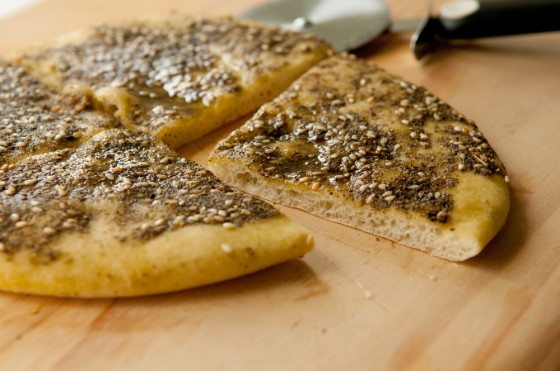
zaatar pita breadNot even zaatar gurus can spot a fake that easily.

Although it pains me to say it, I might have to think twice about buying zaatar items at the next Middle Eastern bakery I pass:  It could be the case that there are harmful additives in the spice mixture.

Zaatar, the unique combination of such spices as thyme, sumac, oregano, and sesame, among others, is seen in bakeries and in home kitchens across the Middle East.  Food connoisseurs like Green Prophet’s own Miriam Kresh probably don’t hesitate to make homemade zaatar, but for the rest of us, it’s as simple as stopping in our favorite bakeries for a quick purchase.

However, industry sources in Lebanon have recently revealed that bakeries have started to use unfit ingredients in zaatar, to decrease its production costs.  After all, prices of produce are going up, but the government has done little in terms of subsidization.  Kazem Ibrahim, the head of the Association of Bakeries in Lebanon, admitted the likelihood of some bakeries’ use of “fake zaatar.”

Flatbread with zaatar, or manakeesh bil zaatar, is filling and relatively healthy.  In Lebanon, especially, it ranks among the top first meals of the day.  I clearly remember eating it for brunch (or for breakfast, if you may, on those few occasions when I was up and about early enough) when I vacationed in the country.

Manakeesh can be made with meat or cheese, instead of zaatar.  In fact, the non-vegan options came first.  Where health is concerned, the spice mixture would be the best choice of the three, as it is not known to pose any threats.  However, the phony variety of zaatar is basically a thyme mix that contains less of the essential herbs and more chemical additives, which could potentially cause food poisoning and other bacterial infections.  Last year, Saudi Arabia turned away a shipment of zaatar from Lebanon, after lab tests proved that less than half the zaatar was made of real herbs.

Mohammad Halbawi, owner of Beirut’s Halbawi Grindery, shared his insider’s scoop that some grinderies mix the thyme with what they call “wheat derivatives,” but which are actually “shavings of spoiled kaak…crusty bread,” or even rely on a mix that is almost exclusively bran and whose green dye contributes a so-called herbal smell and appearance.

Additionally, there are rumors circulating about wood shavings in the artificial zaatar.

The tricky part about this scandal is the surprising indistinguishability between fake and real zaatar.  “Not even a zaatar guru can distinguish the taste,” said Halbawi.

Bakery owners who know of the fake zaatar but who have yet to make the switch are thinking of their loyal customers.  The revelation of spoiled zaatar could mean a spoiled reputation.

If they are so inclined, consumers are able to reveal the truth for themselves.  It is a little-known fact that, when added to a glass of water, real contents of zaatar will sink to the bottom, in time, while unwanted additives should float.  A change to the color of the water likely means that the mix contained a dye.

It is no longer such a mystery why manakeesh bil zaatar prices have such a wide range in Lebanon, from LL500 to LL 3,500.  It follows that the higher the prevalence of unwanted additives in any given bakery’s zataar, the higher the price.

Government officials say they are willing to fight for change, for a return to the good old days of real zataar, but the citizenry must be the catalyst.  Consumers are encouraged to file complaints if they detect any funny business – which, as we have learned, is hard to do, even for zaatar gurus – but with the water test, science comes up with an answer for you.  Only after the people make known their unrest will further investigations be launched.

: The Daily Star

Image of zaatar man’oushe from Shutterstock

Kelly Milone
Kelly Milonehttp://www.greenprophet.com
Kelly Milone holds an MA in cultural heritage management (Johns Hopkins University), BA in anthropology, BFA in dance and Arabic minor (Montclair State University). She is a dance teacher and choreographer, quick-study interior designer, and aspiring creative and travel writer.

Read More

TRENDING

Lebanon reporting fellowship for truth-tellers

Lebanon’s environmental crisis is not abstract. It is shaped by war, neglect, corruption, and silence. Rivers carry untreated sewage and industrial waste into the Mediterranean. Dynamite fishing shatters fragile marine ecosystems along the coast. In many areas, Hezbollah’s military presence and decades of instability have made environmental accountability nearly impossible. What flows into the sea is not only pollution — it is politics, poverty, and unresolved war. And yet, these stories are rarely told with depth, care, or courage. Silat Wassel’s Environmental Justice Journalism Fellowship is opening space for exactly that. They are looking for a few brave souls. 

Slow food market Souk el Tayeb in Lebanon celebrates food and Eid El Barbara

What makes Souk El Tayeb in Lebanon remarkable is not only its insistence on local, seasonal produce, but its belief that dignity and sustainability must go hand in hand. Farmers are paid fairly. Villages are uplifted. Traditional recipes are kept alive not as nostalgia but as knowledge systems: real food is carbon-light, waste-free, and is adapted to the land.

The Pope visits Lebanon and the site of the deadly Beirut blast

“Lebanon, stand up,” he added. “Be a home of justice and fraternity! Be a prophetic sign of peace for the whole of the Levant!”

Dead shark on beach injured by fishing nets

  A dead shark that washed ashore this week at...

Lebanon ski resorts and when to escape climate change

Lebanon’s mountain resorts — from Mzaar Ski Resort Faraya to the Cedars of God in Bsharri — offer rare snow in the Middle East, where you can ski by day and swim in the sea by night. But climate change is shrinking snow seasons fast. Resorts like Zaarour, Laqlouq, Faqra, and the Cedars are adapting, turning toward year-round eco-tourism and mountain conservation.

Yerukim Forms a New Green Economy Where the Money is Really Green

The Yerukim members who pick up the recyclables get to keep the monetary reward, the public earns "green" bills that can be used in shops, and business owners get to be associated with environmentalism.

Choosing Riyadh over Dubai? What Investors Should Know

Saudi Arabia is deploying capital at unmatched scale to catalyze tourism and advanced industry while rewiring its power-and-water backbone. The investable frontier is widening—especially in renewables, grid storage, water efficiency/desal retrofits, and hospitality operating platforms. Prudent investors will insist on phased delivery, enforceable KPIs (energy, water, biodiversity), and RHQ/zone compliance—while pricing political-economy and reputational risks alongside growth upside.

Sell your cooking oil for biodiesel money

Want to make money on old french fry oil? Sell it.

Qatar Alternative Energy Summit Pairs Investors And Innovators

Alternative energy investors and innovators can meet n' greet in Doha, Qatar March 16 and 17.

Here’s How To Implement The Four Pillars Of Employee Engagement

If you throw a party for your work team and they are vegans, don't make it a barbecue. Know the sustainability values of your team to boost moral and retain good people.

Locals From Rishon Fight IKEA

Big Box stores are a pretty new concept in Israel, and thank God that not every Israeli city wants them in their backyard. A word from someone who has see the beautiful farmland around her hometown Newmarket, Ontario stripped and converted into vulgar strip malls of big box shops: they have no place in a healthy and sustainable town or city.

The Jewish National Fund Meets An Inconvenient Truth

According to the JNF, it has transformed thousands of acres of barren land into green forests in Israel. They state that each person emits about 23 tons of carbon per year, estimating that each tree planted can absorb one ton of carbon in its lifetime. That's a whole lot of trees you'd need to be planting. Could so many fit in Israel?

How to quiet noise from construction in your office

Streets need to be resurfaced in New York but the humming and grinding noise is unsettling. Noise is environmental pollution. 

Popular Categories