Gaza’s First Recycling Plant Opens and Not a Minute Too Soon

waste management, Gaza, recycling, methane gas, trash, health,Stock image of trash dump, Shutterstock.

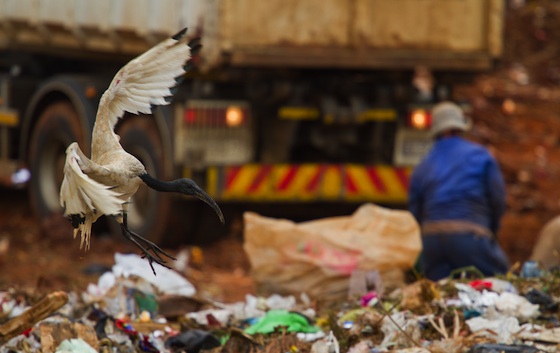
Gaza produces roughly 1,000 pounds of waste every day and until now most of it has gone untreated. But a new recycling plant situated very close to the border with Egypt has recently opened to manage some of this waste, which is otherwise scattered throughout farmlands or in the case of Sofa, piles up in a mound that is 30 meters high.

Residents have complained about the teaming hill that attracts vermin and releases methane gas, but officials have run out of space to distribute the waste. So when university professor Samir al-Afifi proposed to open a small recycling plant in Rafah, both the municipality and Friends of the Earth Middle East rallied to support the project.

“Once Samir al-Afifi managed to get an approval for his project proposal, we started contacting some local mechanics to design equipment we needed,”  Mohammad al-Neirab, an engineer at the factory told The Electronic Intifada.

Many of the materials required to build the plant, which is able to process approximately 50 tons of waste every day, were smuggled through underground tunnels from Egypt because of limits imposed by Israel.

For now the plant only serves Rafah, which has a population of 180,000, and it is staffed by women from impoverished families. They are employed for three week stints and earn $350. When their contract comes to an end, an additional 26 women are brought on board so that a greater proportion of the community can benefit.

It’s nasty work that involves sorting through teaming waste to separate organic waste from solid waste. The former is converted into fertilizer that is then distributed to local farmers.

One of the factory engineers Mohammad al-Neirab, who is also a FoEME board member, told the paper that there are several ways the plant needs to be improved. In addition to upgrading the sand floor so that harmful pollutants don’t leach into the ground and affect the area’s water supply, none of the ten machines in the plant are useful for recycling paper or metal.

“Al-Neirab hopes to export such waste to other countries, which have the capacity to recycle it,” wrote Rami Almeghari.

Still, there is hope the plant will eventually expand so that it can also service nearby Khan Younis as well, and handle a total load of up to 150 pounds of waste a day.


Tafline Laylin
Tafline Laylinhttp://www.greenprophet.com
As a tour leader who led “eco-friendly” camping trips throughout North America, Tafline soon realized that she was instead leaving behind a trail of gas fumes, plastic bottles and Pringles. In fact, wherever she traveled – whether it was Viet Nam or South Africa or England – it became clear how inefficiently the mandate to re-think our consumer culture is reaching the general public. Born in Iran, raised in South Africa and the United States, she currently splits her time between Africa and the Middle East. Tafline can be reached at tafline (at) greenprophet (dot) com.

Read More

TRENDING

Self-repairing contact lenses and desalination membranes that fix themselves?

Could the humble contact lens become a sustainability breakthrough? Researchers in Korea have developed a self-healing hydrogel lens that repairs scratches with just one hour of UV light exposure. Beyond reducing waste from disposable contacts, the technology could one day help extend the life of solar panels, water filtration systems, and other plastic-based products.

Lyme Disease And The Great Outdoors

Planning on being outdoors a lot this summer? We...

Abortion Pills, Plan B and Mifepristone and what the new US mail ban means

Abortion pills, often confused with Plan B (the morning-after pill), and historically referred to as RU486 (mifepristone), are part of a broader category of reproductive health medications that women have been using for decades. But they are not the same thing.

The Next New Cosmetic: Human Fat Known as Alloclae

In this Ozempic age, a person may diet themselves...

From Pilot Plant to Global Stage: How Aduro Clean Technologies’ 2026 Expansion Signals a Turning Point for Chemical Recycling Investors Like Yazan Al Homsi

The company's Next Generation Process (NGP) Pilot Plant in London, Ontario, has officially moved into initial operating campaigns, generating the kind of structured, repeatable data that separates laboratory promise from commercial viability.

Yerukim Forms a New Green Economy Where the Money is Really Green

The Yerukim members who pick up the recyclables get to keep the monetary reward, the public earns "green" bills that can be used in shops, and business owners get to be associated with environmentalism.

Choosing Riyadh over Dubai? What Investors Should Know

Saudi Arabia is deploying capital at unmatched scale to catalyze tourism and advanced industry while rewiring its power-and-water backbone. The investable frontier is widening—especially in renewables, grid storage, water efficiency/desal retrofits, and hospitality operating platforms. Prudent investors will insist on phased delivery, enforceable KPIs (energy, water, biodiversity), and RHQ/zone compliance—while pricing political-economy and reputational risks alongside growth upside.

Sell your cooking oil for biodiesel money

Want to make money on old french fry oil? Sell it.

Qatar Alternative Energy Summit Pairs Investors And Innovators

Alternative energy investors and innovators can meet n' greet in Doha, Qatar March 16 and 17.

Here’s How To Implement The Four Pillars Of Employee Engagement

If you throw a party for your work team and they are vegans, don't make it a barbecue. Know the sustainability values of your team to boost moral and retain good people.

Locals From Rishon Fight IKEA

Big Box stores are a pretty new concept in Israel, and thank God that not every Israeli city wants them in their backyard. A word from someone who has see the beautiful farmland around her hometown Newmarket, Ontario stripped and converted into vulgar strip malls of big box shops: they have no place in a healthy and sustainable town or city.

The Jewish National Fund Meets An Inconvenient Truth

According to the JNF, it has transformed thousands of acres of barren land into green forests in Israel. They state that each person emits about 23 tons of carbon per year, estimating that each tree planted can absorb one ton of carbon in its lifetime. That's a whole lot of trees you'd need to be planting. Could so many fit in Israel?

How to quiet noise from construction in your office

Streets need to be resurfaced in New York but the humming and grinding noise is unsettling. Noise is environmental pollution. 

Popular Categories