
New Stone Age Figurines For the Hunt Discovered in Jerusalem

stone age figure israel bovine ram hunt
Israel is part of the Levant region believed to be the cradle of civilization. New 9,500 year-old carvings found in Jerusalem reveal humanity’s Stone Age past and our reverence for the hunt.

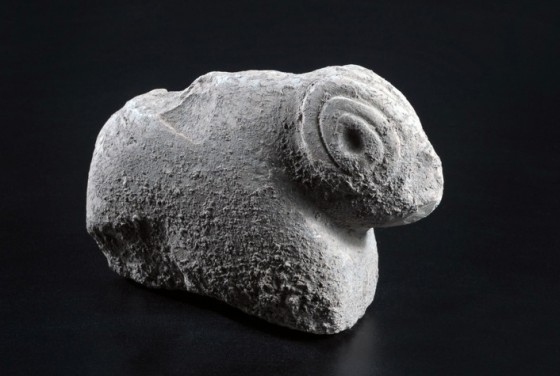
Two figurines found recently in Jerusalem are about 9,500 year old. One is the image of a ram and the second of a wild bovine, and they point to the existence of a cultic belief in the region in the New Stone Age. They might have been used good-luck statues to ensure a successful hunt, archeologists say. The two figurines from the New Stone Age were discovered in excavations the Israel Antiquities Authority is currently conducting at the Tel Moza archaeological site, prior to work being carried out on the new Highway 1 from Sha’ar HaGai to Jerusalem by the National Roads Company.

According to Anna Eirikh and Dr. Hamoudi Khalaily, directors of the excavation at the site on behalf of the Israel Antiquities Authority, “The figurines, which are 9,000 to 9,500 years old, were found near a large round building whose foundations were built of fieldstones and upper parts of the walls were apparently made of mud brick.

“The first figurine, in the shape of a ram with twisted horns, was fashioned from limestone and is c. 15 cm in size. The sculpting is extraordinary and precisely depicts details of the animal’s image; the head and the horns protrude in front of the body and their proportions are extremely accurate.

“The body was made smooth and the legs of the figurine were incised in order to distinguish them from the rest of the body. The second figurine, which was fashioned on hard smoothed dolomite, is an abstract design; yet it too seems to depict a large animal with prominent horns that separate the elongated body from the head. The horns emerge from the middle of the head sideward and resemble those of a wild bovine or buffalo”.

According to Dr. Khalaily, the Pre-Pottery Neolithic B period (the eighth millennium BCE) is considered one of the most fascinating chapters in the history of mankind; many changes took place in it that shaped human society for thousands of years to come.

During this period, the transition began from nomadism, based on hunting and gathering, to sedentary life, based on farming and grazing.

“It was at this time that mankind began to inhabit permanent settlements and started building settlements that extended across a large area,” he says. “In several sites that were exposed in our region remains were discovered indicating preliminary architectural planning of those same settlements and complex engineering capabilities including the construction of two story houses. The process of animal and plant domestication was accelerated in this period.

“The archaeological evidence from Pre-Pottery Neolithic B, particularly the artistic objects such as the figurines that were discovered at Tel Moza, teaches us about the religious life, the worship and the beliefs of Neolithic society.

Dr. Khalaily adds, “It is known that hunting was the major activity in this period. Presumably, the figurines served as good-luck statues for ensuring the success of the hunt and might have been the focus of a traditional ceremony the hunters performed before going out into the field to pursue their prey.”

Another theory presented by archaeologist Anna Eirikh, his research partner, links the figurines from Moza to the process of animal domestication – such as the wild bovine and different species of wild goat.

Image by Yael Yolovitch, courtesy of the Israel Antiquities Authority

Read More

3 COMMENTS
  1. Well the contemporary interpretation of that view is that “civilization” is about 5000 years old. Perhaps there are niches of radicals who interpret the number literally, but as far as I’ve heard there is an acceptance of evolution in the orthodox community, just as it has been accepted in the Catholic community.

TRENDING

Ancient Jewish New Year for Animals revived with global campaign against factory farming

Jewish Vegan Life has launched a global campaign celebrating the New Year for Animals, with synchronized events in Washington, D.C., Los Angeles, Pittsburgh, Montreal and Jerusalem, alongside an international livestream on August 9 featuring partners including Mercy for Animals, The Good Food Institute and Freedom Farm Animal Sanctuary.

The Space Orchestra, and the search for extraterrestrial life, to eclipse celebration

The event will livestream eclipse views from Iceland and northern Spain, where the eclipse will be total, while the 35-member International Space Orchestra, made up of astronauts, scientists, engineers, and researchers—performs a new orchestral interpretation of Voyager by PJ Harvey.

Canada’s healthcare became the world’s digital health laboratory. Now Europe is taking notice

Canada's healthcare system may be under pressure, but its decades-long experience with digital transformation is becoming a model for Europe and beyond. In an interview with Nordic's Alison MacDonald, Green Prophet explores why successful AI in healthcare depends less on software than on empowering clinicians, improving workflows and building resilient systems.

Jewish Climate Network founded so innovators don’t leave their identity at the door

Rather than retreating from climate change work, the Jewish Climate Trust organization has backed a new initiative designed to strengthen both climate action and Jewish community.

The Hidden Components Powering the Renewable Energy Revolution

A rooftop solar system looks simple: panels, an inverter, a battery and a few cables. But beneath that simplicity lies a bill of materials thousands of lines long, where tiny current sensors, magnetic cores, gate drivers, capacitors and connectors quietly determine efficiency, safety and lifespan. These overlooked components—not the solar panels themselves—are why today's residential solar systems are smaller, smarter and far more reliable than those of a decade ago.

The Essential Guide To Sustainability in Project Management

Sustainability is an approach where businesses and individuals balance the environmental, social, and economic aspects of a project such that current and future stakeholders are not overburdened with the impacts of the project in future.

Yerukim Forms a New Green Economy Where the Money is Really Green

The Yerukim members who pick up the recyclables get to keep the monetary reward, the public earns "green" bills that can be used in shops, and business owners get to be associated with environmentalism.

Choosing Riyadh over Dubai? What Investors Should Know

Saudi Arabia is deploying capital at unmatched scale to catalyze tourism and advanced industry while rewiring its power-and-water backbone. The investable frontier is widening—especially in renewables, grid storage, water efficiency/desal retrofits, and hospitality operating platforms. Prudent investors will insist on phased delivery, enforceable KPIs (energy, water, biodiversity), and RHQ/zone compliance—while pricing political-economy and reputational risks alongside growth upside.

Sell your cooking oil for biodiesel money

Want to make money on old french fry oil? Sell it.

Qatar Alternative Energy Summit Pairs Investors And Innovators

Alternative energy investors and innovators can meet n' greet in Doha, Qatar March 16 and 17.

Here’s How To Implement The Four Pillars Of Employee Engagement

If you throw a party for your work team and they are vegans, don't make it a barbecue. Know the sustainability values of your team to boost moral and retain good people.

Locals From Rishon Fight IKEA

Big Box stores are a pretty new concept in Israel, and thank God that not every Israeli city wants them in their backyard. A word from someone who has see the beautiful farmland around her hometown Newmarket, Ontario stripped and converted into vulgar strip malls of big box shops: they have no place in a healthy and sustainable town or city.

The Jewish National Fund Meets An Inconvenient Truth

According to the JNF, it has transformed thousands of acres of barren land into green forests in Israel. They state that each person emits about 23 tons of carbon per year, estimating that each tree planted can absorb one ton of carbon in its lifetime. That's a whole lot of trees you'd need to be planting. Could so many fit in Israel?

Popular Categories