Leap-second Bug Consumes Megawatts of Electricity

leap second clock frogWas it the leap-second bug that pushed America’s power plants beyond their capacity?

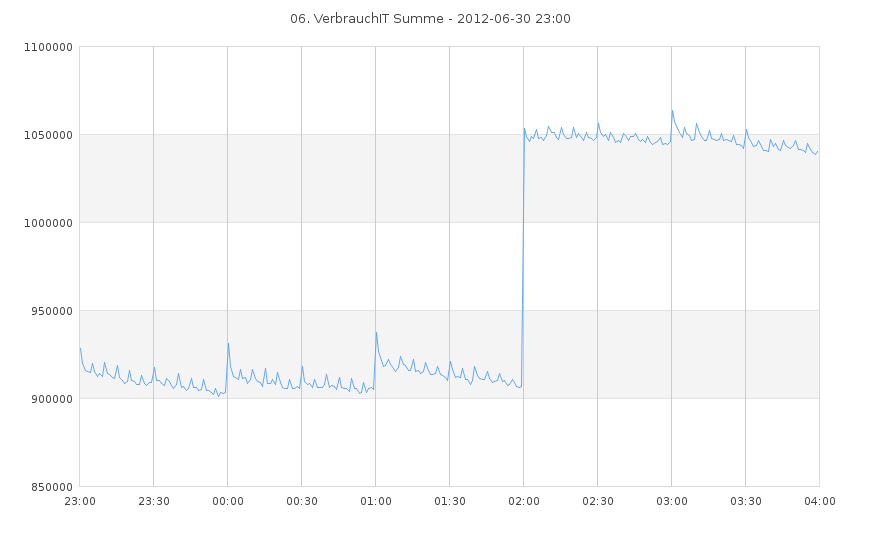
A 61 second minute was added to clocks around the world on June 30, 2012 at 23:59:60 UTC in order to compensate for slight variations in earth’s rotation speed.  This triggered a number of software bugs one of which caused a spike in data center electrical power consumption.

We won’t have to worry about a replay of Y2k until the year 10,000 but leap-year bugs reappear like clockwork every four and four hundred years.  Programmers periodically reinvent leap-year mistakes while re-implementing an algorithm first perfected by Pope Gregory XIII in 1582.  Leap second bugs are less predictable.  Leap seconds are necessary because the Earth’s rotation speeds up and slows down in
hetzer power graph

response to lunar and solar tidal forces.   Leap seconds realign astronomical time with standard earth (UTC) time.  This year’s leap second caused a number of software bugs including a Linux kernel bug which caused server power consumption to spike at web hosting companies such as OVH of France and Hetzner AG of Germany.

In a message to their customers, Hetzner AG admitted that this leap-second bug caused their electrical power consumption to increase by about a megawatt.

Even as I type this article on a Linux-powered laptop, I hear the fan speed up and slow down in response to varying CPU load.  Websites such as Facebook, online games and web advertisements cause the CPU to draw more power and run hotter so the fan speeds up.  Computer malware such as stuxmark and flame also have a significant energy cost as do the anti-virus programs which are designed to protect us from these threats.

Computers are far more efficient than they were a few decades ago.  They have grown so efficient that software developers can no longer justify spending time on optimizing algorithms or hunting down CPU performance bugs.  But because computers have become so ubiquitous, they consume an increasing fraction of our electrical power consumption and should not be ignored.

The June 30th leap second bug coincided with heat waves in parts of North America.  Air conditioning pushed some electric power utilities to the brink of their capacity.  Thunderstorms took out some redundancy and the remaining active power lines actually sagged as electrical load heated them enough to soften their copper core.

It is certainly within the realm of possibility that the power consumption spike associated with a leap-second bug could have pushed power plants beyond their capacity, leaving consumers in the dark.

Such “butterfly effect” power outages have occured in the past.  One of the most famous ones began in November 1965 when a mis-configured circuit breaker tripped and caused a cascade of overloads which left much of Northeastern US and Quebec in the dark.  So as the world moves towards a more efficient balance between electrical production and consumption, we must pay more attention to the energy consumed by inefficient computers and buggy software.

Stopwatch and frog image from Shutterstock; Leap second power spike graph via Hetzner, color fill added to improve contrast.

Brian Nitz
Brian Nitzhttp://www.greenprophet.com
Brian remembers when a single tear dredged up a nation's guilt. The tear belonged to an Italian-American actor known as Iron-Eyes Cody, the guilt was displaced from centuries of Native American mistreatment and redirected into a new environmental awareness. A 10-year-old Brian wondered, 'What are they... No, what are we doing to this country?' From a family of engineers, farmers and tinkerers Brian's father was a physics teacher. He remembers the day his father drove up to watch a coal power plant's new scrubbers turn smoke from dirty grey-back to steamy white. Surely technology would solve every problem. But then he noticed that breathing was difficult when the wind blew a certain way. While sailing, he often saw a yellow-brown line on the horizon. The stars were beginning to disappear. Gas mileage peaked when Reagan was still president. Solar panels installed in the 1970s were torn from roofs as they were no longer cost-effective to maintain. Racism, public policy and low oil prices transformed suburban life and cities began to sprawl out and absorb farmland. Brian only began to understand the root causes of "doughnut cities" when he moved to Ireland in 2001 and watched history repeat itself. Brian doesn't think environmentalism is 'rocket science', but understanding how to apply it within a society requires wisdom and education. In his travels through Europe, North America, Asia and the Middle East, Brian has learned that great ideas come from everywhere and that sharing mistakes is just as important as sharing ideas.

Read More

TRENDING

Desalination experts debunk Aqua Solaire, the floating desalination barge

AI makes it easy to dream, develop, and create images of what could be world-changing ideas, until the reality sets in. A new project making the rounds is Aqua Solaire, an allged French concept for a solar-powered desalination vessel designed to bring drinking water to coastal communities facing drought, storms, and infrastructure failures.

Thank you, LinkedIn — and what your Jobs on the Rise report means for sustainable careers

While “green jobs” aren’t always labeled as such, many of the fastest-growing roles are directly enabling the energy transition, climate resilience, and lower-carbon systems: Number one on their list is Artificial Intelligence engineers. But what does that mean? Vibe coding Claude? 

Is It Safe to Be Around Artificial Snow?

The bacterium used in Snomax is non-viable (it is killed first) and it cannot grow at human body temperature. Regulatory reviews in Europe and North America have not found evidence that it causes infectious disease in humans. But not a lot of studies have been done.

Why this French ski village is being stalked by a nerve disease

Researchers found that this French ski village was known for eating this one thing

Brigitte Bardot dies but her legacy of animal rights lives on

Iconic French actress dies but leaves behind a legacy of caring for animals.

Yerukim Forms a New Green Economy Where the Money is Really Green

The Yerukim members who pick up the recyclables get to keep the monetary reward, the public earns "green" bills that can be used in shops, and business owners get to be associated with environmentalism.

Choosing Riyadh over Dubai? What Investors Should Know

Saudi Arabia is deploying capital at unmatched scale to catalyze tourism and advanced industry while rewiring its power-and-water backbone. The investable frontier is widening—especially in renewables, grid storage, water efficiency/desal retrofits, and hospitality operating platforms. Prudent investors will insist on phased delivery, enforceable KPIs (energy, water, biodiversity), and RHQ/zone compliance—while pricing political-economy and reputational risks alongside growth upside.

Sell your cooking oil for biodiesel money

Want to make money on old french fry oil? Sell it.

Qatar Alternative Energy Summit Pairs Investors And Innovators

Alternative energy investors and innovators can meet n' greet in Doha, Qatar March 16 and 17.

Here’s How To Implement The Four Pillars Of Employee Engagement

If you throw a party for your work team and they are vegans, don't make it a barbecue. Know the sustainability values of your team to boost moral and retain good people.

Locals From Rishon Fight IKEA

Big Box stores are a pretty new concept in Israel, and thank God that not every Israeli city wants them in their backyard. A word from someone who has see the beautiful farmland around her hometown Newmarket, Ontario stripped and converted into vulgar strip malls of big box shops: they have no place in a healthy and sustainable town or city.

The Jewish National Fund Meets An Inconvenient Truth

According to the JNF, it has transformed thousands of acres of barren land into green forests in Israel. They state that each person emits about 23 tons of carbon per year, estimating that each tree planted can absorb one ton of carbon in its lifetime. That's a whole lot of trees you'd need to be planting. Could so many fit in Israel?

How to quiet noise from construction in your office

Streets need to be resurfaced in New York but the humming and grinding noise is unsettling. Noise is environmental pollution. 

Popular Categories