Put a Zebra in Your Tank: A Chemical Crapshoot?

zebra and butterfly, biofuel
Making alcohol from sugars is easy; maybe the third oldest profession in the world. Making butanol from zebra droppings is another story.

Processors have made ethanol from cornstarch and sugar for decades, but using food products to make biofuel raises demand for staple commodities like corn and seed oils with disastrous impact to the food chain.

So let’s try again, back things up a step. Start with cellulose, not sugar. Add some enzymes that convert the cellulose into sugar. Next ferment the sugar into alcohol. Then distill the alcohol into fuel. Four simple steps and we’re juicing our cars with sawdust and coconut shells instead of Middle East oil.  Scientists know how to turn plants into fuel, but doing it profitably is another thing: Cellulose is the problem.

Found in the walls of plant cells, cellulose is the most abundant naturally occurring organic molecule on the planet. These tough fibers, indigestible to humans,  protect plants from predators.  And they’re hard to break down.

Some animals have evolved elegant ways to do the chemistry. Cow, camel and goat guts host microbes which produce cellulose-chomping enzymes to get the job done.  Called cellulase, these enzymes can be lab-produced, but they aren’t cheap: processors often rely on government subsidies to offset costs. For an academic researcher, trying to convert cellulose into fuel, in a lab, on a budget, hasn’t been easy.

It’s all happening at the zoo.

Maybe professor of microbiology, Dr. David A. Mullin is a Simon & Garfunkel fan, or it’s simply serendipitous that his Tulane University lab is near New Orleans’ Audubon Zoo.

His exploration to discover a microbe that could produce a biofuel straight from cellulose began inside the animal cages.  Braving odors and muck, he and his grad students collected manure from all sorts of exotic vegetarians. Then the  team cultured 40 different bacteria colonies from the Audubon droppings.  When fed cellulose, over a dozen of these strains made butanol. Holy cow!

Butanol, with four carbon atoms, has twice the kick of ethanol and only slightly less energy-potential than gasoline. It can be used straight-up (needs no blending with traditional fossil fuels), and can be transported via existing oil/gas infrastructure (tanker trucks, ships and pipelines).

Due to these commercially-friendly characteristics, this class of biofuel holds potential to lead the pack of alternative fuels.

Mullin’s team experimented to find butanol-producing strains that could work in open air (not in vacuum-sealed animal bellies) and at temperatures easily replicated in a lab.

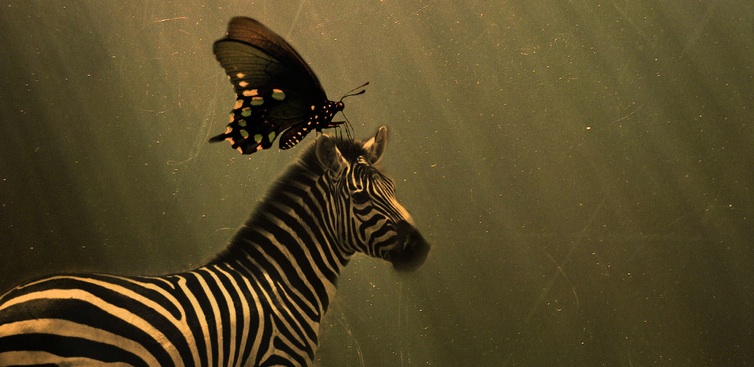
Bacteria from African Zebra droppings earned their stripes by hitting all the targets. His tests now focus on TU-103, the name of the magical zebra-poop microbe.  Experiments combine TU-103 with a variety of high-fiber meals, and measure chemical output.  Mullin has demonstrated that, in addition to butanol, TU-103 converts cellulose into acetone and hydrogen (both with commercial value) and carbon dioxide.

OK, so not completely net-zero, but very close. The team is now working to minimize the time for fermentation and demonstrate that the enzyme can consistently convert an array of biomass waste feedstock.

Environmental push-back against biofuel targets competition with food sources; stresses on water supply; and negative impact to biodiversity since it encourages farmers to dedicate large tracts of  arable land to single-crop production.

“We don’t want to create new monocultures,” said Sheila Karpf,  policy analyst for the Environmental Working Group, a nonprofit advocacy group in Washington.

Biofuels created from industrial and agricultural bio-waste neatly sidesteps these issues: this Green Prophet advises.

Image via loveisnotabvictorymarch

Read More

2 COMMENTS

TRENDING

40 more migratory animals need protecting, warns UN group

The Convention on the Conservation of Migratory Species of Wild Animals (CMS), governments agreed to extend protection to 40 more migratory species, from cheetahs and striped hyenas to snowy owls, giant otters, and great hammerhead sharks. Too many of them are slipping toward extinction .

Koh Phangan’s angels for the dogs and the cats

Koh Phangan may be known for yoga, detox retreats, and full moon parties, but beyond the curated paradise lies a different reality—one of injured stray animals and the quiet work of rescue. This story explores PACS (Phangan Animal Care for Strays), a grassroots animal shelter tackling overpopulation, disease, and neglect on the island. Through firsthand experience with teens, it reveals how meaningful travel, volunteerism, and compassion offer a deeper kind of healing—far from the Instagram version of paradise.

Microplastics Are Becoming Superbug Highways — New Study Warns Beachgoers to Wear Gloves

Prof. Pennie Lindeque added that microplastics “act as carriers for antimicrobial-resistant bacteria, enhancing their survival and spread… each particle becomes a tiny vehicle capable of transporting pathogens from sewage works to beaches, swimming areas and shellfish-growing sites.”

Who gave the first kiss?

When you experience your first kiss you might feel like you are the first in the world to feel that way. Kissing, scientists say, occurs in a variety of animals (even if today it's not in every culture), and it presents an evolutionary puzzle: kissing, a learned behavior, carries high risks, such as disease transmission like herpes and hepititis, while offering no obvious reproductive or survival advantage.

Biodiversity Blueprint Set for 2026

If we seize this moment, the 2026 review can catalyse a new wave of finance (see Green Finance mechanisms in the UAE), innovation and policy coherence — and move us closer to the vision of a nature-positive world by 2050. If not, the checkpoint risks becoming another missed opportunity while ecosystems, livelihoods and economies continue to degrade.

Yerukim Forms a New Green Economy Where the Money is Really Green

The Yerukim members who pick up the recyclables get to keep the monetary reward, the public earns "green" bills that can be used in shops, and business owners get to be associated with environmentalism.

Choosing Riyadh over Dubai? What Investors Should Know

Saudi Arabia is deploying capital at unmatched scale to catalyze tourism and advanced industry while rewiring its power-and-water backbone. The investable frontier is widening—especially in renewables, grid storage, water efficiency/desal retrofits, and hospitality operating platforms. Prudent investors will insist on phased delivery, enforceable KPIs (energy, water, biodiversity), and RHQ/zone compliance—while pricing political-economy and reputational risks alongside growth upside.

Sell your cooking oil for biodiesel money

Want to make money on old french fry oil? Sell it.

Qatar Alternative Energy Summit Pairs Investors And Innovators

Alternative energy investors and innovators can meet n' greet in Doha, Qatar March 16 and 17.

Here’s How To Implement The Four Pillars Of Employee Engagement

If you throw a party for your work team and they are vegans, don't make it a barbecue. Know the sustainability values of your team to boost moral and retain good people.

Locals From Rishon Fight IKEA

Big Box stores are a pretty new concept in Israel, and thank God that not every Israeli city wants them in their backyard. A word from someone who has see the beautiful farmland around her hometown Newmarket, Ontario stripped and converted into vulgar strip malls of big box shops: they have no place in a healthy and sustainable town or city.

The Jewish National Fund Meets An Inconvenient Truth

According to the JNF, it has transformed thousands of acres of barren land into green forests in Israel. They state that each person emits about 23 tons of carbon per year, estimating that each tree planted can absorb one ton of carbon in its lifetime. That's a whole lot of trees you'd need to be planting. Could so many fit in Israel?

How to quiet noise from construction in your office

Streets need to be resurfaced in New York but the humming and grinding noise is unsettling. Noise is environmental pollution. 

Popular Categories