
Marzan’s Luminescent Future Cityscapes With Solar OLEDs

Israeli inventor Meidad Marzan has a vision of solar-powered futuristic city lights

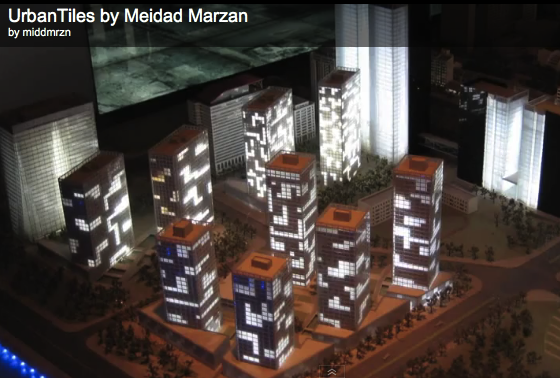
Solar power embedded in tiny tiles cladding the sides of skyscrapers could be used to efficiently power programmable light-scapes like lamps creating ever-changing patterns on buildings at virtually no energy cost, using the nascent technology of OLEDs, suggests Marzan.

“The city and its buildings are epic light objects that emit light energy as far as the outer space”, says inventor Marzan. “That, while in daytime the city absorbs great sun energy not being used at all. The cycle of light and lighting in the urban space made a design intervention, that along with other urban values, stood [as] the basis of this project”.

The reversible tiles would have organic photovoltaic cells on one side to collect energy during the day, and the other side features an OLED (organic light emitting diodes) lighting panel.

Millions of tiny OLED tiles create changing images using light by flipping into an on or off position, as seen below. When the dark side faces out, it creates the dark area in an image, when the light emitting side faces out, it forms part of an pattern created in light.

OLEDs are super thin films of organic molecules coated on plastics, that are able to give off light when electricity is applied. Even when the electricity supplied is traditional, OLEDs are such energy misers that they are the the most futuristic of the greenest of green tech. They are beginning to be used in advanced consumer electronics to make more energy-efficient and brighter displays using almost no energy, as they are brighter even than LEDs – with their piercingly brilliant light.

But Marzan proposes to take them one step further and use solar to power the tiny flipping tiles, and clad buildings with them, in order to create luminous displays on the sides of skyscrapers.

As with any new technology, there are problems with the skyscraper plan he’ll need to work on. So far, OLEDs are quite fragile.Water can damage them. They also do not yet last as long as the cladding for most buildings. Blue OLEDs for example last only about 14,000 hours.

But the technology is just in its infancy – and growing fast with exciting new milestones announced almost daily. When it’s ready, Marzan will be too.

Related stories:

Dubai’s New Net-Zero Building Code
Greening Your Flat Screens with Organic LEDs
Looking to Spintronics to Make Batteries Last Longer


2 COMMENTS

Comments are closed.

TRENDING

Koh Phangan’s angels for the dogs and the cats

Koh Phangan may be known for yoga, detox retreats, and full moon parties, but beyond the curated paradise lies a different reality—one of injured stray animals and the quiet work of rescue. This story explores PACS (Phangan Animal Care for Strays), a grassroots animal shelter tackling overpopulation, disease, and neglect on the island. Through firsthand experience with teens, it reveals how meaningful travel, volunteerism, and compassion offer a deeper kind of healing—far from the Instagram version of paradise.

Climate change traced in sea turtle shells

It's sea turtles which may in the end save islands in the Seychelles. They may also better help us understand climate change. Like rings on a tree, scientists have found a way to read sea turtle shells and how they are impacted by climate change tells a story. 

We’ve lived through the past 11 of the hottest years on record

Have we forgotten about global warming when the world...

SolCold wants to cool buildings using sunlight

For centuries people living in hot climates have tried...

Eco organization offices destroyed by Iran missile

Tel Aviv's eco organization, the Heschel Center, was impacted by an Iranian missile.

Nobul’s Regan McGee on Shareholder Value: “Complacency Is the Silent Killer” 

Why the governance framework designed to protect shareholders so...

Should You Invest in the Private Market?

startustartup Unlike public stock exchanges, which offer daily trading, strict...

How to build a 100-year-company

Kongō Gumi is a Japanese construction company, purportedly founded in 578 A.D., making it the world's oldest documented company. What can we learn about building sustainable businesses from them?

From Pilot Plant to Global Stage: How Aduro Clean Technologies’ 2026 Expansion Signals a Turning Point for Chemical Recycling Investors Like Yazan Al Homsi

The company's Next Generation Process (NGP) Pilot Plant in London, Ontario, has officially moved into initial operating campaigns, generating the kind of structured, repeatable data that separates laboratory promise from commercial viability.

How AI Helps SaaS Companies Reduce Repetitive Customer Support Work

SaaS products are designed for large numbers of users with different levels of experience, and also in renewable energy.

Pulling Water from the Air

Faced with water shortage in Amman, Laurie digs up...

Turning Your Energy Consultancy into an LLC: 4 Legal Steps for Founders in Texas

If you are starting a renewable energy business in Texas, learn how to start an LLC by the books.

Tracking the Impacts of a Hydroelectric Dam Along the Tigris River

For the next two months, I'll be taking a break from my usual Green Prophet posts to report on a transnational environmental issue: the Ilısu Dam currently under construction in Turkey, and the ways it will transform life along the Tigris River.

Related Articles

Popular Categories