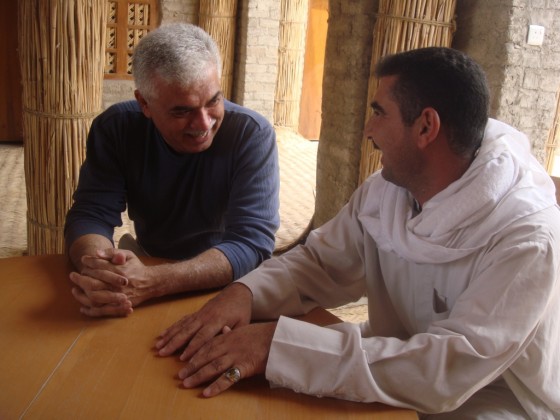
 Azzam Alwash (left), director of the environmental organisation Nature Iraq, talks with a Marsh Arab who lives in the Mesopotamian Marshlands of Iraq
In the first part of this two-piece feature, Azzam Alwash the director of Nature Iraq, spoke to us about his warm memories as a child visiting the Mesopotamian Marshlands of Iraq with his father; the shock he faced when he returned to Iraq from America in 2003 to find the marshes completely decimated under Saddam’s regime and his vow to help restore the wetlands to their former glory.
Despite a shaky start to the restoration of the marshlands due to two years of drought and dwindling water supplies, the marshlands (which are home to a wide range of wildlife such as water buffalos, foxes and rare birds) are on the mend. And a new generation of Iraqi environmentalists as well as the Marsh Arabs have played their part in restoring a global ecosystem which has existed for over 7,000 years.
A New Generation of Iraqi Environmentalists
“Soon after arriving in Iraq I realized that the devastation [to the marshes] was all the way up stream with most cities dumping raw sewage and industrial waste directly into the water of the Tigris and Euphrates – in other words, Iraq is using the Tigris and Euphrates as open sewers!”
Indeed, Alwash states that part of the aim of setting up Nature Iraq was to help educate a new generation of Iraqis about the importance of protecting the environment be they mountains or marshes. “It was vital that I take under my wing young Iraqis and train them… I am glad to report to you that I am about to hand over the day to day operations of Nature Iraq to the next generation of environmental activists.” As well as the difficulties they face in restoring the marshes, those who work in region face very real security threats. Many don’t venture into the marshes without an armed security guard. This may seem a step too far but a dozen employees of the project have died in terrorist attacks in the last seven years alone.
Half Way Through An Impossible Task
When I ask Alwash what motivates him to continue his work through droughts, dangers to his life and other difficulties, he replies that in all honesty he is not sure how to answer that question. “Coming to Iraq has had a huge tax on me personally and professionally, regardless of the recognition that Nature Iraq has gotten over the years. It is my ardent desire to see my children enjoy the marshes as I did, but that is not enough to explain my personal motivation… I suppose in a sense the impossibility of the task is what motivates me.
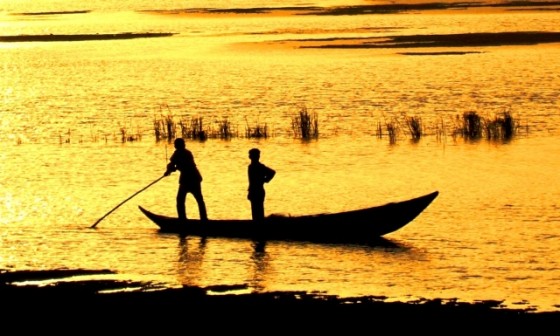
“In 2002/03 people were saying that the marshes cannot be restored, nor do the people of the marshes want them restored yet the evidence on the ground countered those claims and 8 years later we have the marshes back (albeit only 50% of the marshes) and some 100,000 people have come back.” Wildlife is flourishing in the marshlands again, reeds are shooting up and the Basra Reed Warbler and the Greater Flamingo can now been seen flying across the marshland. The Marsh Arabs that are returning to their homes in the marshes are also playing an important role in the recovery of this precious ecosystem.
A Future For The Marsh Arabs
As Alwash insists, “Marsh Arabs restored the marshes and not Azzam Alwash. My job is limited to helping them come up with solutions to their problems… As for what the Marsh Arabs want, well they want TV’s, electricity, schools and hospitals and mobile phones and there is no reason why these can not be provided in a manner that is sensitive to the environment.” In fact, one of Nature Iraq’s projects combines two traditional ways of life- the agricultural mud house with the reed arches of the Marsh Arab huts- to create a stunning and sustainable mud house that comes with modern conveniences such as electricity, indoor plumbing, internet services and connectivity to the rest of the world.
Even so, Alwash admits that brick houses remain the status symbol of ‘success’ in the region and so it will take time for these concepts to take root. However, Alwash remains optimistic (he did achieve the impossible after all) that as soon as people recognize that the new methods are more suited to their environment they will embrace them. As he adds with a smile, “I plan to move permanently to my mud house in the coming year to live and to preach…”
: Images via Nature Iraq.
For more on nature in Iraq see:
Restoring Iraq’s ‘Garden of Eden’- The Mesopotamian Marshlands
Iraqi Sheikh Threatens To Demonstrate If Kurds Don’t Share Water