


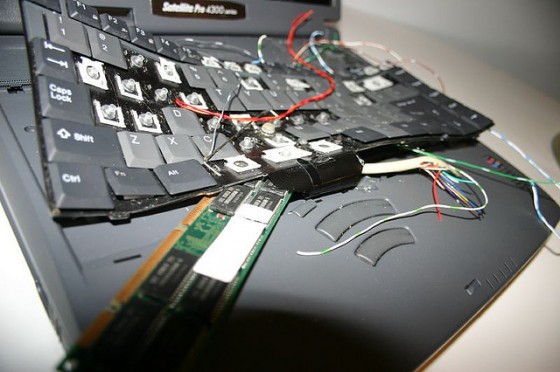
It was like a scene from those rubbish action/comedy films when someone drops a precious vase. You know – everything moves in slow motion and the actor reaches out, eyes wide to catch the vase and at the very last moment it lands in his/her arms after which they let out a sigh of relief. Well, when I dropped my laptop it was exactly like that except I failed to catch the laptop which hit the ground with a dutiful ‘crack’ and I said … well, let’s not go there. The point is that my laptop is on its very last legs and I have to think about a) disposing of it and b) replacing it.
All this got me thinking about e-waste: electrical products we throw away and replace. Where do they go? Why do we have to replace our products so often? What is the scale of the problem and what impact is it having on our planet?
I have to confess that my laptop has had its fair share of scrapes, bangs and bumps. The right hand side of the screen is cracked and the swivelly bit that holds the screen to the main body has snapped so the screen now just hangs limply like a flap. There are wires exposed where there shouldn’t be and my screen flickers when it’s charging inducing serious eye fuzziness. Don’t get me wrong, I have been careful but I guess there comes a time (around three years and two months for my laptop) when we have to replace our electrical goods. So where do they go?
A Devastating Deluge of Electronic Waste
Well, on a global scale e-waste has become a serious problem over the last couple of decades and part of the problem is that we’re not 100% sure where our waste goes to. It seems that there is so much of it that countries who can afford to, pay for other countries (read: not so strict and usually developing nations) to just bury it. Worldwide, three billion electronic units end up landfills and it’s estimated that by 2015, over 70 million metric tonnes of e-waste are likely to be generated. Only around 15-20 of e-waste from developed countries is believed to be recycled with the rest making its way to landfills.
In the US alone, around 30 million computers are thrown away every year and worldwide 50 million mobiles are replaced every month. Whilst the Middle East is a relative newcomer to highly disposable electrical products such as mobiles and computers, the last decade has seen the consumption of electronic goods shoot up, especially in the Gulf nations, Egypt and Israel.
E-Waste= A Toxic Cocktail of Heavy Metals
The Middle East currently recycles just 5% of all e-waste produced (and most of that recycling occurs outside the region) which means that the majority goes to landfills. In Israel, over 20,000 tonnes of e-waste are sent to regular landfills each year yet this is extremely problematic as e-waste contains lots of harmful toxins. A UN report, ‘Recycling – From E-Waste to Resources‘ warned that the world is heading for a potentially devastating deluge of electronic waste which could create intractable problems for people’s health and environment due to the toxic nature of e-waste.
A lot of e-waste contains heavy metals such as lead, cadmium and mercury which can contaminate land and groundwater when dumped into ordinary landfills once the metals begin to deteriorate and seep out. Furthermore, whilst e-waste makes up a small proportion of normal waste it makes up a large chunk of all toxic waste. For example, in the US e-waste represent just 2% of landfill waste but makes up 70% of toxic waste and in Israel e-waste it makes up 75% of the heavy metals found in landfills.
Stemming The Flow of E-Waste
The only solution to e-waste is recycling. We can’t toss out our mobiles and laptops with our ordinary rubbish due to their toxicity but the reality is that the appropriate recycling facilities are far and few between. So as well as pushing for more local recycling services we need force companies that are selling the toxic TV sets and telephones to take them back as part of their ‘corporate social responsibility’ and recycle them.
We also need to be questioning the increasingly short ‘buy-consume-dispose’ cycle of many electrical products. Why is it so much cheaper to replace our goods rather than get them fixed? Why do they break down so quickly? Some commentators state that companies purposely make their products so that they break down quickly or become obsolete to keep us buying (and consequently, making them money). As such, finding a solution to e-waste shouldn’t just be about recycling but also needs to be about challenging the way that these products are sold to us in the first place.
::Image via SBaker/Flickr.
For more on E-waste and electronics news see:
Re-Routing Deadly Electronic Waste



There are two sides of this story. Repair, reuse, and refurbishment is so much a part of the emerging markets that they have become a threat to OEMs, who are beginning to market “planned obsolescence in hindsight”. I urge you to look deeper into the sources of electronic scrap and the markets which import it. http://retroworks.blogspot.com/2011/03/motherboard-ewaste-exports-are-good.html
The waste disposal method in Oman is landfill or burning, for everything. So toxic metals are piled over with debris and the occasional rain fall over a period of time spreads the toxins or smoke spreads the particles. There needs to be an alternative