
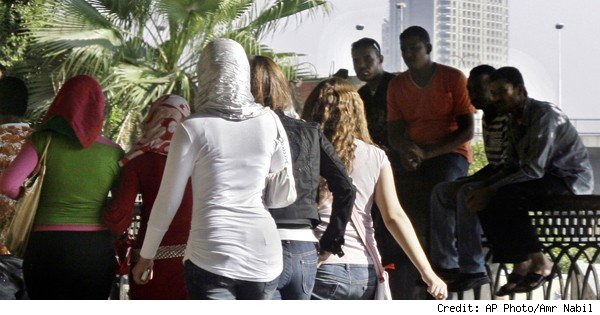

Conservative Muslim bloggers and women’s rights activists bring harassers and inadequate legal and cultural protection to task, with women leading the charge.
Women’s rights are a key environmental issue, a topic we’ve covered in recent articles about the need for a language revolution and the Arab Spring of women. Women in the MENA region are struggling behind their western counterparts with regards to reproductive and sexual sovereignty. From virginity tests to sexual harassment, environmentalists are committed to giving voice to efforts that stake a stand against gender-based social injustices.
That conversation recently becoming more pronounced in the MuslimMatters.org community, with the April 25, 2011 publication of an article entitled, “Sex & the Ummah | Sexual Harassment: A Muslim Problem?” The author, Hena Zuberi, shares her personal encounters with unwanted touch – each one is chilling and some are echoed in the experiences of other commentators of her blog.
“A touch, a feel, a whisper. It doesn’t take much to make a young girl feel dirty, stripped of her dignity. Walking in the streets of this Muslim country was treacherous,” she writes. And then in thoughtful language that spares neither civility nor responsibility, she ascertains those features of her beloved country and religion (or interpretations thereof) that allow for the continued subjugation of women.
Her conclusion: Women and men must speak loudly about the problem, and no longer hide in shame when someone harasses them for simply being a woman in the wrong place at the right time from the perspective of the aggressor.
Sexual Harassment is at epidemic proportions in some countries in the region. Consider these statistics, taken from Zuberi’s article: “In 2008, Abul Komsan, the woman’s rights activist, polled 1,000 women from all parts of the country. What she found shocked her. 98 percent of foreign women polled said they had been sexually harassed. And about eight out of 10 Egyptian-born women said the same thing. She also surveyed Egyptian men, and almost two-thirds of men polled actually admitted that they harassed women.”
Religious and non-religious women, Muslim and not, dressed conservatively and otherwise, have been reporting extraordinary high numbers of untoward advances that include groping, inappropriate language, to outright assault.
Further, she writes that, “From Mexico City to Chicago, this is a male problem. According to National Crime Records Bureau, the fastest growing crime in India is violence against women. Walking down the street, taking public transportation or having a career, all put women at risk for sexual harassment and sexual assault, no matter the city, country or continent.” No country and no female are fully safe, she states, even those dressed in the most conservative attire.
Zuberi holds men and women responsible – not those who are victimized, but those who as she experienced as a child either offered no support or looked the other way. “I do not believe a victim is responsible, but the other women in the society are. Having said that… just as we would caution children about sexual predators, we should remind ourselves not to be vulnerable and accessible, the two qualities that rapist and harassers look for.”
Society must change its responses, she insists. “Men need to support their daughters, sisters, wives when they complain of harassment instead of forbidding them from going out or blaming them for causing the incident. Men and women both need to raise sons to be men who do not treat women like toys.” These sentiments may resonate particularly well with important allies – non-Muslim women living in Western countries who have long pointed out that no manner of dress or behavior is an invitation to assault.
What’s equally noteworthy about the article, aside from the author’s convictions, are the responses by many readers (at last count, they totaled 160 comments). Many women shared their experiences, suggestions and outrage over sexual harassment in Muslim countries. One female writer identifying herself as Nadia expressed alarm in response to suggestions that women bring sexual violence upon them because of how they are dressed (i.e., modestly, but without a niqab) or for simply leaving the house (one male reader insisted that harassment would stop if women stayed home all the time).
“That lesson is not going to be learned by just covering someone up because you are validating the point that women are simply sexual beings and cannot be seen as human beings until you add some kind of artificial barrier over them,” Nadia writes. “How come women seem to understand this and don’t demand that men cover their hair or smile or arms, because those can be attractive? Why is a woman not offended or “challenged” by a man walking around and living his life regularly?”
“Obviously rape happens all over the world, but it is unique in the Muslim world for being framed as a clothing-responsibility and gender-responsibility argument instead of a religious-values, social upbringing argument.” She continues.
 The author references several important steps men and women can take to end the social acceptance of sexual harassment, including the role that Harrassmap.com (no longer operating as of 2023) can play in empowering women.
According to the website, the aim of harrassmap.com is to, “implement a system in Egypt for reporting incidences of sexual harassment via SMS messaging. This tool will give women a way to anonymously report incidences of sexual harassment as soon as they happen, using a simple text message from their mobile phone. By mapping these reports online, the entire system will act as an advocacy, prevention, and response tool, highlighting the severity and pervasiveness of the problem.”
In a blog about the grassroots program, London-born journalist Jack Shenker investigates why sexual harassment has increased in the Middle East, Egypt in particular, over the last twenty years. He writes:
Why is sexual harassment such a problem in Egypt? Anecdotal evidence suggests that 20 years ago this simply wasn’t an issue on the same scale; when cases of harassment did occur other people on the street would often step in to help. These days such assistance is rarely forthcoming.
Many different explanations have been put forward, with varying degrees of credibility. Some blame Islam’s (highly contested) attitude to women, though harassment levels in Egypt seem to far outstrip those in other Muslim countries. Others point to sexual frustration, which is certainly a factor in a country where economic pressures are forcing many young people to wait longer and longer before they can afford to marry – but this doesn’t account for pre-pubescent children and married men being among the harassment repeat offenders.
HarassMap’s Rebecca Chiao offers another perspective: “Egyptians today are exposed to a great many pressures: unemployment, inflation, urban overcrowding, pollution … pressure from all directions. And one of the ways that pressure manifests itself is in the targeting of the weak and marginalised; in the news we see negative attitudes towards refugees, sectarian violence, and of course harassment of women – who are a social minority, despite making up 50% of society.”
The program currently operates on a volunteer basis, and was formed by both foreign and Middle East born women’s rights activists.
Related News:
The Middle East Needs More Sluts
The Rising Voices of Arab Women
Harrassmap Let’s Women Cyclists Report Abuses in Cairo


