
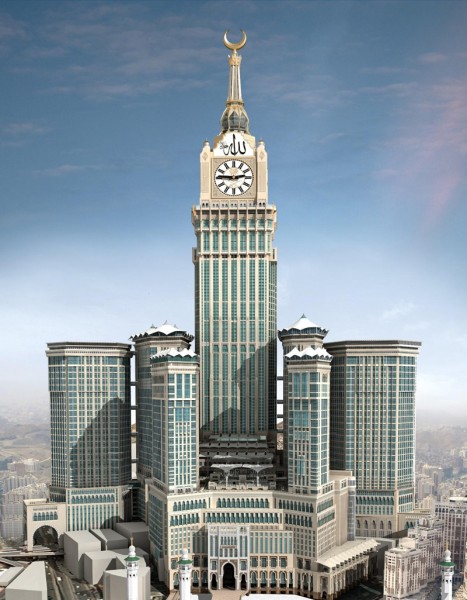

 Can commercial monstrosities like these in Mecca cause political upheaval in Saudi Arabia?
The Kingdom of Saudi Arabia has always had its share of enemies. This is especially true in these times, when both the Islamic Republic of Iran and the Al Qaeda terrorist organization have both expressed great interest in replacing the monarchy there with a government more receptive an “Islamic democracy” as is now the case in Iran. The Saudi royal family has had close relations with the United States and other Western countries ever since the 1930s, when it was concluded that American oil reserves would not last forever. The recent political upheavals in the Middle East, beginning with Tunisia, carrying on to Egypt, and now threatening Jordan and what’s left of non-Islamic elements in Lebanon is undoubtedly of great concern to the Saudi extended Royal Family.
Their many palaces, luxurious life-styles and other benefits of their oil wealth are now being threatened by elements practicing the same religious fundamentalism that they themselves have proclaimed to be the historic protectors of. Besides sitting on what is said to be 70 percent of the world’s readily available oil reserves, the Saudis are also in charge of maintaining and preserving Islam’s holiest sites in Mecca and Medina.
These sites have recently come under harsh criticism due to the construction of new grandiose buildings in the holy sites, including a luxury hotel complex and a huge clock tower that when completed will be grander than London’s Big Ben.
It hasn’t taken an event such as Egypt’s present political implosion to cause economists and government officials in Western countries to worry about the implications of the Saudi oil fields falling into to wrong hands. The world oil crisis of 1974, as well as a number of mini oil crises events since then, including the 1991 Gulf War, has indicated that the non-availability of Saudi Arabian crude oil would cause Western and Eastern economies – especially China to go into an economic tailspin.
The Saudis, despite their extreme practice of Wahhabi Islam are still tied to West, especially the USA in an unbroken relationship that goes back to when US President Franklin Roosevelt had his first meeting with Saudi King Ibn Saud.
Despite all of the efforts being made to promote solar, wind and other forms of renewable energy, including efforts by the Saudi government itself, current realities indicate that fossil fuels will be around for many years to come.
A new oil crises could spur a faster development, and implementation of renewable energy to generate electricity, and a more serious move towards alternative fuels for cars and other vehicles. These fuels include electricity produced from solar energy power plants, hydrogen, alcohol-based fuels like methanol — made from coal, natural gas and biomass, and ethanol made from alcohol derived from plants or algae.
Without oil, the economies of countries like Saudi Arabia would be quite different than they are today; and perhaps not so much in the limelight as those who do possess substantial oil reserves. For their part, under the present set of circumstances, all the Saudi royal family can do is wait to see how events turn out in Egypt – events that could well determine their own destiny.
Read more on Saudi Arabian energy and commercialization issues:
Saudi Arabia Considers Solar Energy to Fuel Desalination Plants
Has Saudi Arabia Seen the Renewable Energy Light?
Luxury Architecture in Mecca: Has the Hajj Lost its Egalitarian Spirit?


YEAH RIGHT!
Another case of those living there put on the defensive side. I’m referring to Adam, not the guy who wrote this piece!
There’s just too much info about this country that points out a lot of things wrong with the society there. And those connected with the Saudi royal family don’t want to ruin a good thing – for them.
This has to be the dumbest article iv read in a long time. I’ve lived in saudi arabia all my life and yes people dislike the commercial buildings around Makkah but we are still happy with the monarchy.
clearly the article couldn’t conduct actual research on what saudi citizens think and therefore made his/her own ill-founded theories and assumptions!
Adam, we invite you to submit your thoughts in a post. Would you be interested?