
Brown Rice and Bisli: Why Don’t Consumers Make Healthy Food Choices?

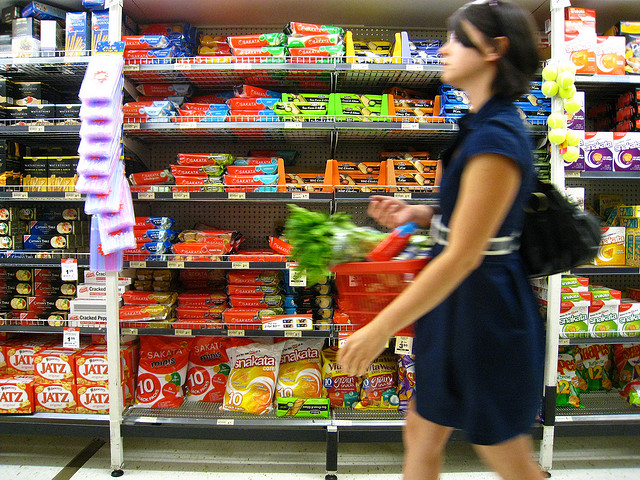
young woman purchasing greens in grocery, candy in backgroundBad food choices lead to obesity and poor health. Why do we do it?

Israeli business magazine The Marker reports that sales of healthy foods have increased in the last two years. However, sales of snack foods and soft drinks have remained stable or increased slightly. People are simply buying more food, and obesity rates continue to rise. Of course, purchase of healthy food doesn’t mean it gets eaten. The brown rice might find a home at the back of the cabinet, or  the garbage.

We all know we should eat healthier food, so why don’t more people choose it? Here are the main factors that affect all of us.

  • Information: Nutrition and health are in the news, but data prevented as fact can be misleading or downright wrong. Other health claims are controversial, or we simply don’t have enough information. Is soy healthy, or not? Antioxidants and vitamin D are good, but how much do we need and in what form? In many cases, there is no simple answer. When people get contradictory findings, or are bombarded with information, they are likely to throw up their hands and choose foods that appeals to them at the moment.
  • Advertising. Advertising and public relations pitches greet us everywhere, and people who claim to be immune are simply naive. Even if you could ignore the advertising, much of the scientific research is tainted. Food manufacturers fund studies that they believe will help promote their product. See the Israeli Dairy Board’s contribution to a faulty study that claimed that exposing babies to cow’s milk at an early age could prevent allergies.
  • Labeling. The way foods are labeled in many countries is confusing. Sugar and fat might be listed in the ingredients under several different names, and most consumers don’t bother to calculate sodium content. The good news is that the Holland-based Choices International Foundation issues a tag affirming that a product meets a minimum nutritional standard based on the amount of fiber, transfat, sugar and sodium in the item. In Israel, a few products by Knorr, Angel, Lipton, Etz Hazayit, Telma and Patit carry the tag.
  • Habits. The Marker stressed that while Israeli consumers purchase more buckwheat, olive oil and sesame paste now than in 2008, sales of fried chicken breasts and instant soups have stayed the same. Purchases of snack foods and soft drinks have actually increased slightly.
  • Cost. People in lower socio-economic groups have less acccess to accurate information about health. While lentils will always remain cheaper than frozen pizza,olive oil can cost ten times that of soy. Brown rice, whole-wheat flour and whole-grain bread are all more expensive than their white counterparts. The cost to health and the health care system is difficult to calculate. One solution might be to subsidize the cost of healthy foods.
  • Convenience. Cooking from scratch is always healthier than purchasing ready-made, but home cooking takes time, skill, and advance preparation. Demanding careers and lack of experience, along with the other reasons listed, mean that home-cooked meals are becoming rarer.

Remaining aware of barriers to healthy eating can help us make wiser choices at our next shopping trip.

More Green Posts by Hannah Katsman:

Wear Your Baby in a Sling for Eco-Benefits

What Is Causing Breast Growth in Chinese Toddlers?

Why Baby’s First Gift Shouldn’t Be Formula from the Hospital

Hannah Katsman also writes at CookingManager.Com, a website devoted to helping beginning and advanced cooks make healthy food while saving time and money.

Photo credit: lu_lu

Hannah Katsman
Hannah Katsmanhttps://www.greenprophet.com/
Hannah learned environmentalism from her mother, a conservationist before it was in style. Once a burglar tried to enter their home in Cincinnati after noticing the darkened windows (covered with blankets for insulation) and the snow-covered car in the driveway. Mom always set the thermostat for 62 degrees Fahrenheit (17 Celsius) — 3 degrees lower than recommended by President Nixon — because “the thermostat is in the dining room, but the stove’s pilot light keeps the kitchen warmer.” Her mother would still have preferred today’s gas-saving pilotless stoves. Hannah studied English in college and education in graduate school, and arrived in Petach Tikva in 1990 with her husband and oldest child. Her mother died suddenly six weeks after Hannah arrived and six weeks before the first Gulf War, and Hannah stayed anyway. She has taught English but her passion is parental education and support, especially breastfeeding. She recently began a new blog about energy- and time-efficient meal preparation called CookingManager.Com. You can find her thoughts on parenting, breastfeeding, Israeli living and women in Judaism at A Mother in Israel. Hannah can be reached at hannahk (at) greenprophet (dot) com.

Read More

7 COMMENTS
  1. Interesting article. Author did a nice job.

    I do have an issue with the photo editor who chose a headless person for the image. Seems most articles about health and food are accompanied by an unidentified, headless fat person. Fat people have faces, y’all, and personalities, and names. Sometimes we even smile and look friendly.

  2. Great article Hannah. I agree with all of your points and I’m all for subsidies of healthy food too!

    As a Nutrition and Health Educator, I see something else that stops people from making healthy changes also: Healthy food is perceived a less “fun” and less tasty than unhealthy food. I hear all the time “Who wants to eat healthy? We could all die tomorrow and I want to enjoy!” Taste-wise, healthy, natural foods have a hard time competing with the chemicalized super flavors of processed foods. Taste buds need to adjust to the less intense flavors of natural foods. Israelis are so used to shoveling soup powder into their soups, that without it, they feel it tastes bland.

    And with bakeries on every corner, cafes, packaged processed foods everywhere we turn, people seem to just not to deprive themselves this bounty of sugar, fat and artificial flavor.

  3. Good article. Your suggestion to have subsidies for healthy foods is spot-on, especially since the reason why whole-wheat flour/bread is more expensive than their white counterparts is usually because of government subsidies on white flour/bread. Whole wheat should be cheaper, since there is less done to the flour, but subsidies make the unhealthier option more financially viable.

TRENDING

Understanding Food Production: Karl Studer on the Urban-Rural Knowledge Gap

Karl Studer occupies an unusual position in American business. As President of Quanta Services, he oversees electrical infrastructure operations across the United States, Canada, and Australia, managing thousands of employees and multibillion-dollar projects.

Tigris River oil spill highlights Iraq’s environmental oversight and our addiction to oil

A fresh oil spill in the Tigris River, filmed by an Iraqi university student, has reignited concern over Iraq's polluted waterways. From ancient Mesopotamia to modern Basra, the country's dependence on oil has come at a steep environmental and human cost, with activists warning that unchecked contamination is putting ecosystems and public health at risk.

Doctor-Led Direct Hair Transplant: What Surgeon Involvement Means for Outcomes

Hair restoration technology continues to evolve, but the surgeon behind the procedure remains the most important factor. Doctor-led hair transplants emphasize careful diagnosis, conservative donor management, natural hairline design, and long-term planning rather than simply maximizing graft counts. By treating donor hair as a limited resource and tailoring each procedure to the patient's future hair loss, experienced surgeons can reduce the need for corrective surgery while delivering more natural, sustainable results.

Data centers in Space? Sophia Space and Apex plan on busing them in

Can data centers really be built in space? Pasadena-based Sophia Space is partnering with Apex to test the idea by launching modular AI computing systems into low Earth orbit in 2027. Using radiation-hardened compute TILEs cooled by passive radiative systems and mounted on scalable satellite buses, the companies aim to prove that edge computing can operate reliably in space. While challenges remain, the project represents an important step toward distributed orbital computing networks that could support everything from climate monitoring and pollution tracking to autonomous spacecraft navigation in an increasingly crowded orbital environment.

Mona Khalil, Orange House Project founder, sea turtle protector killed in Lebanon

Mona Khalil spent decades protecting Lebanon's sea turtles and coastal ecosystems. Her death in the ongoing conflict between Israel and Hezbollah shines a light on a broader environmental tragedy unfolding across northern Israel and southern Lebanon. From damaged wetlands and disrupted bird migrations to threatened seed banks and endangered wildlife, the region's ecosystems are becoming casualties of a war with no clear end in sight.

Yerukim Forms a New Green Economy Where the Money is Really Green

The Yerukim members who pick up the recyclables get to keep the monetary reward, the public earns "green" bills that can be used in shops, and business owners get to be associated with environmentalism.

Choosing Riyadh over Dubai? What Investors Should Know

Saudi Arabia is deploying capital at unmatched scale to catalyze tourism and advanced industry while rewiring its power-and-water backbone. The investable frontier is widening—especially in renewables, grid storage, water efficiency/desal retrofits, and hospitality operating platforms. Prudent investors will insist on phased delivery, enforceable KPIs (energy, water, biodiversity), and RHQ/zone compliance—while pricing political-economy and reputational risks alongside growth upside.

Sell your cooking oil for biodiesel money

Want to make money on old french fry oil? Sell it.

Qatar Alternative Energy Summit Pairs Investors And Innovators

Alternative energy investors and innovators can meet n' greet in Doha, Qatar March 16 and 17.

Here’s How To Implement The Four Pillars Of Employee Engagement

If you throw a party for your work team and they are vegans, don't make it a barbecue. Know the sustainability values of your team to boost moral and retain good people.

Locals From Rishon Fight IKEA

Big Box stores are a pretty new concept in Israel, and thank God that not every Israeli city wants them in their backyard. A word from someone who has see the beautiful farmland around her hometown Newmarket, Ontario stripped and converted into vulgar strip malls of big box shops: they have no place in a healthy and sustainable town or city.

The Jewish National Fund Meets An Inconvenient Truth

According to the JNF, it has transformed thousands of acres of barren land into green forests in Israel. They state that each person emits about 23 tons of carbon per year, estimating that each tree planted can absorb one ton of carbon in its lifetime. That's a whole lot of trees you'd need to be planting. Could so many fit in Israel?

How to quiet noise from construction in your office

Streets need to be resurfaced in New York but the humming and grinding noise is unsettling. Noise is environmental pollution. 

Popular Categories