
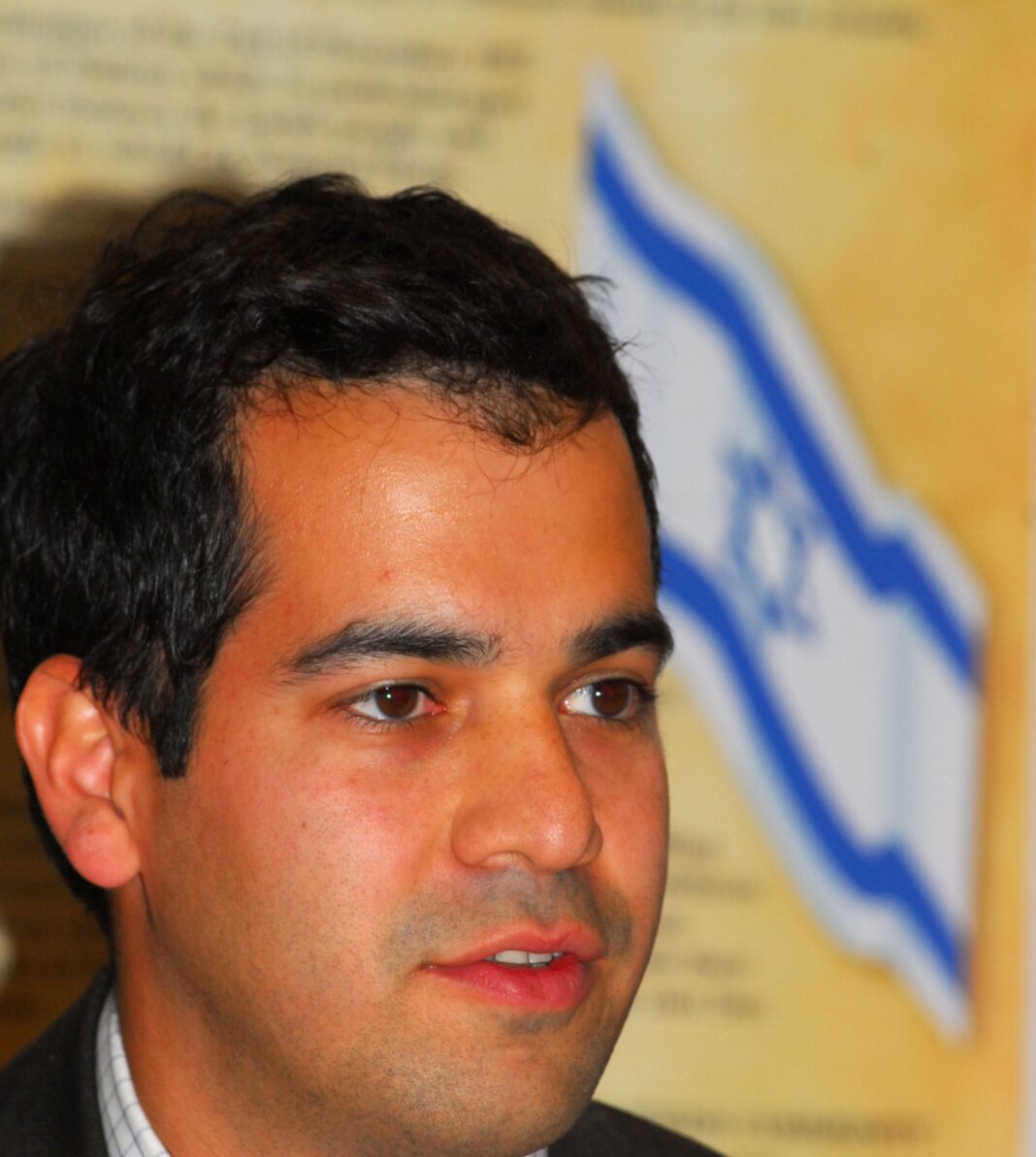

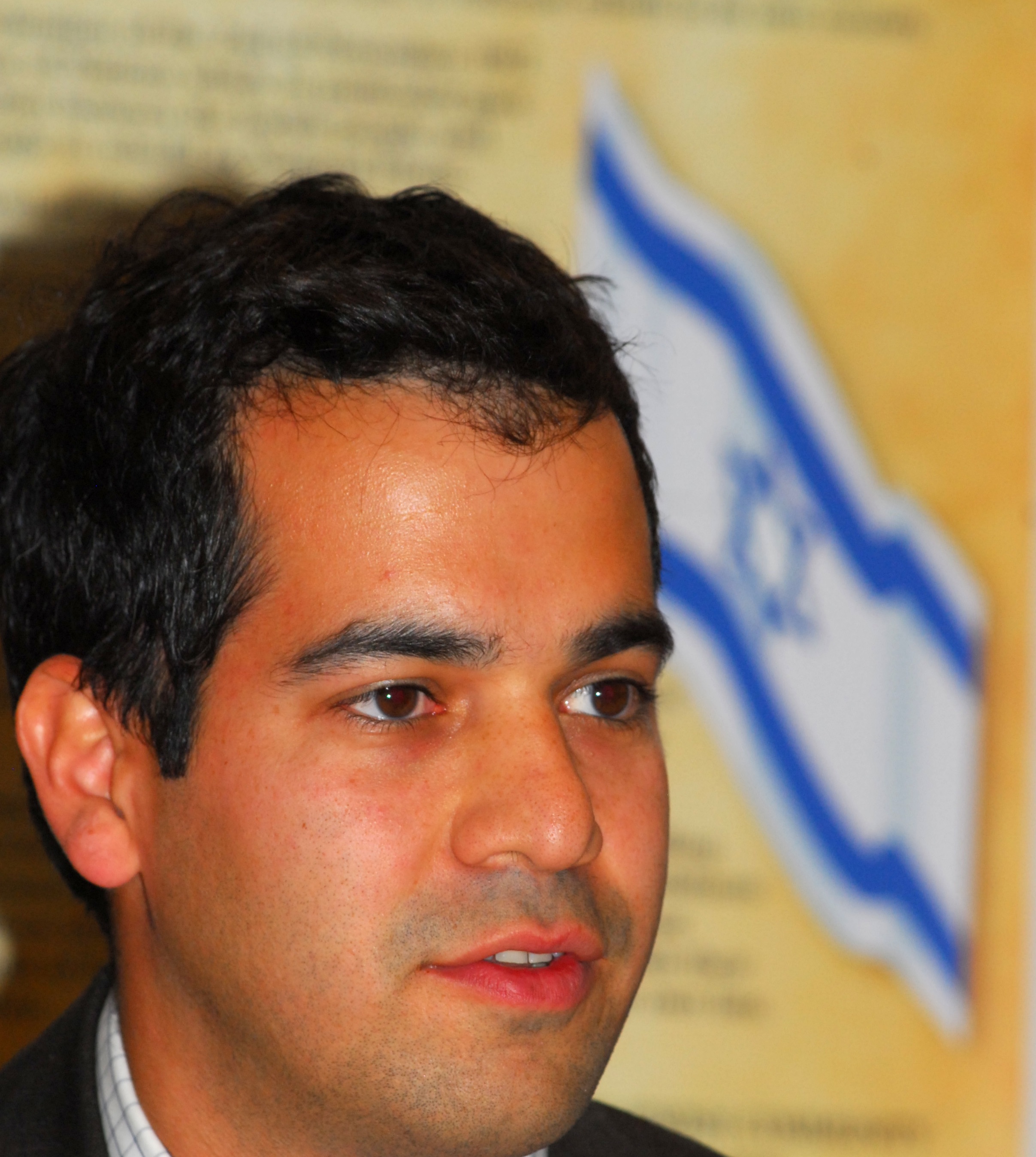
 Daniel Birns, international activities advisor at the U.S. Department of Energy, speaks Dec. 15 at a US-Israel environmental symposium at the Israeli Embassy in Washington, DC.
Virginia’s largest electric utility is eagerly seeking Israeli “clean-tech” partners that offer innovative technologies aimed at slashing the world’s dependence on fossil fuels through the development of renewable energy sources like solar, wind, seawater and biofuels.
Dominion Resources GreenTech Incubator, based in Ashland, Va., is a nonprofit business incubation program formed by Dominion Resources, the Virginia Biosciences Development Center and two other local entities. David Lohr, the program’s executive director, will lead an official Virginia delegation to Israel on Jan. 6, with the goal of identifying three to five companies that could be ideal matches for the year-old venture.
“This is our first international effort, and we’re very excited,” said Lohr. “Our joint initiative tries to incubate and commercialize technologies in the clean-energy sector. We are hoping to replicate the success we had with Israeli life-sciences companies three years ago by moving into green-tech. This has been part of our strategy from the outset.”
The Virginia executive was one of three speakers at a Dec. 15 environmental symposium co-sponsored by the Israeli Embassy, Washington law firm ZAG/S&W and the U.S.-Israel Science and Technology Foundation.
Lohr, who formerly operated the life sciences incubator at Richmond’s Virginia Bio-Technology Research Park, said that “through our corporate affiliations, we provide a unique offering to those Israeli life-science companies wanting to enter the U.S. market with their products.”
Daniel Birns, an international advisor at the U.S. Department of Energy, said that while both the United States and Israel share “a common commitment to environmental stewardship, Israel is a little more ambitious than we are.”
The Jewish state — concerned about the long-term effects of climate change — has committed to reducing carbon emissions by 20% between now and 2020, while the United States has only committed to a 17% reduction.
“It’s clear we need to dramatically change the way we power our homes and businesses,” Birns told his audience of about 50 business executives, lawyers and U.S. government officials. “We need to invest in new grid systems capable of moving renewable energy from where it’s produced to where it’s used. And it’s not enough to do it just in our two countries. We need to do it globally.”
Since 2008, the U.S. Department of Energy and Israel’s Ministry of National Infrastructures have jointly funded innovative projects through BIRD — the Binational Industrial Research and Development Foundation.
Operating on a $4 million budget over the past two years, BIRD issues competitive soliciations for U.S.-Israeli ventures, funding up to 50% of the combined companies’ R&D expenses associated with the project. If it’s successful, BIRD claims royalties of up to 150% of the initial grant.
In the beginning, those pairings usually involved a large U.S. company and a small Israeli startup. But in the past year, big Israeli conglomerates have begun teaming up with smaller American startup firms.
In 2010, three collaborative projects were granted BIRD funds. They include Israel’s Panoramic Power Ltd., which along with San Francisco’s MNLB will develop and pilot self-powered, wireless sensors to facilitate load management strategies in commercial buildings.
Jerusalem-based OMAT Ltd., in cooperation with General Dynamics Ordnance and Tactical Systems Inc. of Scranton, Pa., will develop a system to monitor, control and economize energy consumption in metal machining industries.
And Tel Aviv-based HCL CleanTech Ltd. is partnering with Virent Energy Systems of Madison, Wis., to produce biogasoline from non-food sources.
Last year, HelioFocus Ltd. of Nes Ziona, Israel, took advantage of BIRD money to develop — along with Capstone Turbine Corp. of Chatsworth, Calif. — a microturbine that produces electric power from concentrated solar energy.
Tigo Energy of Kfar Saba came up with a complete Building Integrated Photovoltaic system with help from Architectural Glass and Aluminum Co. Inc. of Alameda, Calif.
And TransBiodiesel Ltd. of the Israeli town of Shfar-Am, working with Purolite Co. of Bala Cynwyd, Pa., designed a way to produce biodiesel fuel on a commercial scale.
“BIRD offers a conditional grant or loan that enables companies with breakthrough technologies to create value for both countries,” said Birns. “I can’t overstate how unique this model is. If we could replicate it elsewhere, we probably should.”
One of the most exciting projects underway involves Israel’s Seambiotic, which utilizes carbon-dioxide effluent from a coal-fired power plant in Ashkelon to grow microalgae, a feedstock for biofuels — in a project partially underwritten by Sandia National Laboratories in New Mexico.
Asaf Vitman, minister for economic affairs at the Israeli Embassy, said the Jewish state could be a world center for the development of green technologies.
“We don’t have oil, but nature gave us the sun, so we try to develop products that can take the sun and create energy,” he explained. “Solar water heaters are on all our roofs. It’s nothing related to clean-tech or high-tech, but this saves us 3-4% of our energy bill every year. Over 40 years, that’s a lot of money.”
Likewise, said Vitman, “because Israel is a desert country, we have to manage our water very carefully. Thirty years ago we invented drip irrigation to promote agriculture in the desert. Most of our products are for export now.”
Vitman said Israel is on the verge of becoming a world leader in geothermal energy and electric vehicle technology as well. Even Israel Aircraft Industries — which manufactures airplanes — is getting into the act, with a pilot program on wind energy.
“We are also looking to collaborate with other countries. We have research projects going with the European Union, China and India. That’s very important for us because the market is worldwide, not in Israel,” he said, adding that “we’re looking to give huge incentives to startups. We are the startup nation, so now we have to move from IT to clean-tech to achieve our goals.”
Veteran journalist Larry Luxner is news editor of The Washington Diplomat and editor of CubaNews, a monthly newsletter on political and business developments in Cuba. He also writes frequently for The Middle East and Saudi Aramco World.




Actually, Daniel Birns is giving the Israeli government credit it doesn’t really deserve – the Israeli government’s decision refers to reducing 20% emissions from the growth in Israel’s emissions – this is very far from reduction of 20% in the actual emissions and certainly lower than the 17% (which refers to an absolute reduction) the U.S. is committed to.