
Syria’s Dustbowl Attributed To Wasted Water

euphrates-water-wasteSyria’s livelihood is going down the drain. Unless the country learns to conserve, their future will be painfully dry.

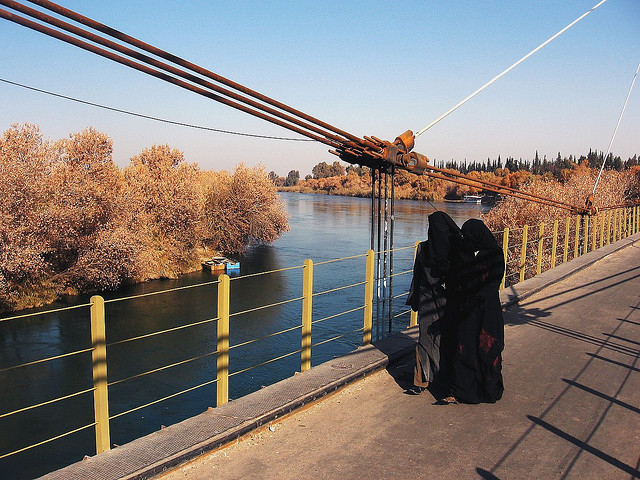
The Euphrates River, which meanders diagonally through the top quarter of Syrian territory, was once a source of agricultural bounty. Expatriates recall a time of lush plenty: orchards blooming with fruit, healthy cotton fields, and sparkling streams. Syria had it made with an agricultural surplus which could have easily sustained a healthy, vibrant population.

But then in the 1960s the Khabur River Project was developed to build a series of dams and canals, leading to excessive extraction. A culmination of that, a four year long drought exacerbated by rising temperatures, and old-fashioned bad management has dried up the Euphrates’ largest tributary, the Khabur River. Some are in denial, but scientists claim that unless the country learns how to stop wasting water, Syria faces a shriveled future.

What a waste!

Of the 80% of the country’s water resource allocated to agriculture, 70% is wasted. This waste is mostly attributed to antique irrigation methods. George Malaki Sawmi has replaced the former Irrigation Minister and is tasked with modernizing this system, according to The National.

But poor irrigation should not shoulder the entire blame. Swansea University water scientist Nidal Hilal suggests that all of society contributes to the waste responsible for the current water crisis.

“People are using water excessively,” he told the paper.

“The message of reduce, recycle and reuse needs to be heard in Syria, from the young people in schools right up to the highest authorities.”

At a Damascus conference addressing water use that concluded last week, scientists reported that between 2002 and 2008, water availability dropped from 1200 cubic meters to 750 cubic meters per person, according the The National.

Fleeing for greener pastures

“You can call it whatever you want, but as things stand, Syria doesn’t have enough water to meet its needs,” Ghassan Ejjeh – the conference chairman who is based in Brussels – told the paper.

“If they have 750 cubic metres a year, that’s a water crisis and it will quickly become something worse unless action is taken. Supplies dropped from 1,200 cubic metres to 750 very quickly and at that rate, there is going to be a real problem very soon.”

While the North Eastern province Hasika, where the Khabur River has run dry, has the fewest water resources, the historically fertile Jazeera region that provides much of the nation’s agriculture was hit by a  drought that prompted food assistance from aid agencies.

According to the United Nations, 600,000 people have already fled.

Authorities have investigated grand schemes for pumping water from the west coast to Damascus, but Mr. Hilal shuns this solution.

“For now we should look to the water that is available and just use it better. That will go a long way to dealing with this matter,” he told the paper.

:: The National

More on water shortages:

Saudi Arabia’s Desalination Market A $50 Billion Opportunity

Ecowash M.E.: How To Wash Your Car In A Water-Parched Desert

Water Problems in Cyprus Worse Than Those of Israel, Syria and Lebanon

image via Ai@ce

Tafline Laylin
Tafline Laylinhttp://www.greenprophet.com
As a tour leader who led “eco-friendly” camping trips throughout North America, Tafline soon realized that she was instead leaving behind a trail of gas fumes, plastic bottles and Pringles. In fact, wherever she traveled – whether it was Viet Nam or South Africa or England – it became clear how inefficiently the mandate to re-think our consumer culture is reaching the general public. Born in Iran, raised in South Africa and the United States, she currently splits her time between Africa and the Middle East. Tafline can be reached at tafline (at) greenprophet (dot) com.

Read More

TRENDING

Who Owns the Farm Robot? A State of Jefferson Startup Takes on Carbon Robotics

In California's self-proclaimed State of Jefferson, a small agricultural technology company is challenging the dominant laser-weeding business model. Laudando & Associates believes farmers should own and repair their AI-powered weeding tools rather than pay ongoing subscription fees. The approach has put the company on a collision course with industry leader Carbon Robotics, sparking a patent dispute that has pushed the Jefferson startup toward overseas markets while raising broader questions about ownership, right-to-repair, and the future of farm automation.

Regenerative Wool or Greenwashing? Zentera Responds to Critics

Zentera responds to questions about ZQ wool, animal welfare, regenerative farming, ethical fashion and the fallout from PETA's New Zealand investigation.

10 Amazing Facts About the Sidr Tree

Most people in the West have never heard of the Sidr tree. That's strange when you think about it. This tough, thorny desert tree has fed people, bees, birds, and camels for thousands of years. It appears in Islamic tradition. Its honey sells for astonishing prices.

Tanner Winterhof on the Custom Harvesters Quietly Holding American Agriculture Together

In late January, in a Des Moines hotel ballroom that smelled faintly of diesel and convention coffee, Tanner Winterhof spent three days hosting the members and attendees of the  U.S. Custom Harvesters Inc. annual convention on his podcast as Farm4Profit’s official media partner for the show.

Jujube, the sidr tree of medicine and magic

A magic holy sidr bath to deflect the evil eye? It needs 7 powdered sidr leaves stirred into a bucket of warm water. The hadith of the Prophet Muhammad allows to repeat healing prayers and verses from the Koran to increase the water’s potency. 5 grams, or 1 tablespoon of sidr powder equals 7 leaves.

Yerukim Forms a New Green Economy Where the Money is Really Green

The Yerukim members who pick up the recyclables get to keep the monetary reward, the public earns "green" bills that can be used in shops, and business owners get to be associated with environmentalism.

Choosing Riyadh over Dubai? What Investors Should Know

Saudi Arabia is deploying capital at unmatched scale to catalyze tourism and advanced industry while rewiring its power-and-water backbone. The investable frontier is widening—especially in renewables, grid storage, water efficiency/desal retrofits, and hospitality operating platforms. Prudent investors will insist on phased delivery, enforceable KPIs (energy, water, biodiversity), and RHQ/zone compliance—while pricing political-economy and reputational risks alongside growth upside.

Sell your cooking oil for biodiesel money

Want to make money on old french fry oil? Sell it.

Qatar Alternative Energy Summit Pairs Investors And Innovators

Alternative energy investors and innovators can meet n' greet in Doha, Qatar March 16 and 17.

Here’s How To Implement The Four Pillars Of Employee Engagement

If you throw a party for your work team and they are vegans, don't make it a barbecue. Know the sustainability values of your team to boost moral and retain good people.

Locals From Rishon Fight IKEA

Big Box stores are a pretty new concept in Israel, and thank God that not every Israeli city wants them in their backyard. A word from someone who has see the beautiful farmland around her hometown Newmarket, Ontario stripped and converted into vulgar strip malls of big box shops: they have no place in a healthy and sustainable town or city.

The Jewish National Fund Meets An Inconvenient Truth

According to the JNF, it has transformed thousands of acres of barren land into green forests in Israel. They state that each person emits about 23 tons of carbon per year, estimating that each tree planted can absorb one ton of carbon in its lifetime. That's a whole lot of trees you'd need to be planting. Could so many fit in Israel?

How to quiet noise from construction in your office

Streets need to be resurfaced in New York but the humming and grinding noise is unsettling. Noise is environmental pollution. 

Popular Categories