
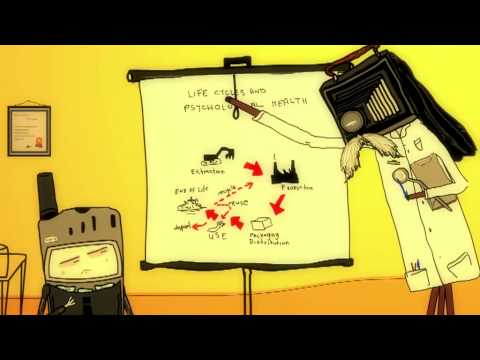

Animation: Past Life Regression For Eric-Sun, The Abandoned Cell Phone

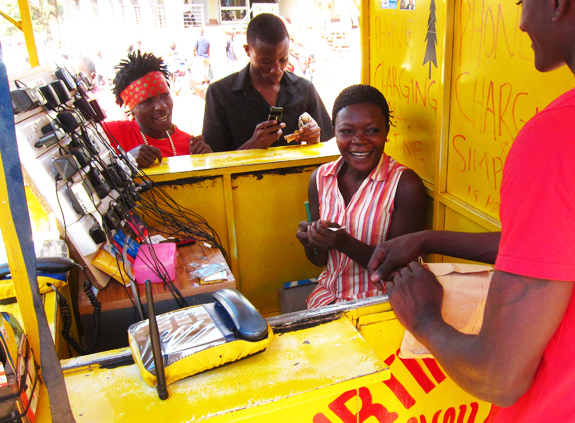
cell phone charging in Africa

The next time you think of replacing your cell phone, remember it’s made of nickel, silver, gold, platinum, as well as plastics and other finite materials; will you reconsider?

We love to share clever designs with our readers, to write about the technologies we hope will save the world one micro chip at a time. There are motorized bikes, energy reduction innovations, smart grids, and numerous other designs worth sharing. But rarely do we consider the ethics of design; nor do we ponder the origin of components that make up the technologies that render life more convenient. For Australian designer Leyla Acaroglu, these questions are central.

From Extraction to End of Life

In an interview with The Zone, Leyla criticizes universities for selling design philosophies that are deliriously short of morals. Her creative response, as Director of Eco-Innovators, was to develop an animated series called “The Secret Life of Things” that depicts the trajectory of products from natural resource extraction to end of life.

In this video, we meet Eric-Sun, the traumatized cell phone that has been discarded after only one year and seeks psychological treatment from an old Russian? camera.

All the pieces that put Eric-Sun together

Together, the phone and camera map Eric-Sun’s life history. This little compilation of metals traveled extensively before coalescing into a hand-held cellular device. Pieces of him were extracted from South African gold fields and Russian platinum mines, and he is composed of silver from Mexico and nickel from Australia. In fact, the doctor says, “if we go through all [his] metals, we’ll be here all day.”

When he was first born in the factory, taken home and plugged in, Erin-Sun was bright and shiny and life was exciting, but by his first birthday, his battery no longer stayed charged and he was eventually replaced by a sleeker, sexier model.

Out with the old, in with the new

This is the fate of many cell phones. In fact, of the 1.2 billion phones in use today, only 1% are re-used, according to Leyla. The rest, like Eric-Sun, are shoved in a drawer, dropped in a landfill, or shredded. The precious resources used to build the phones are then wasted.

Leyla’s model, via the animation, proposes design with a conscious. She encourages students to make products in consideration of the environmental and social impact, to make products that are either designed to last longer, or at least that can be taken apart and re-used elsewhere.

Don’t plan for obsolescence or fads. Plan for upgrades, plan for upward capabilities.

Hold on to your phone

America’s Environmental Protection Agency (EPA) suggests – where cell phones are concerned – that consumers play a role as well. They recommend that users keep their phones for longer and charge batteries correctly in order to prevent Eric-Sun’s unfortunate fate. And then, when it is impossible to keep the product any longer, at least reuse or recycle it.

Holding on to cell phones for as long as possible is especially necessary in the Middle East, where we have fewer opportunities to assemble their components into new incarnations. Although it is hard to resist the pernicious marketing for the new iphone or blackberry, please consider the resources it takes to make them. They are finite, after all.

Tafline Laylin
Tafline Laylinhttp://www.greenprophet.com
As a tour leader who led “eco-friendly” camping trips throughout North America, Tafline soon realized that she was instead leaving behind a trail of gas fumes, plastic bottles and Pringles. In fact, wherever she traveled – whether it was Viet Nam or South Africa or England – it became clear how inefficiently the mandate to re-think our consumer culture is reaching the general public. Born in Iran, raised in South Africa and the United States, she currently splits her time between Africa and the Middle East. Tafline can be reached at tafline (at) greenprophet (dot) com.

Read More

LEAVE A REPLY

Please enter your comment!
Please enter your name here

TRENDING

Saving Gourmet Wild Plants For The Future

Think of truffles, a gourmet wild food. The European...

Middle-Eastern spices and natural medicine (A through C)

In the Middle East, aromatic traditional foods are regarded...

Astro uses AI to help procure land for renewable energy

For oil-rich, environmentally vigilant Gulf states, Astro isn’t just another startup story. It is a blueprint for accelerating an energy transition that is now existential, not optional.

Iran’s water mafia and thirst for war leaves the country on brink of being dry

Iran’s Lake Urmia, once the Middle East’s largest saltwater lake, has shrunk by 90 percent due to mismanagement, dams, and drought. As Tehran pours billions into foreign conflicts, water activists face repression at home. The crisis mirrors Syria’s drought-driven unrest, showing how water scarcity can destabilize entire regions.

Don’t Regret Your Host: Alternatives to SiteGround That Impress

Discover top alternatives to SiteGround that offer impressive features and performance. Make an informed choice for your hosting needs today!

How to quiet noise from construction in your office

Streets need to be resurfaced in New York but the humming and grinding noise is unsettling. Noise is environmental pollution. 

EarthX and a blueprint for sustainable investing

Trammell S. Crow, a Dallas-based businessman and father of four, is focusing his efforts on impact investing, and media that focuses on saving the planet through EarthX.

Mining Afghanistan’s Mineral Discoveries Similar to Avatar

Now that American forces in Afghanistan are commemorating the longest period of any war that America has been involved in, including the 1965-73 Vietnam War, the recent discoveries of large and extremely valuable mineral and metal deposits may finally bring to light a reason to continue the presence of US fighting forces in this war torn and backward country.

From Pilot Plant to Global Stage: How Aduro Clean Technologies’ 2026 Expansion Signals a Turning Point for Chemical Recycling Investors Like Yazan Al Homsi

The company's Next Generation Process (NGP) Pilot Plant in London, Ontario, has officially moved into initial operating campaigns, generating the kind of structured, repeatable data that separates laboratory promise from commercial viability.

Nobul’s Regan McGee on Shareholder Value: “Complacency Is the Silent Killer” 

Why the governance framework designed to protect shareholders so...

Should You Invest in the Private Market?

startustartup Unlike public stock exchanges, which offer daily trading, strict...

How to build a 100-year-company

Kongō Gumi is a Japanese construction company, purportedly founded in 578 A.D., making it the world's oldest documented company. What can we learn about building sustainable businesses from them?

How AI Helps SaaS Companies Reduce Repetitive Customer Support Work

SaaS products are designed for large numbers of users with different levels of experience, and also in renewable energy.

Popular Categories