

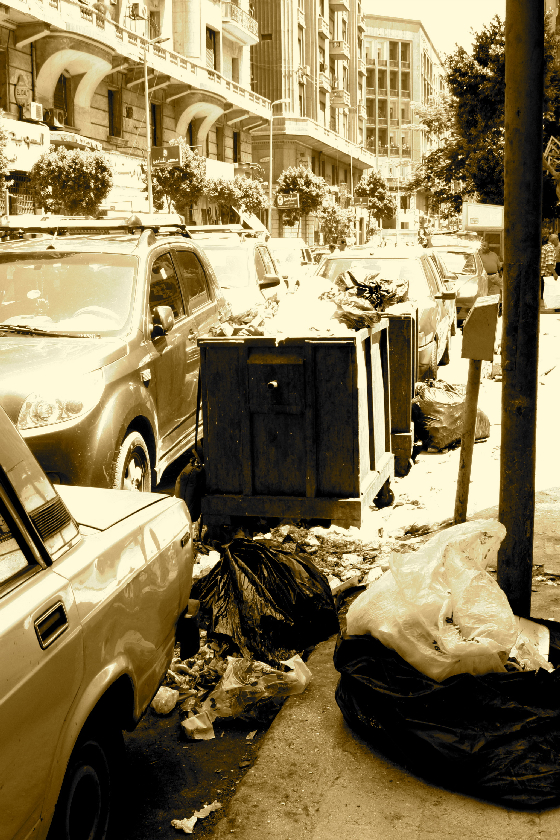
 Education puts Cairo one step towards getting rid of its nemesis: solid waste.
Within a 3 minute walk down Cairo’s streets, an environmentalist is bound to have an apoplectic fit: litter lies everywhere. Tiny trash bins – rare jewels – overflow with containers and water (read more about Cairo’s tap water) bottles that will live on long after the residents who used them are gone. And the Nile itself – that mighty river, the longest in the world – carries human debris north to the hapless dumping grounds that is the Mediterranean.
The numbers are overwhelming: the country’s current population is at least 80 million, while 16 million people spill out of the capital city’s cramped confines. Meanwhile, ecooptionsegypt.com, a blog committed to sustainability in Egypt, lists only 6 NGOs involved with environmental issues.
There is also a dearth of government solutions. The Zabbaleen, who used to collect, sort and re-purpose solid waste, and fed organic waste to their pigs, were replaced by the government in favor of a more modern system.

However, the city’s effort to modernize the system fell short in part because they failed to pay a fair wage to this historically efficient group of waste-gatherers who then lacked incentive to help.
 Egypt finally adopted a National Strategy for Integrated Municipal Solid Waste Management in 2000. This resulted in the development of: a government committee charged with oversight, economic incentives, and privatized services that are financed by tax on electricity.
On the street, the change is not seen.
The Mediterranean Environmental Technical Assistance Program claims the “country will face a cycle of rising costs to address ever increasing quantities of waste and will have limited or no ability to correct the situation.”
Therefore, the government has to approach waste management from several angles, namely “(i) strengthened supportive capacity of central government; (ii) application of the polluter pay principle; (iii) application of the principle of attaching an economic value to wastes as being recoverable resources; and (iv) enhanced public awareness and community participation in waste management systems.”
This means in part that citizens must become involved.
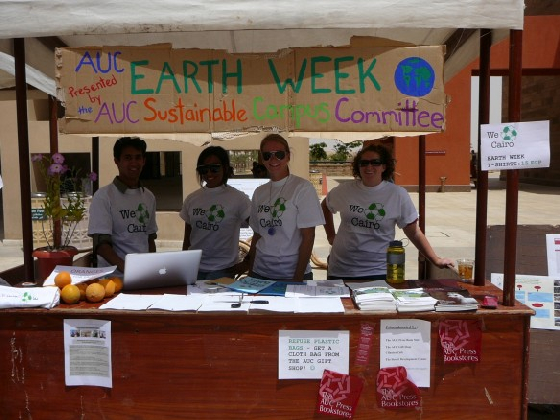 [courtesy of Tina Jaskolski]
To this end, the American University of Cairo is doing their part. They recently established the Sustainable Campus Committee, a subgroup of the Desert Development Center, composed of 20 volunteers committed to “bring together people interested in the environment from around AUC’s campus, to pool ideas and develop strategies for making AUC’s campus more sustainable,” Tina Jaskolski told ecooptionsegypt.
One of their first activities was held in honor of earth day, and focused on waste management. The group visited 20 AUC departments and educated 121 staff members about effective waste management during April.
Although this may seem like a small dent in an enormous junkyard of scrapped cars, and it is, especially given the group’s focus on the university campus, it is also an important step towards cleaning up greater Cairo.
Their work also brings to mind Margaret Mead’s words: “never doubt that a small group of thoughtful committed citizens can change the world; indeed, it’s the only thing that ever does.”
More from Egypt:
Climate Change Poses Threat to Egypt’s Farming, Tourism, Water Supply (Video)
Egypt Government to Invest in Wind, From $110 Billion Renewable Energy Budget
Upstream African Countries Sign Nile Water Deal Against Egypt’s Interests


I am really impressed by the efforts of EcoOptions in Egypt and am rooting for similar organizations to sprout up in other countries like Jordan, Syria and Lebanon.