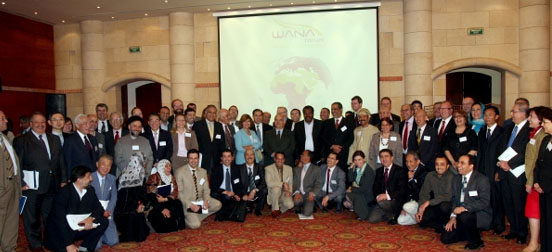

 WANA, a North Africa and West Asia forum recently convened in Jordan to discuss the environment, a green economy, sustainable development and the revival of Hima, an Islamic environmental conservation practice.
The West Asia – North Africa WANA Forum is a long-term initiative that brings together decision-makers, civil society orgs, religious leaders, researchers, business owners, media reps and other relevant regional stakeholders from the region. It works through an annual forum and interim consultations, and looks to engage the public in its processes. The facilitator and guardian of the forum is Prince of Jordan El Hassan bin Talal, with the support of Japan’s Nippon Foundation and the International Senior Advisory Board.
The WANA Forum recently met in Amman, Jordan and sent Green Prophet some updates and policy and green themes the group is working toward: Over 130 participants, representing over 50 nationalities, diverse backgrounds, and extensive expertise agreed that developing supranational and regional cooperation is essential if the area wants to find solutions to its challenges.
These are challenges that come in the form of social, economic and environmental degradation as a result of continuous conflict and the uprooting of peoples, rising population growth coupled with consumption and depletion of natural resources and ceding control of solutions to outside parties, the Forum defined.
Prince El Hassan bin Talal stressed that for the region to meet its own challenges, it must help itself: “We don’t need to go to Prague or Paris or London or Washington to discuss the future of WANA,” said Prince El Hassan.
Achieving dignity
“God helps those who help themselves. It is time we consider changing ourselves, our perceptions; shouldering our responsibilities, not consider ourselves at anytime as positional elite. I don’t count, possibly. You don’t count, possibly. The people who count are our children and their children. Let us try to make their world a little more comfortable on the basis of our experience and suffering.”
Achieving human dignity of the peoples of WANA was the common denominator that tied participant presentations, consultations and working sessions throughout the forum.
Prince El Hassan said that in order for peoples of this region to cease being alienated within their own societies there must be a shift from politics to policies of ‘consultation mode’ in all areas of regional cooperation within the third sphere; governments, the private sector and civil society. He reaffirmed that WANA countries must work side by side to preserve the dignity of the peoples of this region, and to achieve real and true empowerment that meets international standards.
Reviving Hima, an ancient concept in conserving for Islam
At the end of three days in May WANA representatives came out with several policy proposals one of which was the revival of the Islamic concept of Hima. Within that is the legal framework of conservation, originally an Islamic concept, which lends support to the utilisation of culturally appropriate frameworks for helping people understand why sustainable development, in the long run, offers the best hope for meeting the needs of future generations.
Some participants witnessed one such example in progress in Jordan’s Badia region, where the Badia Research and Development Centre (BRDC) is working on integrated solutions for resource management, community development and environmental conservation and management.
Throughout the forum Prince Hassan had emphasized the power of knowledge and education in supporting sustainable development and called for creating networks of cooperation across all educational institutions in WANA.
Proposals that emerged from the WANA Forum underlined the significance of regional networking and partnership in several areas, especially education. In order to move from brain drain to brain gain, enable social cohesion and sustainable development, social equity and empowerment and a strong knowledge-based green economy, participants agreed that education was indispensable.
Participants stressed that without education, there is social exclusion and indicated that social exclusion and poverty go hand in hand. They added that without education, activating consultation within the third sphere would be extremely difficult.
Putting water into the picture
Other forum proposals included creating a WANA citizen’s social charter and social cohesion fund that would help facilitate the inclusion of all sectors of society in planning for the future and connect the peoples of the region on a supranational level through education, the media and dialogue.
The Indian-based think-tank Strategic Forsight Group (SFG) organized a session: “our common future, water, environment and energy community, renewed the call for a supranational society for water and energy for human environment in the region.”
The forum a non-governmental initiative that brings together people from the region as well as partners from abroad like the SFG and the United Nations Development Programme’s Commission is sponsored by Japan’s non-profit philanthropic Nippon Foundation whose Chairman Yohei Sasakawais is a WANA Forum International Senior Advisory Board member.
Visible contributions to WANA 2010 were also made by the Regional Human Security Centre, the Arab Thought Forum, International Union for the Conservation of Nature, and the Badia Research and Development Centre.
The diversity of membership and expertise enabled participants to research sustainable approaches that would help the region move from consumption to production and leapfrog into the third industrial revolution of the post carbon economy, WANA reports.
Let’s hope some projects with measurable results emerge from future meetings.