Is Bubbe's Eastern European Diet "Kosher" for Your Health?

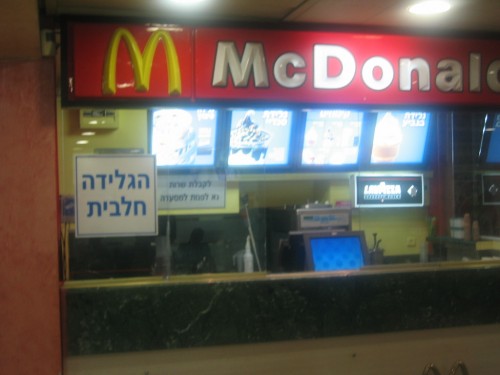
McDonald's, Ramat Gan, Israel

Israelis come from a variety of countries and their diets tend toward the eclectic. My own culinary heritage is staunchly eastern European. But while my mother rendered chicken fat from time to time, she preferred adapting traditional foods to make them lighter.

Alternet‘s Terence McNally  interviewed Michael Pollan, ecological food expert and best-selling author of In Defense of Food,  who expressed concern about the loss of food’s cultural connotations. Marketers and researchers  devalue our intuition, leading us to suspect the foods we were raised on:

Michael Pollan (MP): I remember my mother dutifully giving us all margarine instead of butter. She would say, “Some day they’re going to figure out that butter is actually better for you than margarine,” and we thought she was nuts. In fact, it turned out that margarine was lethal and butter is fine.

Terence McNally (TMN): She was still feeding it to you suspecting that would happen…?

MP: The authority of mothers was essentially destroyed by the food industry. The $32 billion a year in marketing muscle out there has undercut culture’s role in determining what we eat, and culture is a fancy word for your mom.

TMN: Just to emphasize that number, that’s not the food industry, that’s the food marketing industry.

Of course many eastern European staples are healthy. Think of  soups rich with legumes and vegetables, stuffed cabbage and chopped liver that “stretch” meat (even if  the cabbage is overcooked), and lots of fresh vegetables straight from the garden.

I have rejected my own mother’s copious use of Crisco, a tasteless, pareve (meaning meat nor dairy, thus neutral for a kosher kitchen) shortening heavily marketed by corporate giant Procter and Gamble. Instead I bake with whole wheat flour and canola oil, and serve humus and eggplant salad along with potato kugel and matzah balls.

How have you adjusted your culinary traditions to eat more healthily?

A Cooking Legacy (from A Mother in Israel)

Syrian recipe for Muhamarra

Organic Falafel in Tel Aviv

Hannah Katsman
Hannah Katsmanhttps://www.greenprophet.com/
Hannah learned environmentalism from her mother, a conservationist before it was in style. Once a burglar tried to enter their home in Cincinnati after noticing the darkened windows (covered with blankets for insulation) and the snow-covered car in the driveway. Mom always set the thermostat for 62 degrees Fahrenheit (17 Celsius) — 3 degrees lower than recommended by President Nixon — because “the thermostat is in the dining room, but the stove’s pilot light keeps the kitchen warmer.” Her mother would still have preferred today’s gas-saving pilotless stoves. Hannah studied English in college and education in graduate school, and arrived in Petach Tikva in 1990 with her husband and oldest child. Her mother died suddenly six weeks after Hannah arrived and six weeks before the first Gulf War, and Hannah stayed anyway. She has taught English but her passion is parental education and support, especially breastfeeding. She recently began a new blog about energy- and time-efficient meal preparation called CookingManager.Com. You can find her thoughts on parenting, breastfeeding, Israeli living and women in Judaism at A Mother in Israel. Hannah can be reached at hannahk (at) greenprophet (dot) com.

Read More

6 COMMENTS
  1. Considering that the entire modern world walks toward globalization I am not surprised if cultural eating habits will disappear. Religion is losing it's impact on people and many of these habits were canonical. Everybody is more preoccupied with eating healthy rather than kosher and I can't blame them for that._________________Seattle HCG weight loss consultant

  2. I don’t think chicken fat is as unhealthy as one would think (not that it’s so great, either). Crisco, margarine, and the antibiotics/hormones that the chicken ate are worse. We do need some fat.

    Somewhere there was a study of people in Holland? Belgium? during World War II. They couldn’t get hold of animal products, and there was less degenerative disease.

    Karin, yes, Bubbe didn’t have a choice! There was no supermarket of processed food.

  3. My father grew up in a shtetl (small, mainly Jewish town) in Poland. They ate garden vegetables, mostly potatoes. My father collected eggs from the local non-Jewish farmers and sold them, but I doubt his family ate many. The way he tells it they were close to starving. When he went away to yeshiva they served cholent every day, without much meat. Well, he is in his 80s.
    I agree that they ate less meat, but relied on large amounts of chicken fat. At least I suspect that was the case in wealthier families.

  4. People everywhere, not just religious or Jewish ones, ate much much less meat than some people eat today. People have taken it for granted due to the cheapness of meat (thanks to new and “advanced” farming methods); I bet Bubbe, even if she didn’t cook meat all that often, made very healthy food.

  5. One of the problems I find is the move to the right of the Orthodoxy seems to include eating less vegetables, eating less fresh vegetables (you can buy tasteless bodek in a bag, much easier but then vegetables get a bad name), and certainly not organic.

    My paternal grandmother, who was a very frum Orthodox woman, definitely believed in eating vegetables. And a variety, too.

    Another issue is that in Eastern Europe, Jews couldn’t afford much meat. Now the amount of meat they buy (at least in the U.S.) is staggering and represents a break from tradition, even if they don’t see it that way.

    On the topic of food in Israel, visiting establishments like the one you pictured unfortunately was one of the highlights of our recent trip for our kids. Sigh. I ate elsewhere.

TRENDING

HelloFresh’s pride prepping ad raises a bigger question: we are we still outsourcing dinner?

The backlash against HelloFresh's Pride Month marketing campaign has sparked a wider conversation about food, labor, sustainability, and whether consumers should reconnect with local farmers, butchers, and home gardens instead of relying on subscription meal kits.

Regenerative Wool or Greenwashing? Zentera Responds to Critics

Zentera responds to questions about ZQ wool, animal welfare, regenerative farming, ethical fashion and the fallout from PETA's New Zealand investigation.

The Ocean’s Hidden ‘Dark Web’ Is Being Fished Before Scientists Understand It

Deep below the ocean's surface, in a dimly lit region known as the twilight zone, millions of fish are being caught every year. Scientists say the consequences are largely unknown.

Barnacle glue could fix coral reefs, inspire new advances in building and medicine

Aalto University researchers create a protein-based adhesive inspired by barnacles and mussels that works underwater and could aid coral reef restoration.

Jaakko Torvinen finds that the next green building revolution is misfit trees

Crooked, forked and curved trees are often treated as second-class timber. They are considered less valuable, and not suitable for load bearing walls or support systems in building. If a tree trunk is not straight enough to become a saw log, it is frequently diverted into pulp production or burned for energy. Now, new research from Aalto University could help change that.

Locals From Rishon Fight IKEA

Big Box stores are a pretty new concept in Israel, and thank God that not every Israeli city wants them in their backyard. A word from someone who has see the beautiful farmland around her hometown Newmarket, Ontario stripped and converted into vulgar strip malls of big box shops: they have no place in a healthy and sustainable town or city.

The Jewish National Fund Meets An Inconvenient Truth

According to the JNF, it has transformed thousands of acres of barren land into green forests in Israel. They state that each person emits about 23 tons of carbon per year, estimating that each tree planted can absorb one ton of carbon in its lifetime. That's a whole lot of trees you'd need to be planting. Could so many fit in Israel?

How to quiet noise from construction in your office

Streets need to be resurfaced in New York but the humming and grinding noise is unsettling. Noise is environmental pollution. 

EarthX and a blueprint for sustainable investing

Trammell S. Crow, a Dallas-based businessman and father of four, is focusing his efforts on impact investing, and media that focuses on saving the planet through EarthX.

Mining Afghanistan’s Mineral Discoveries Similar to Avatar

Now that American forces in Afghanistan are commemorating the longest period of any war that America has been involved in, including the 1965-73 Vietnam War, the recent discoveries of large and extremely valuable mineral and metal deposits may finally bring to light a reason to continue the presence of US fighting forces in this war torn and backward country.

From Pilot Plant to Global Stage: How Aduro Clean Technologies’ 2026 Expansion Signals a Turning Point for Chemical Recycling Investors Like Yazan Al Homsi

The company's Next Generation Process (NGP) Pilot Plant in London, Ontario, has officially moved into initial operating campaigns, generating the kind of structured, repeatable data that separates laboratory promise from commercial viability.

Nobul’s Regan McGee on Shareholder Value: “Complacency Is the Silent Killer” 

Why the governance framework designed to protect shareholders so...

Should You Invest in the Private Market?

startustartup Unlike public stock exchanges, which offer daily trading, strict...

Popular Categories