

Green Prophet recently wrote about the rise in environmental activism and awareness amongst Palestinians, including conservation biologist and educator, Sami Backleh. In this guest post, Sami, a resident of east Jerusalem, writes about the flora and fauna of Wadi Qelt in the Jordan Valley near Jericho. (Article originally published in This Week in Palestine.)
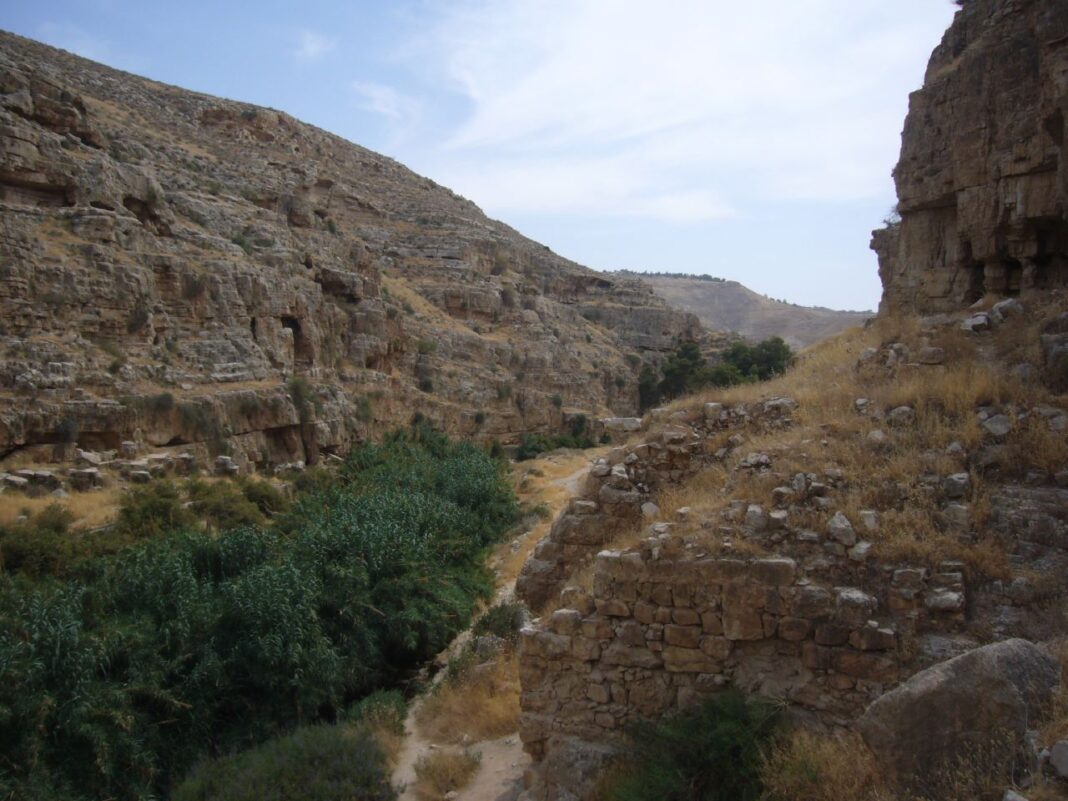
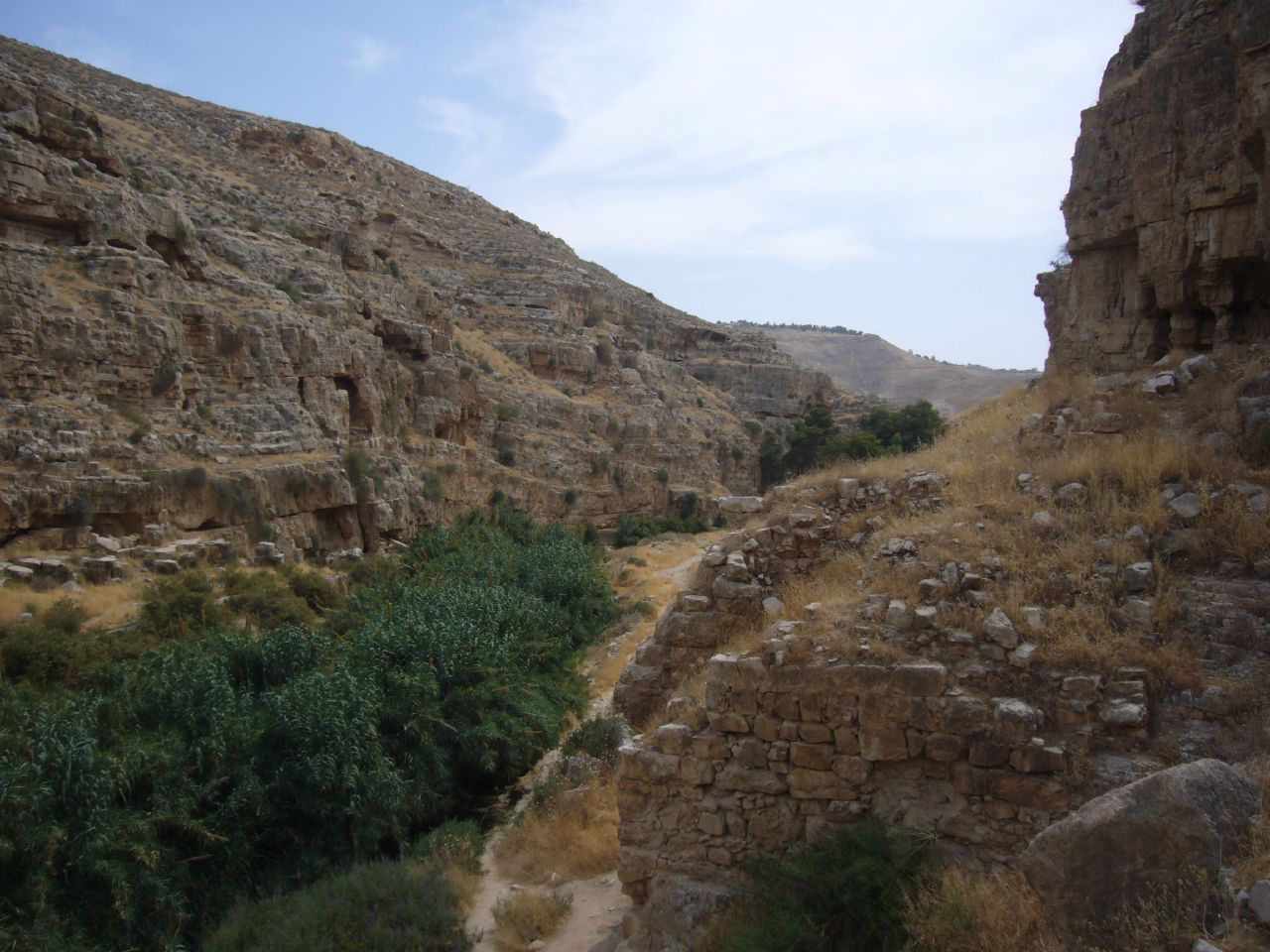
It was on the second of November that I decided to go hiking and bird watching in Wadi Qelt, a site that I always admired, not only because of its rich history, archaeology, and natural scenes, but also for being a goldmine of diverse flora and fauna, many of which form important elements of our valuable natural heritage.
Naturalists are an odd bunch. For most people, a holiday means relaxation and sleeping in, but not for us. An ideal break involves being up and running before dawn, at least a couple of hours before work requires, and wrapping up exhausted, but overjoyed, by 8:00 am. I tried to reach Wadi Qelt from its eastern side by 7:00am, starting from a high hill with a panoramic view overlooking Jericho and the Dead Sea. By 8:00am, however, the temperature had risen to about 25°C, and the Dead Sea had disappeared behind a screen of bluish haze, so I decided to keep on going to see other forms of wildlife down the Wadi.
Wildlife in Palestine? To those steeped in bad news from this tiny corner of the world – whether they know it as Palestine, the West Bank and Gaza, or the occupied territories – it can be a shock to learn that much is thriving here, wild or otherwise. But hyenas and gazelles are still roaming through the wadis of the eastern slopes of Palestine, and ibex still gambol in the mountains of the Dead Sea. I kept on walking down the steep sides of the Wadi, teaming with an array of desert life thriving on the numerous freshwater springs, which still provides water for the city of Jericho using old aqueducts. Indeed, it is a place for exploration.
As I hiked through this harsh but astonishing landscape, I tried to keep my eyes on the sky in anticipation of a potential sighting of a gliding raptor as it was the time for the autumn migration. Loud, trumpeting, far-reaching calls, and deep “kroo kroos” emerged from nowhere and I tried to make out where the sound was coming from.
Suddenly the air became filled with hundreds of cranes soaring and twirling in the sky as they were carried up by the warm air currents. Like squadrons of fighter-pilots, the birds adopt arrow-like formations as they are lifted by the thermals which will eventually guide them south towards Africa. Within a few minutes, they had disappeared into the horizon.
It is one of nature’s most astonishing spectacles: Every spring, more than half a billion birds fly north from Africa to breeding grounds in Europe and Asia – and every autumn they return. A few strong fliers can cross the Mediterranean in one go, but the vast majority of the 500-odd species that make the trek are obliged to do so overland, for example, passerines (small perching birds) who need to stop and eat, as well as raptors and other big soaring birds, because they depend on thermals, spiralling updrafts, that don’t form over water.
The choke point for most of this traffic is this bottleneck piece of land between Africa and Asia, a region currently shared (if that’s the right word) by Israel, the fledgling Palestinian political entity, and Jordan. This slender land-bridge is furrowed by two parallel mountain ranges and, between them, the Jordan Valley, itself a northward continuation of Africa’s Great Rift. The valley forms a perfect avian flyway, its high temperatures and steep walls spin off thermals while its wetlands offer abundant cover and forage.
Wadi Kelt’s birds include many species typical to the dry and semi-dry ecosystems. A number of Black Redstarts, males in black breast and face with a rusty-red rump and tail, work their way along the Wadi floor; Mourning Wheatears seem to call from every other boulder while the similar but much less common Hooded Wheatear probably also breeds in the area.
One of my most memorable incidents came after I was alerted by a group of bulbuls behaving very oddly, calling incessantly, and flitting up and down – clearly very nervous. The cause of their unrest soon became clear: a snake disappearing between the rocks. I didn’t manage to see it well, but the colour of its last few centimetres hinted that it could be a Palestine viper. I was sad for upsetting the viper during its potential hunt, but I sure that the bulbuls were happier about my arrival.
By that time it was about noon, so I decided to look for some shade on a hill in order to rest and watch some migratory soaring birds. As I sat enjoying my packed lunch, I watched a pair of rocky hyraxes with their pups foraging for roots in the Wadi bed. Suddenly, one of the hyraxes let out a chilling call and the groups quickly scattered in different directions.
Peering through my binoculars to see what commotion was all about, I saw the shadow of a big bird hovering over one of the pups trying to catch it. It was an incredible, breathtaking moment as a cloud of dust formed when the raptor, probably a Great Spotted Eagle, hit the ground. In the end, the the eagle failed to catch the little hyrax and flapped its wings as it flew southwards, leaving the hyrax with another survival adventure and me with an unforgettable experience.
Green Prophet thanks the author for permission to reproduce this article.
::This Week in Palestine.
For more on the region, see:
Dancing At The Dead Sea Book Review
Palestinian Eco-Activism Is On The Rise
Israel’s National Bird Poll
Is Wind Energy A Danger To Migrating Birds?




Reflections On A Day Hiking Through Jordan Valley's Wadi Qelt http://tinyurl.com/yl59sq2
Green Prophet » Reflections On A Day Hiking Through Jordan… http://tinyurl.com/yl59sq2
Hi Sami – I’ve got a review copy of ‘Palestinian Walks’ by Raja Shehadeh.
Would you like to review it for GP (and other places too). Let me know.
Wonderful piece on Wadi Qelt….thanks for refocussing us all on ‘wildlife’.
James