Egypt’s Pyramid Builders Succumbed to Climate Change

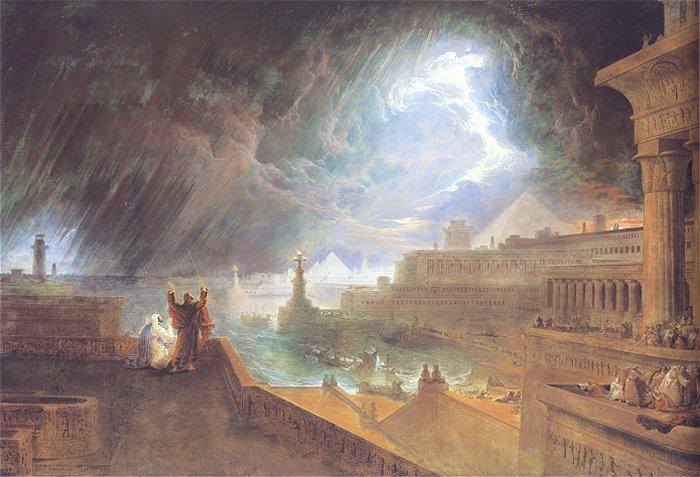
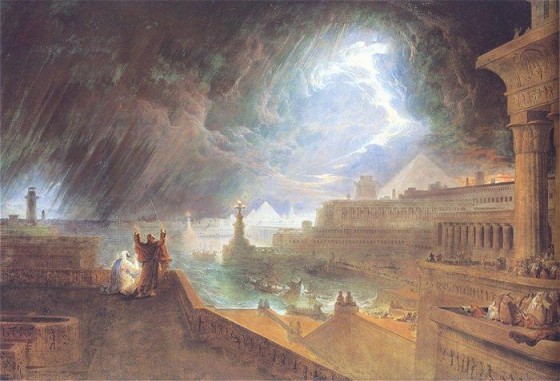
Martin_John_The_Seventh_Plague_1823

Pollen and ash in Nile river delta sediment provides evidence of ancient climactic events including mega-droughts and wildfires which wiped out pyramid-building civilizations, says a study published in the recent July 2012 edition of Geology.

They waited seventy days for her to reappear. Finally she came. For a moment just before sunrise, the bright star Sirius, daughter of Ra, shimmered over the pyramids of Cairo. For generations she had always appeared as a sign that the Nile would soon flood, bringing water, fertile sediment and life to the people of Egypt. But one year her promise of sustenance failed.  Something happened around the year 2200 BCE.  Perhaps the snow melt from the highlands of Ethiopia never arrived. Or the infrequent rains stopped coming altogether.

Whatever the cause, a once-great river became mud.  Parts of its fertile delta turned to dust. Then the fires came. They swept through the valley destroying homes, trees and crops. The people who had built the great pyramids were powerless against the climate change which led to a global drought 4200 years ago. Egypt’s pyramid-building Old Kingdom met its demise. Was climate change to blame?
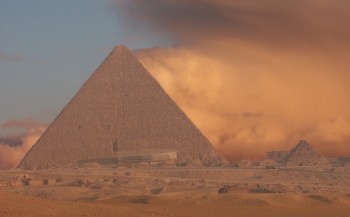
sandstorm_pyramid The study entitled Nile delta response to Holocene climate variability,was authored by Christopher Bernhard of the US Geological survey (USGS), Benjamin Horto of the University of Pennsylvania, and Jean-Daniel Stanley of the Smithsonian Institution.

These researchers found that during various times throughout history, the proportion of wetland pollens in Nile Delta sediment decreased and the proportion of charcoal ash increased.

The sediment layer suggested that climate change caused severe drought conditions 3000, 4200, 5000 and 6000 years ago. Some of these drought sediment layers correspond with human records of severe droughts and the collapse of civilizations.

The Uruk Kingdom in modern Iraq collapsed about 5000 years ago. The drought 3000 years ago is associated with the fall of the Ugarit Kingdom and famines in the Babylonian and Syrian Kingdoms. The drought 4200 years ago corresponds with the end of the Old Kingdom, the pyramid builders of Egypt.

In a USGS press release, Christopher Bernhardt said, “Humans have a long history of having to deal with climate change. Along with other research, this study geologically reveals that the evolution of societies is sometimes tied to climate variability at all scales – whether decadal or millennial.”

Benjamin Horton added that, “The study geologically demonstrates that when deciphering past climates, pollen and other micro-organisms, such as charcoal, can augment or verify written or archaeological records – or they can serve as the record itself if other information doesn’t exist or is not continuous.”

Sudan, Djibouti, Eritrea, Somalia, Ethiopia, Kenya, Syria, the UK, the US and northeastern Brazil  have all faced droughts this year. Blogs around the world are writing about it.

Australia faced a series of severe droughts and wildfires just in the last few years.  Most of the Middle East and North Africa live precariously with scarcely enough water during a normal year, much less a drought. Much has changed over the past 6000 years, but when a drought hits and wildfires rage, we can imagine how such events might have ended civilizations.

Public domain image of The Seventh Plague (Old testament bible story, “plague of hail and fire”, Exodus 9:13-35.) by John Martin via Wikimedia.

Photo of sandstorm over Egyptian pyramids via Shutterstock

Brian Nitz
Brian Nitzhttp://www.greenprophet.com
Brian remembers when a single tear dredged up a nation's guilt. The tear belonged to an Italian-American actor known as Iron-Eyes Cody, the guilt was displaced from centuries of Native American mistreatment and redirected into a new environmental awareness. A 10-year-old Brian wondered, 'What are they... No, what are we doing to this country?' From a family of engineers, farmers and tinkerers Brian's father was a physics teacher. He remembers the day his father drove up to watch a coal power plant's new scrubbers turn smoke from dirty grey-back to steamy white. Surely technology would solve every problem. But then he noticed that breathing was difficult when the wind blew a certain way. While sailing, he often saw a yellow-brown line on the horizon. The stars were beginning to disappear. Gas mileage peaked when Reagan was still president. Solar panels installed in the 1970s were torn from roofs as they were no longer cost-effective to maintain. Racism, public policy and low oil prices transformed suburban life and cities began to sprawl out and absorb farmland. Brian only began to understand the root causes of "doughnut cities" when he moved to Ireland in 2001 and watched history repeat itself. Brian doesn't think environmentalism is 'rocket science', but understanding how to apply it within a society requires wisdom and education. In his travels through Europe, North America, Asia and the Middle East, Brian has learned that great ideas come from everywhere and that sharing mistakes is just as important as sharing ideas.

Read More

2 COMMENTS

TRENDING

Dan Zaslavsky’s energy tower dream is rising again in Iran and China

The Energy Tower idea never made the leap from drawings and engineering studies to full-scale construction. But nearly two decades after most people stopped talking about it, the concept is quietly evolving in two unexpected places: China and Iran. The concept let dreamers dream and doers do - figuring out more pleasing designs and engineering.

A visit to Amirim, Israel’s first all-vegetarian village in the Galilee

Just 15 kilometers from Tzfat there is a moshav that was founded in the late 50s that was ideologically influenced by organic, vegetarian and vegan principles. My hostess at Ohn-Bar, the tzimmer where I stayed, explained that the people of Amirim were among the pioneers of Israel’s strong vegetarian movement.

Weston Higginbotham found dead in a Kyoto forest: is climate anxiety part of the story?

In some ways, Weston has become a symbol of a generation wrestling with environmental and technological anxiety. Friends and family described him as deeply concerned about environmental issues. Reports also noted that he questioned the growing role of artificial intelligence in daily life, even reportedly disagreeing with his mother about her use of AI.

Billie Eilish’s Mom Takes the Stage at Hollywood Climate Summit — But Does Hollywood Still Care About Climate Change?

Hollywood once promised to help save the planet. Leonardo DiCaprio warned of climate catastrophe from awards stages. Celebrities flew to climate conferences. Studios pledged greener productions. Streaming platforms rushed to commission environmental documentaries. But in 2026, with the aftermath of wildfires, heatwaves and floods becoming routine, a question lingers: Does Hollywood still care about climate change?

Can Scientists Predict Coral Bleaching Before It Happens?

Now researchers at the Woods Hole Oceanographic Institution (WHOI) in the US say they have developed a way to predict coral bleaching five to six months before it occurs, potentially giving reef managers enough time to intervene and save vulnerable corals.

Yerukim Forms a New Green Economy Where the Money is Really Green

The Yerukim members who pick up the recyclables get to keep the monetary reward, the public earns "green" bills that can be used in shops, and business owners get to be associated with environmentalism.

Choosing Riyadh over Dubai? What Investors Should Know

Saudi Arabia is deploying capital at unmatched scale to catalyze tourism and advanced industry while rewiring its power-and-water backbone. The investable frontier is widening—especially in renewables, grid storage, water efficiency/desal retrofits, and hospitality operating platforms. Prudent investors will insist on phased delivery, enforceable KPIs (energy, water, biodiversity), and RHQ/zone compliance—while pricing political-economy and reputational risks alongside growth upside.

Sell your cooking oil for biodiesel money

Want to make money on old french fry oil? Sell it.

Qatar Alternative Energy Summit Pairs Investors And Innovators

Alternative energy investors and innovators can meet n' greet in Doha, Qatar March 16 and 17.

Here’s How To Implement The Four Pillars Of Employee Engagement

If you throw a party for your work team and they are vegans, don't make it a barbecue. Know the sustainability values of your team to boost moral and retain good people.

Locals From Rishon Fight IKEA

Big Box stores are a pretty new concept in Israel, and thank God that not every Israeli city wants them in their backyard. A word from someone who has see the beautiful farmland around her hometown Newmarket, Ontario stripped and converted into vulgar strip malls of big box shops: they have no place in a healthy and sustainable town or city.

The Jewish National Fund Meets An Inconvenient Truth

According to the JNF, it has transformed thousands of acres of barren land into green forests in Israel. They state that each person emits about 23 tons of carbon per year, estimating that each tree planted can absorb one ton of carbon in its lifetime. That's a whole lot of trees you'd need to be planting. Could so many fit in Israel?

How to quiet noise from construction in your office

Streets need to be resurfaced in New York but the humming and grinding noise is unsettling. Noise is environmental pollution. 

Popular Categories