Jerusalem Dig Reveals First Etrog Tree in the Holy Land

ramat rachel citron, etrog
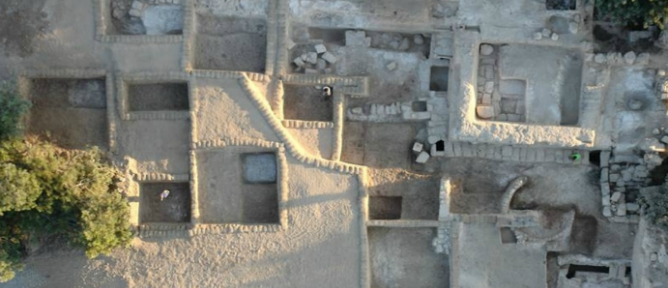
Ramat Rachel is an ongoing archeological dig on the southern outskirts of Jerusalem. A 2,500-year-old garden at the site, probably built by local Judeans, holds many secrets about the past waiting to be uncovered. An elaborate network of irrigation channels made it clear that this was a garden, but what was planted in it has been a big mystery.

New research by Tel Aviv University into ancient pollen found embedded in plaster suggests something very exciting for Jewish and natural historians of the region. Among the imported species of trees and plants determined by pollen analysis to have grown in the garden is the citron tree, known also as the etrog. According to the researchers, this pollen is evidence for the first cultivation of the citron tree, which is not native to Israel.

What makes it interesting for traditional Jews is that the citron, or etrog in Hebrew, is a powerful and mystical symbol used during the Jewish holiday of Succoth. An unusually fragrant citrus fruit, the etrog accompanies a bundle of three other plant species – willow, palm frond and myrtle — used in the weeklong festive fall holiday.

Could it be that the trees imported to Ramat Rachel thousands of years ago by foreigners have made such a lasting impact on the land of Israel and the traditions that the people abide by today?

Researchers at the site of Ramat Rachel –– Prof. Oded Lipschits, Dr. Yuval Gadot and Dafna Langgut –– think so. That’s why they are investing much energy into understanding the pollen deposits located at the ancient garden. The hope is one day to reconstruct it in all its glory.

Langgut is a palynologist, meaning she studies pollen and spores, and she specializes in ancient pollen from the Levant region. She was approached by the curious archeologists. “We didn’t have any clue about what was growing in this garden,” she recalls. “So they asked me to analyze fossil pollen embedded within the ground. I told them that I didn’t think it would be preserved.”

Chasing pollen in the wind?

Then one day she heard a talk about Ramat Rachel and learned that there were inscriptions found at the garden written in plaster. This gave Langgut some fresh ideas on how to find and study what could be ancient pollen trapped in the old plaster.
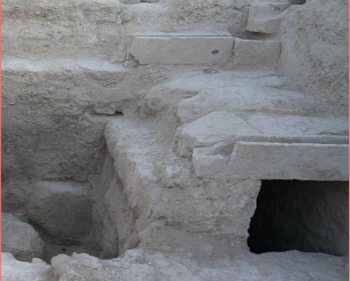
Unique water gutters at the Ramat Rachel garden.


“If one of the layers of plaster was prepared in the spring while the garden was blooming, if we will be lucky we can analyze what was growing in this garden then, because the pollen would be preserved in this plaster,” she says.

After analyzing the layers of plaster in the lab, she was thrilled to find that all the layers of plaster contained fossilized pollen and one layer was particularly intriguing because it contained pollen assemblages of plants not at all typical to the Judean Mountains, she tells ISRAEL21c.

Finding the trace of etrog pollen was the biggest news for the researchers and a highlight of Langgut’s career. “I can tell you that I was astonished to find the citron pollen because I knew it is not a typical plant in the area so I realized it was imported. And I saw other [non-native trees] like the cedar of Lebanon,” she says, noting that from the pollen records and physical archeological evidence it is clear that a lot of work was put into this elaborate garden. It was built to impress.

From the Garden of Eden to the Hanging Gardens of Babylon, the thought of ancient gardens conjures up the stories from legends. What more can the ancient garden of Ramat Rachel reveal?

Reviving an ancient garden

The site was originally uncovered by Tel Aviv University researchers and their partners from Heidelberg University in Germany a few years ago. According to them, this is first full-scale excavation of this type of archaeological site anywhere in the pre-Hellenistic Levant, an interesting fact for archeology buffs.

Lipschits says he thinks that what is revealed at Ramat Rachel can give important archeological information about ancient gardens in the whole Middle East. Only two miles from the Old City of Jerusalem, Ramat Rachel likely has a lot more secrets to tell.

For now, a basic layout of the garden has been constructed. The researchers know that indigenous trees such as figs and grapevines were planted there. New evidence also points to myrtle and citron, the Persian walnut tree, birch trees and the cedar of Lebanon.

The grandiosity of the garden, the researchers speculate, was for the ruling class at the time to flaunt their wealth. Now that information on the garden is pouring in, in the form of ancient pollen, the archeologists will be able to reconstruct ancient times so modern people can enjoy the opulence that once was.

This article was first published on ISRAEL21c – www.israel21c.org

Karin Kloosterman
Karin Kloostermanhttp://www.greenprophet.com
Karin Kloosterman is an award-winning journalist, innovation strategist, and founder of Green Prophet, one of the Middle East’s pioneering sustainability platforms. She has ranked in the Top 10 of Verizon innovation competitions, participated in NASA-linked challenges, and spoken worldwide on climate, food security, and future resilience. With an IoT technology patent, features in Canada’s National Post, and leadership inside teams building next-generation agricultural and planetary systems — including Mars-farming concepts — Karin operates at the intersection of storytelling, science, and systems change. She doesn’t report on the future – she helps design it. Reach out directly to [email protected]

Read More

TRENDING

Are the Great Lakes polluted?

The Great Lakes may look pristine, but a new cleanup report reveals a growing tide of plastic pollution beneath the surface. From cigarette butts and food wrappers to tiny plastic fragments and discarded nicotine pouches, researchers are finding evidence that everyday consumer waste is making its way into North America's largest freshwater ecosystem. New technologies, including Canada's first BeBot beach-cleaning robot, are helping scientists understand how plastic travels through lakes, shorelines and stormwater systems before breaking down into microplastics.

What Makes a Hair Care Review Trustworthy?

Looking for natural hair care reviews?

Can a one trillion-Dollar SpaceX IPO change life on earth?

A SpaceX IPO could become one of the most consequential financial events of the century, creating thousands of millionaires and fueling investment across the New Space economy. From orbital robotics and African space programs to launch infrastructure and satellite networks, the ripple effects may extend far beyond Earth—while forcing investors to reconsider whether generative AI remains the most compelling technology bet of the decade.

Anthropic, Google and Stripe put nearly $1 Billion on carbon removal

A coalition led by Frontier, backed by Stripe, Google, Salesforce and newly joined AI company Anthropic, has committed an additional $915 million to remove carbon dioxide from the atmosphere. The pledge adds to a previous $1 billion commitment and brings Frontier's total buying power to nearly $2 billion.

Bathroom dad Tyler Brodsky shows us why Americans need more common sense

Oklahoma father Tyler Brodsky became the center of a national debate after accompanying his young daughters into a women's restroom during a road trip. For many parents, the story is less about politics and more about a simple question: how do you help your children feel safe when public bathrooms often fail families?

Yerukim Forms a New Green Economy Where the Money is Really Green

The Yerukim members who pick up the recyclables get to keep the monetary reward, the public earns "green" bills that can be used in shops, and business owners get to be associated with environmentalism.

Choosing Riyadh over Dubai? What Investors Should Know

Saudi Arabia is deploying capital at unmatched scale to catalyze tourism and advanced industry while rewiring its power-and-water backbone. The investable frontier is widening—especially in renewables, grid storage, water efficiency/desal retrofits, and hospitality operating platforms. Prudent investors will insist on phased delivery, enforceable KPIs (energy, water, biodiversity), and RHQ/zone compliance—while pricing political-economy and reputational risks alongside growth upside.

Sell your cooking oil for biodiesel money

Want to make money on old french fry oil? Sell it.

Qatar Alternative Energy Summit Pairs Investors And Innovators

Alternative energy investors and innovators can meet n' greet in Doha, Qatar March 16 and 17.

Here’s How To Implement The Four Pillars Of Employee Engagement

If you throw a party for your work team and they are vegans, don't make it a barbecue. Know the sustainability values of your team to boost moral and retain good people.

Locals From Rishon Fight IKEA

Big Box stores are a pretty new concept in Israel, and thank God that not every Israeli city wants them in their backyard. A word from someone who has see the beautiful farmland around her hometown Newmarket, Ontario stripped and converted into vulgar strip malls of big box shops: they have no place in a healthy and sustainable town or city.

The Jewish National Fund Meets An Inconvenient Truth

According to the JNF, it has transformed thousands of acres of barren land into green forests in Israel. They state that each person emits about 23 tons of carbon per year, estimating that each tree planted can absorb one ton of carbon in its lifetime. That's a whole lot of trees you'd need to be planting. Could so many fit in Israel?

How to quiet noise from construction in your office

Streets need to be resurfaced in New York but the humming and grinding noise is unsettling. Noise is environmental pollution. 

Popular Categories