Trees That Don’t Stand a Chance Against Climate Change

The answer to climate woes for pines and and maples may be blowing in the wind.

Sad news so soon after the Jewish New Year for the trees: Many tree species might become extinct due to climate change if no action is taken in time: This is the conclusion of a new research study from the Hebrew University.  According to the research, trees which disperse their seeds by wind, such as pines and maples, will be unable to spread at a pace that can cope with expected climate changes. The research, which focused on the ecological consequences of expected changes in the climate and the environment on tree spread, was conducted by Prof. Ran Nathan and his student, Nir Horvitz.

“Our research indicates that the natural wind-driven spread of many species of trees will increase, but will occur at a significantly lower pace than that which will be required to cope with the changes in surface temperature,” said Prof. Nathan.

“This will raise extinction risk of many tree populations because they will not be able to track the shift in their natural habitats which currently supply them with favorable conditions for establishment and reproduction. As a result, the composition of different tree species in future forests is expected to change and their areas might be reduced, the goods and services that these forests provide for man might be harmed, and wide-ranging steps will have to be taken to ensure seed dispersal in a controlled, directed manner.”

On the basis of earlier work, elevated concentration of carbon dioxide is expected to cause trees to produce many more seeds and to reach maturity earlier than under current conditions, hence speeding up their spread. On the other hand, the weakening of wind speed in certain areas should reduce spread rate of these trees. The balance between these opposing forces remained unknown.

The new research showed that the faster spread predicted for these trees in the future will be much slower than the expected poleward shift of climate (temperature) ranges. Consequently, these tree species might not be able to withstand the climate change.

Published in the journal Ecology Letters, the research provides a mechanistic model developed to predict trends in plant spread. Predictions which were made until now were founded on past trends and did not take into consideration the expected future changes in the key biological and environmental factors that determine plant spread.

In Israel, the research has bearing on various native tree species whose seeds are dispersed by the wind, such as Aleppo pine, Syrian maple and Syrian ash. The model that has been developed will be useful also in predicting the invasive spread of alien tree species, such as the tree of heaven, into Israeli natural habitats. It might be able to be used by planners investigating how to replant after the massive Israel forest fire.

Hand-sown seeds?

Trees with wind-dispersed seeds are mainly common in forests of North America and Eurasia. The current research points to the need to take human action to insure the dispersal of the seeds of these trees within the next half century, in view of the expected climate changes.

“It is important for those responsible for forest management in many parts of the world to understand that nature alone will not do the job,” said Prof. Nathan.

“Human action will be required to ensure in a controlled manner the minimization of unexpected detrimental byproducts, and that those trees which are very important for global ecological processes will not become extinct,” he said.

Read more on trees:

Ancient Palm in Egypt Faces Extinction

Celebrate the Jewish New Year of the Trees

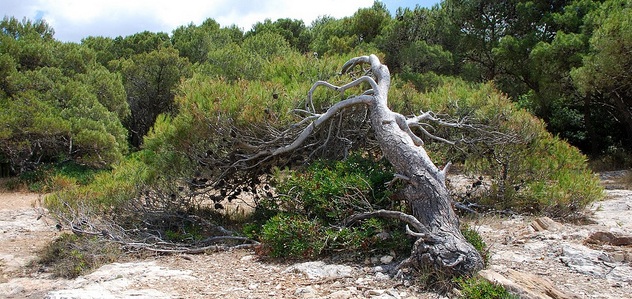
Image via yellow.cat

Karin Kloosterman
Karin Kloostermanhttp://www.greenprophet.com
Karin Kloosterman is an award-winning journalist, innovation strategist, and founder of Green Prophet, one of the Middle East’s pioneering sustainability platforms. She has ranked in the Top 10 of Verizon innovation competitions, participated in NASA-linked challenges, and spoken worldwide on climate, food security, and future resilience. With an IoT technology patent, features in Canada’s National Post, and leadership inside teams building next-generation agricultural and planetary systems — including Mars-farming concepts — Karin operates at the intersection of storytelling, science, and systems change. She doesn’t report on the future – she helps design it. Reach out directly to [email protected]

Read More

2 COMMENTS

TRENDING

Dan Zaslavsky’s energy tower dream is rising again in Iran and China

The Energy Tower idea never made the leap from drawings and engineering studies to full-scale construction. But nearly two decades after most people stopped talking about it, the concept is quietly evolving in two unexpected places: China and Iran. The concept let dreamers dream and doers do - figuring out more pleasing designs and engineering.

A visit to Amirim, Israel’s first all-vegetarian village in the Galilee

Just 15 kilometers from Tzfat there is a moshav that was founded in the late 50s that was ideologically influenced by organic, vegetarian and vegan principles. My hostess at Ohn-Bar, the tzimmer where I stayed, explained that the people of Amirim were among the pioneers of Israel’s strong vegetarian movement.

Billie Eilish’s Mom Takes the Stage at Hollywood Climate Summit — But Does Hollywood Still Care About Climate Change?

Hollywood once promised to help save the planet. Leonardo DiCaprio warned of climate catastrophe from awards stages. Celebrities flew to climate conferences. Studios pledged greener productions. Streaming platforms rushed to commission environmental documentaries. But in 2026, with the aftermath of wildfires, heatwaves and floods becoming routine, a question lingers: Does Hollywood still care about climate change?

Can Scientists Predict Coral Bleaching Before It Happens?

Now researchers at the Woods Hole Oceanographic Institution (WHOI) in the US say they have developed a way to predict coral bleaching five to six months before it occurs, potentially giving reef managers enough time to intervene and save vulnerable corals.

Israeli Hydrogen Startup H2Pro Are Trying to Solve Clean Energy’s Hardest Problem

The company has attracted backing from major investors including Breakthrough Energy Ventures, the climate fund founded by Bill Gates, along with industrial partners such as Sumitomo, ArcelorMittal, and Temasek, a multi-billion dollar company that owns Singapore airlines. H2Pro has raised more than $100 million USD and is moving from pilot projects toward commercial-scale deployments.

Yerukim Forms a New Green Economy Where the Money is Really Green

The Yerukim members who pick up the recyclables get to keep the monetary reward, the public earns "green" bills that can be used in shops, and business owners get to be associated with environmentalism.

Choosing Riyadh over Dubai? What Investors Should Know

Saudi Arabia is deploying capital at unmatched scale to catalyze tourism and advanced industry while rewiring its power-and-water backbone. The investable frontier is widening—especially in renewables, grid storage, water efficiency/desal retrofits, and hospitality operating platforms. Prudent investors will insist on phased delivery, enforceable KPIs (energy, water, biodiversity), and RHQ/zone compliance—while pricing political-economy and reputational risks alongside growth upside.

Sell your cooking oil for biodiesel money

Want to make money on old french fry oil? Sell it.

Qatar Alternative Energy Summit Pairs Investors And Innovators

Alternative energy investors and innovators can meet n' greet in Doha, Qatar March 16 and 17.

Here’s How To Implement The Four Pillars Of Employee Engagement

If you throw a party for your work team and they are vegans, don't make it a barbecue. Know the sustainability values of your team to boost moral and retain good people.

Locals From Rishon Fight IKEA

Big Box stores are a pretty new concept in Israel, and thank God that not every Israeli city wants them in their backyard. A word from someone who has see the beautiful farmland around her hometown Newmarket, Ontario stripped and converted into vulgar strip malls of big box shops: they have no place in a healthy and sustainable town or city.

The Jewish National Fund Meets An Inconvenient Truth

According to the JNF, it has transformed thousands of acres of barren land into green forests in Israel. They state that each person emits about 23 tons of carbon per year, estimating that each tree planted can absorb one ton of carbon in its lifetime. That's a whole lot of trees you'd need to be planting. Could so many fit in Israel?

How to quiet noise from construction in your office

Streets need to be resurfaced in New York but the humming and grinding noise is unsettling. Noise is environmental pollution. 

Popular Categories