

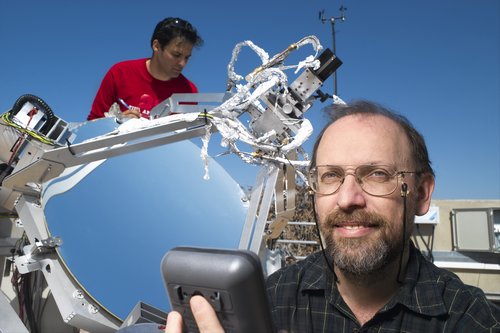
(Prof. Avi Kribus)
Center will explore clean energy production through transformational technologies and unique multidisciplinary approach
Natural resources everywhere are rapidly being depleted. Traditional energy sources, like oil, have become hostages to a weakening world economy. The future, it seems, may depend on renewable energy ― new technology that bridges scientific disciplines and commercial opportunities. Tel Aviv University has just taken a big step toward making renewable energy a daily reality.
At Israel’s international conference on renewable energy last month, Tel Aviv University announced it will create a new “Supercenter” to develop renewable energies. The Supercenter will conduct pioneering research in groundbreaking solar energy applications, wind energy, biofuels and energy storage, taking advantage of the transformational and incremental technologies already being explored by Tel Aviv University researchers.
Opening the conference, “Renewable Energy and Beyond,” hosted at Tel Aviv University, keynote speaker Al Gore discussed the soaring price of oil and the continuing threat of greenhouse gases, warming the planet to what Gore said could be the “point of no return.” Gore came to Tel Aviv University in May to accept a $1 million Dan David Prize for his work on “social responsibility with particular emphasis on the environment.”
The Supercenter is Tel Aviv University’s profound response to the serious environmental issues facing the world.
Robert Goldberg, Chairman of the Board of Governors of Tel Aviv University, announced the creation of the new Supercenter during the conference. Gore attended the conference along with other American energy luminaries, including Harvard University Prof. Michael B. McElroy and deputy assistant secretary Steven Chalk of the U.S . Office of Energy Efficiency and Renewable Energy.
A Multi-Disciplinary Powerhouse
The proposed Supercenter “will be much more than a hatchery for new clean technologies,” said Prof. Abraham Kribus, an engineer and solar energy expert. “It will be a multi-disciplinary powerhouse including all the non-technological aspects, such as economics, law, and public policy, for making clean technology a reality in Israel and beyond.”
In his opening address, TAU President Prof. Zvi Galil called the mass adoption of renewable energy sources a matter of economics. “Our challenge is to develop technologies for higher yield, more cost-efficient production of energy from renewable sources – another green revolution – for a famine of energy rather than food. This is the key contribution that research universities can make,” he said.
“It is here that the research is advanced, that green energy technology companies look to improve their products,” he said, adding that “Tel Aviv University is well positioned to take a major part in this new green revolution. In fact, we already have multidisciplinary teams working on solar and wind energy and on bio-mass for bio-fuels.” Such solutions, Prof. Galil pointed out, could lessen the increasing levels of greenhouse gas emissions now being produced by emerging economies such as China and India.
Linking innovation, academia and policy, Tel Aviv University is expected to be a top center in the world in the renewable energy field.
Small Steps, Then Giant Leaps
Tel Aviv University researchers believe that both incremental and transformational technologies can push the renewable energy market forward. Incremental technologies will produce more efficient solar panels, for example, while transformational technologies will change the very way we use energy – like the hyper-efficient batteries being developed at Tel Aviv University for storing and transporting energy from intermittent sources such as wind and sun.
TAU Prof. Amram Eshel is growing desert plants for use as a renewable fuel, using marginal lands and reclaimed sewage and saline water –– a solution that doesn’t compete with food crops.
Prof. Kribus’ own Solar Energy Laboratory is increasing the efficiency of solar cells by collecting both heat and electricity from solar panels. Borrowing the power of photosynthesis from bacteria, Prof. Chanoch Carmeli is developing “artificial leaves,” a new breed of low-cost solar cells to convert sunlight to electricity (based on the natural process of photosynthesis which occurs in leaves), at Tel Aviv University laboratories.
Power the World Over
Besides being in a strategic geographical location for providing immediate solutions to countries such as China and India, Tel Aviv University’s Supercenter will advance multidisciplinary research to achieve viable renewable energy solutions for the global community. At the Supercenter’s helm will be scientists, engineers, economists, sociologists and legal scholars, including 30 faculty members and dozens of TAU graduate students. Cross-institutional collaborations will all be part of the formula of the planned Supercenter, in order to nurture future generations of environmentalists, scientists, and businesspeople.
Related Supercenter news:
Al Gore at Tel Aviv University



[…] of renewable energies, including wind energy, solar energy, and biofuel applications. This Supercenter is the response of Tel Aviv University and the severe environmental issues the globe is facing when […]
i have do some project in solar energy so can u help to me
[…] says that “going hybrid” is a quicker and cheaper route to cleaner electrical power. Prof. Avi Kribus has developed a technology that combines the conventional fuel used in today’s power plants […]
[…] of renewable energies, including wind energy, solar energy, and biofuel applications. This Supercenter is the response of Tel Aviv University and the severe environmental issues the globe is facing when […]
[…] Green Prophet blogs about the announcement by Tel-Aviv University. The proposed Supercenter “will be much more than […]