
Home Blog Page 126

Recycle your contact lenses

eye asbestos talc

New research presented by the American Chemical Society at their August meeting warned of the damage disposable contact lenses cause after they are flushed down our home plumbing, a daily habit of many of the 45 million Americans who wear them. Plastic is pollution in whatever form it comes in.

Those flimsy, flexible lenses easily pass through sewage treatment plant filters. Sinking to the bottom of rivers and oceans, the impacts to bottom-feeding fish and other marine life is real.

With awareness on plastic straws covered, it’s time to switch to recycling contact lenses. Some opticians in Canada have started accepting used lenses, a compounding problem if you wear dailies. Canada is a leading country in environmental awareness. 

Myopic me has had a long love/hate relationship with contact lenses, made somewhat better when disposables came online. Pop a fresh pair in, see the world in crystal clarity, maybe even play with a new eye color change, and at the end of the day, kick off my shoes and chuck the used lenses. I toss them in the trash, but what happens if you opt to flush them down a toilet?

Colored lenses means you can change your eye color every day. But when happens when you flush these plastic lenses down the drain?

The researchers tested how 11 types of lenses survive in wastewater treatment facilities, finding that they can fragment into tiny shards, becoming part of the increasing amounts of microplastic pollution in our oceans and other waterways. Alarmingly, the shredded plastic sops up high volumes of other pollutants on its trip to the sea, which are ingested by the marine life as part of a dystopian food chain, eventually making its way into human food.

Plastic micro-particles now taint everything from German beer to table salt. That’s an argument for buying pink Himalayan salt which is farmed in Pakistan from the mountains before humans started polluting the sea.

In theory, these sewage-stewed contact lens slivers could hurt coral too. According to The Guardian, a recent study found that microorganisms borne by microplastics that then snag on a single coral can sicken entire reefs an a gangrene-like sweep.

Is the concern overblown? According to the researchers’ anonymous study, 19% of all contact lens wearers flush their lenses down the toilet or dumped them down the sink drain. An estimated 10 metric tons of lenses end up in wastewater each year, and that’s just calculating the American contribution.

An article in Quartz advises that US consumers can participate in a used contacts recycling program offered by lensmaker Bausch + Lomb, check their website for details.  But the simplest solution? Put them in the trash, not down the drain.

New research finds microplastics may be released in the eye

Hydroquinine, an organic compound found in the bark of some trees, is known to have bacterial killing activity against Pseudomonas aeruginosa and several other clinically important germs, including Staphylococcus aureus, Escherichia coli, and Klebsiella pneumoniae.
Contacts may be polluting your eyes with microplastics.

In a 2023 study from the State Key Laboratory of Pollution Control and Resource Reuse, School of Environment, Nanjing University China, researchers found that thousands of bits of microplastics may be released in your eye during the normal course of wearing them. They report in Environmental Science & Technology:

“The widespread use of plastic products leads to the ubiquity of microplastics in daily life, while the release of microplastics from long-used contact lenses has not been reported due to the limitations of conventional detection methods.

“Here, we established a new and rapid method to capture and count microplastics by using a high-content screening system. This method can simultaneously measure the diameter, area, and shape of each plastic particle, and the reliability and applicability of this method were verified with commercial microplastics. It is estimated that 90,698 particles of microplastics could be released from a pair of contact lenses during a year of wearing.

“Our study reveals an undiscovered pathway of microplastic direct exposure to humans, highlighting the urgent need to assess the potential health risks caused by eye exposure to microplastics.”

The solution? Daily eye exercises to correct vision naturally or going back to glasses or the glass-based contact lenses that people wore in the past.

Top 8 Natural Remedies to Fight Nighttime Anxiety

0

natural anxiety at night

After Covid more and more people are noticing nighttime panic-attacks, including this author. Green Prophet looks at some natural solutions to help you cope. 

Having a panic attack is an extremely unpleasant experience for anyone, but, this can be even more frightening for a person who experiences it at nighttime. Nighttime anxiety can manifest itself in several different ways, some including the occurrence of nocturnal panic attacks which can over time begin to disrupt your normal sleep patterns. As a result, one feels tired and sleepy throughout the day.

Causes of Nighttime Anxiety

Expert researchers have done studies and have discovered factors that can contribute to nighttime anxiety, such as:

  • Genetics. Which means a history of parental anxiety or family history of this condition.
  • Tension and stress due to life circumstances.
  • Previous life events that have caused trauma.
  • A mental or emotional disorder such as depression.

Natural Ways of Treating the Condition

Any person that has this condition can cure nocturnal panic attacks in natural ways. Let’s discuss how this is done.

Stay Active

Exercising regularly not only has a positive effect on your physical health – but also helps you mentally.

Doing cardiovascular exercises and lifting weights can help a lot to boost anti-anxiety neurochemicals such as:

  • Serotonin
  • Gamma-aminobutyric acid
  • Brain-derived neurotrophic factor

Stop Drinking Alcohol

Researchers have shown that there exists a clear connection between anxiety and alcohol drinking.

Drinking in excess and consistently can start to interfere with neurotransmitters. This results in an imbalance – leading to anxiety.

Alcohol also interferes with the body’s natural ability to put itself to sleep. This way, heavy alcohol drinking can become a cause of nighttime anxiety. It’s important to moderate the usage of alcohol.

Quit Smoking

man smoking handsome

Smokers often say that they smoke when they are under stress. But in reality, the state of anxiety only gets worse as a person smokes cigarettes.

Scientists have shown that the patients with nighttime anxiety included many of those who started smoking at an early age. The chemicals, including nicotine that are used in the making of cigarettes, are responsible for altering brain functions and causing anxiety.

Slow Down and Take Deep Breaths

Whenever in a state of stress, a person’s breath feels heavy, and their heartbeat increases. It’s therefore important to do deep breathing exercises. To do this, take a moment to slow down and really focus on the in and out of your breathing.

man in yoga pose, CBD anxiety

Aromatherapy

Aromatherapy is a way of healing that has been used by humans for centuries.

The goal is to heal the mind, body, and spirit. 

It’s important to note that for aromatherapy, natural extracts of certain plants are used. These extracts are infused in essential oil to use for aromatherapy.

A lot of patients who have nighttime anxiety have seen improvements from aromatherapy.

The ways to do aromatherapy broadly are:

  • Inhaling directly
  • Add the oil to a warm bath
  • Add the extract to a diffuser

Drinking Chamomile Tea

Another natural remedy to cure nocturnal panic attacks at night is to drink chamomile tea. It’s an effective solution for promoting healthy sleep.

In a scientific study conducted on rats, extracts of chamomile helped rats to go to sleep and improve their quality of sleep.

Maintain Healthy Diet

Diet matters a lot when it comes to setting the mental, physical and emotional health right.

A bad diet causes a lot of damage to health and it directly contributes to stress and anxiety.

Today, more than 70% of the foods we see in grocery stores are processed. Processed foods have artificial flavors, chemicals, and preservatives in them that have a direct effect on mood.

Processed foods result in:

  • Dehydration
  • Low blood sugar levels
  • Adverse chemical effects on health
  • Loss of temperament
  • Mood swings 
  • High levels of anxiety

If you notice that whenever you eat processed foods, your anxiety is increased – then know that your diet is becoming a problem.

What you need to do instead is:

  • Keep yourself well-hydrated by drinking 7-8 glasses of water.
  • Avoid all processed foods whenever possible.
  • Eat a good diet that is rich in nutrients.

Incorporate Meditation

Meditation brings you to a state of being present in the current moment. By meditating regularly, you make your mind and body calm and content.

This way, most of the negative thoughts that cause stress and anxiety can be made to go away.

Mindfulness and meditation are known to be powerful methods of coping with nighttime anxiety disorder.

Hemp solar house highlights vernacular building potential in Morocco

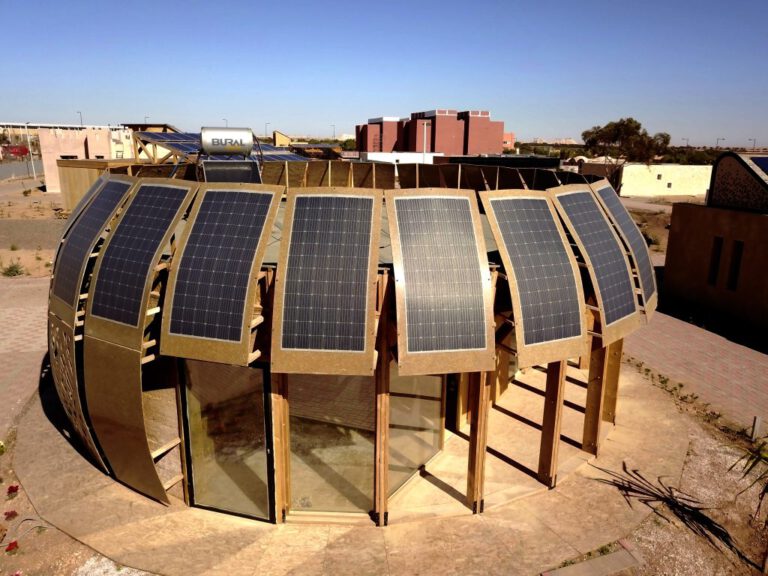
The SUNIMPLANT team developed a concept for the preservation of the environment and cultural heritage in the rural region of the High Rif in north of Morocco. The Sunimplant team developed a concept for the preservation of the environment and cultural heritage in the rural region of the High Rif in north of Morocco.

A team from a Moroccan cooperative and international experts from the Solar Decathlon have highlighted the beauty of vernacular architecture and building in Morocco by creating a hemp house outfitted with solar panels. The hemp and solar panelled house called Sunimplant, is an off-grid house made as a sustainable, relatable demo home for Moroccan people. 

The Sunimplant team developed a concept for the preservation of the environment and cultural heritage in the rural region of the High Rif in north of Morocco. Hemp and solar house vernacular, Rif area Morocco The Sunimplant team developed a concept for the preservation of the environment and cultural heritage in the rural region of the High Rif in north of Morocco. Hemp and solar house vernacular, Rif area Morocco The Sunimplant team developed a concept for the preservation of the environment and cultural heritage in the rural region of the High Rif in north of Morocco. Hemp and solar house vernacular, Rif area Morocco The Sunimplant team developed a concept for the preservation of the environment and cultural heritage in the rural region of the High Rif in north of Morocco. Hemp and solar house vernacular, Rif area Morocco The Sunimplant team developed a concept for the preservation of the environment and cultural heritage in the rural region of the High Rif in north of Morocco. Hemp and solar house vernacular, Rif area Morocco The Sunimplant team developed a concept for the preservation of the environment and cultural heritage in the rural region of the High Rif in north of Morocco. Hemp and solar house vernacular, Rif area Morocco The Sunimplant team developed a concept for the preservation of the environment and cultural heritage in the rural region of the High Rif in north of Morocco. Hemp and solar house vernacular, Rif area Morocco Sun
Student creators built it as part of Solar Decathlon organized in part by the IRESEN Institute for Research in Solar Energy and New Energies in Morocco,  Mohammed VI Polytechnic University, the Moroccan Ministry of Energy, Mines, Water and Environment and the United States Department of Energy (DOE). 

This biannual international competition we’ve covered here challenges teams to design and construct buildings powered by solar energy. The last edition took place in 2020 and this gorgeous building located in Ben Guerir, Morocco is built from locally sourced hemp, plant bio-resins and non-synthetic materials found in the region. 

It was planned and built by Adrar Nouh, a Moroccan cooperative created in 2017 to develop biotechnology for socio-economic development in the Central Rif region of Morocco. Members from Adrar Nouh worked with a team of Moroccan architectural students and international partners in the design of a prototype hemp house of about 90 square meters. The house was first revealed in 2019. 

Blueprints from the hemp solar house are below:

hemp solar house, blueprints

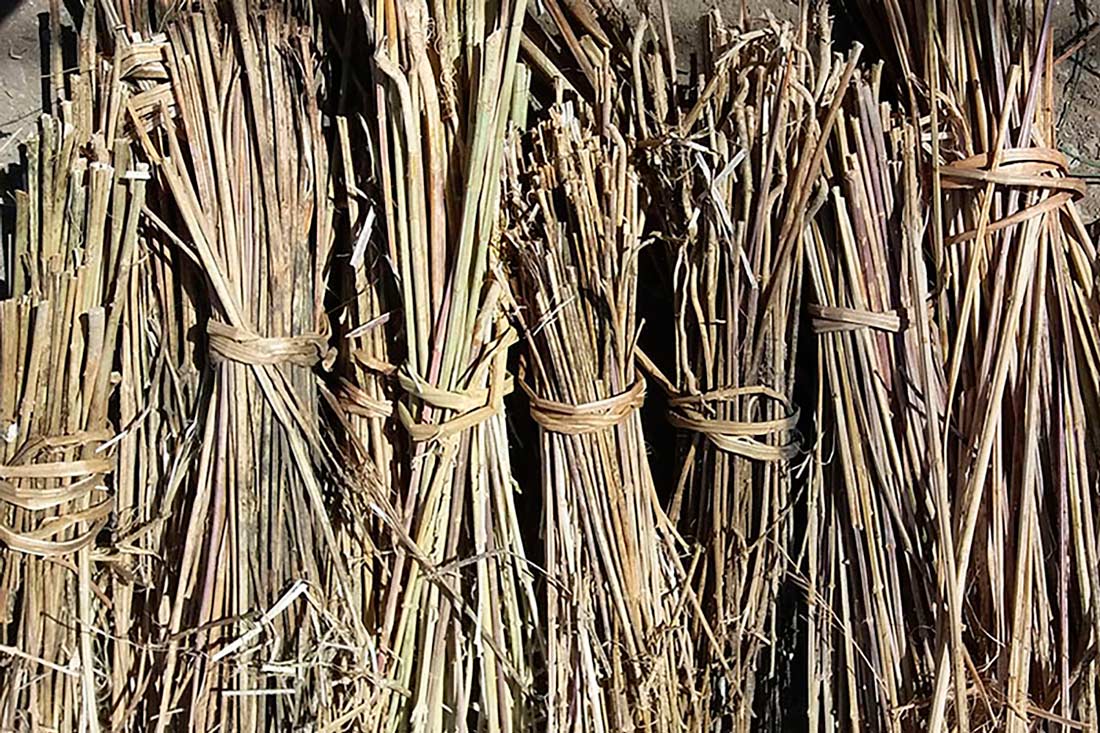
Sunimplant uses local and ancestral hemp from the Rif region, transforming it into new aggregates via a process developed by one of Adrar Nouh’s co-founders Monika Brümmer while doing a doctoral thesis at the University of Granada.

Brümmer also owns the Granada-based Cannabric, a load-bearing hemp-clay blocks and bricks company. 

Natural earth buildings cost a fraction of those built by modern construction companies that use non-renewable resources such as cement and steel. They are passively cool in the summer and tend to stay warm in the winter. They can be built by the hands of the owners of the property, and often don’t require extensive technological know-how. 

What is vernacular architecture?

Vernacular building is making a comeback in the Middle East thanks to Caltech Earth’s Nader Khalili and Hasan Fathy of Egypt. Both were educated and from well-off families but admired the vernacular of their regions, Iran and Egypt respectively, and wanted a sensible, natural approach to building homes for the people. 

Vernacular architecture can be defined as a type of local or regional construction, using traditional materials and resources from the area where the building is located.

Consequently, this architecture is closely related to its context and is aware of the specific geographic features and cultural aspects of its surroundings, being strongly influenced by them. For this reason, they are unique to different places in the world, becoming even a means of reaffirming an identity. 

vernacular architecture, sustainable architecture, green building, clay building, Shibam, UNESCO World Heritage Site, vernacular architecture, sustainable agriculture, sustainable development,
Yemen’s Manhattan of the desert, vernacular architecture from the Middle East created from mud

Builders can be peasants and simple craftspeople. Vernacular architecture can be done outside any academic tradition, and without professional guidance.


Smart Cemetery: Graves with Technology

0
burial pods part of estate planning
Burial pods are a modern but ecological way to bury your loved one. Now, IoT and technology is catching up with burials? Is this technology we want and need?


As technology has revolutionized every field of life, it also brings revolution in the cemetery and the way people remember their loved deceased. Advancement in technology as well as ecological principles brings changes in the traditional concepts of graves. The technology is now used to preserve the record of deceased and his/her life. The smart cemetery provides the facility to people to remain in touch with their loved ones who left them for good by various technological methods. Smart cemetery is getting traction across the world and is now burgeoning business to provide modern facilities at a grave.

Preserving record of a grave

Over a period of time, the grave often vanishes owing to weathering effect and erosion. The information of deceased disappears over a period of time, and people are unable to preserve the information of the deceased. The smart cemetery provides a solution to this by providing mechanism to save a grave. In a smart cemetery, QR code is used to save the information about the grave. A lawyer can use this information to prove his case in the court in case the criminal elements are involved. The Criminal justice system is indispensable for the justice in a society. Just as the cemetery has adopted the modern methods, the educational field has provided a criminal justice degree online. Students can start by scanning a QR code to get their educational data and assistance from their instructors while learning criminal justice system online.

Services to save the life of deceased

The memory of deceased often diluted in the mind of people as the time goes by. Some people might want to be remembered by having an eco funeral. The Smart Cemetery assists in saving the life of the deceased by using modern technological methods. The QR code is used to provide information about the life of deceased. The smart cemetery maintains a website which directs the user to the life of deceased, it includes photos, videos, his/her accomplishments, and other events associated with the life of deceased. This is the revolutionary steps in history, as it provides details about the deceased after he passes away. 

Reminder to pay visits to your loved one

The smart cemetery has the service of reminding people about their loved deceased, if they fail to pay a visit. This keeps the deceased alive in the memory of living people. This smart cemetery service is able to keep people recalling their loved ones frequently. This system is helpful for the bereaved to recall the deceased. Or maybe your loved one will be remembered in a natural setting, starting in a burial pod

Watching graves online

In this time of harsh struggles because of Covid. People find difficult to visit graves physically. The smart cemetery provides videos of the graves streamed live using modern technology. The camera footage is provided to the bereaved live on their cell phones and televisions. The bereaved are able to watch the deceased’s grave, to some degree, by sitting at home. 

Smart Cemetery and IoT

The Internet of Things has changed the way cemeteries are managed. IoT is used in a cemetery to provide information about every grave. The sensors are used in graves that communicate with other graves and provides information about the cemetery and details of the cemetery. Management becomes more easy and effective with the use of IoT.

VR and Smart Cemetery

Virtual reality is emerging technology across the world, this has changed the way people interact and see things. VR heads are used by visitor to see the 3 Dimensional videos of their loved ones. The bereaved can watch their loved deceased and refresh the memories of his/her. VR is a corner stone in developing the smart cemetery, and improves the relationship between the deceased and the living.

Record of Cause of Death and Criminal Justice

The Smart Cemetery provides information about the cause of death, time and date of death. This assists in improving criminal justice system, the details of victims of violence are shared by the concerned authority whenever they are needed. 

Technology is playing an ever-growing part in how we bury and remember our loved ones today. In addition to choosing Smart Cemeteries, families hire professional funeral live streaming services to broadcast the funeral to family and friends abroad. This has become particularly popular during the Covid pandemic and seems to be a common way to include mourners overseas.

Conclusion

The smart cemetery has changed the concepts of traditional graves. Graves are now equipped with technology to provide information about the dead person, and present the history of the deceased to the visitors. IoT is being used in smart cemetery to effectively manage graves and VR technology is used to provide the bereaved 3D views of the deceased. 


Money and energy-saving laundry tips

0
eco laundry machine wood shelves
Make an impact in the laundry room

You use paper straws, say no to plastic bags and use reusable food containers for lunch. Small changes add up. Here are some tips to doing your laundry sustainably. These tips are good for the planet and for saving money too.

Don’t wash it it if it’s not dirty. Use smocks and aprons to protect clothes. Find vintage aprons at second hand shops or made by seniors for sale at local libraries. 

havie upcycled apron
Havie creates upcycled aprons from old army tents

Always fill up the machine. Fill your front loader to the top, turning the drum to make more room. With a regular cycle (lower numbers) the machine can really be stuffed, as long as closing it doesn’t put stress on the door. Be gentle with the door as the hinges are a weak point, as are the knobs.

Have enough clothes. If you are always doing a load because you run out of socks, buy more socks (or work out a system to keep them organized). You should have enough clothes to have something to wear when you are washing, plus something extra in case of emergency.

Hand wash the things you love. They will last longer. Hang them to dry. 

Don’t have too many clothes. They tend to fall on the floor and require rewashing, and it’s harder to find what you need. So balance is key.

Have clothes you love. Wear them several times before you launder them.

Give family members or settle the idea with roommates and their partners, that each person has their own distinctive towels. They are more likely to reuse them.

beach towel

When visiting friends offer to bring your own sheets, or a sleeping bag. Take the sheets you just took off the bed for changing. This takes stress off your friends and allows you to reuse the sheets when you get home. Same goes for towels although consider if you will need to travel with it wet.

Grey water from the bath or from the air conditioner can be reused for laundry. Keep a couple of buckets in the shower and pour the used water into the machine through the opening for detergent while the water is running. I’ve noticed that my machine adds water to the first cycle in intervals. I add water until the water stops running, and try to be around for the second addition of water as well.

Use a minimum of detergent. If your laundry smells like detergent after washing, you’re probably using too much. The extra soap also clogs up your machine. My go-to favorite is Ecover and I add about 1/3 less than what they suggest and the laundry turns out just fine. I don’t use a softener, because it’s not necessary.

Overly perfumed soap and laundry softener can disrupt your endocrine system. Avoid artificial smells. My dad used to scratch his arms after my mom laundered his clothes with regular commercial detergent. Now she uses ECOS now, an ecological brand found in Walmart and hardware stores, and the bulk sized jug goes a long way. The non-eco detergents can have harmful biological compounds in them that can irritate your skin. 

Seventh Generation offers products you can find in regular shops too. 

Hang laundry to dry.

Have more tips or products you want to share for sustainable laundering?

Greening the pride parade, Tel Aviv

0
 
green pride poster
Pride parades have come a long way since the 70s in New York. Israeli activists look to see how the largest pride parade in the Middle East can do better, environmentally speaking. 

Tel Avir, an Israeli environmental non-profit organization serving the the country’s English-speaking community, hosted its first event of the year at the end of February.

The virtual event, titled Greening Pride – Let’s keep the green in the rainbow, focused on making LGBT pride parades and events more sustainable. For over 50 years these events have been a pillar in the LGBTQIA+ community promoting acceptance, achievements, legal rights, and pride.

Today such gatherings attract hundreds of thousands around the world. As the climate crisis worsens, organizers and attendees are becoming more concerned about environmental impacts, including carbon footprints, transportation, and waste.  

The event was moderated by József Kádár, a Ph.D. candidate at Haifa Center for German and European Studies, Haifa University, and researcher at the Arava Institute for Environmental Studies, and includes three speakers from around the world.

Dr. Rachel Dodds, a professor of tourism at Ryerson University in Toronto, Canada, brought her expertise in working with numerous North American LGBTQ+ pride parade organizers, music festivals, and other large public events.

George Rody, the founder of OUT for Sustainability, spoke about their work as a non-profit organization that provides a platform for co-creating climate resilience and environmental justice by and for LGBTQIA+ communities through advocacy, training, fundraising, and relationship-building.

green pride parade
Holding a discussion on how to green pride parades

Their initiative, Greener Pride, engages the LGBTQ+ community to advance more sustainable practices in events, businesses, and other community-building centers. Ruby Magen, the Tel Aviv LGBTQ+ Community Center director, spoke on his experiences working with the city to plan the Pride parade.

Ways to make pride parades more sustainable

The lively discussion centered on making Tel Aviv Pride more sustainable. Tel Aviv Pride is the biggest pride parade in the Middle East and in Asia, with over 250,000 people attending in 2020. The week-long celebration takes place in June each year and includes a parade, numerous parties, concerts, and cultural events mostly located on and near the beach.

While the city does an effective post event cleanup, the amount of garbage and plastic waste is relatively high from the hundreds of thousands in attendance. 

green pride parade

This Zoom event addressed the ways in which waste can be reduced, such as providing reusable cups and increased water stations, encouraging better recycling through manned garbage cans, prohibiting free single-use plastic gifts, and discouraging single-use plastics among participants.

Other potential initiatives include soliciting corporate sponsors for recycling centers located on the parade’s route, advertisements with pro-environmental and sustainable messaging, increasing public transportation and discouraging driving during the events, and including environmental groups in the planning stages of the parade. 

There are several initiatives the Municipality of Tel Aviv must undertake to make the LGBT pride parade more sustainable and meet the needs of the LGBTQ+ community in the city. The parade is a celebration of positivity, diversity, and inclusion which can be expanded to include environmentalism, as well.

Most importantly, the municipality must include sustainability experts and advocates in the planning of the parade and other pride celebrations with a clear commitment towards reducing the environmental impact. An audit must be run to measure the amount of waste and carbon emissions produced at the parade. Then a clear plan to reduce these externalities must be published and executed.

Related: Tahini boycotted in Israel for being “gay”

Next, the parade must ban the distribution of single-use plastic bottles and instead provide a deposit-based system in which people can rent reusable water bottles for the day with filling stations located throughout the parade route. This empowers citizens to feel like they are part of the solution instead part of the problem.

Lastly, recycling and trash centers must be staffed to direct parade goers to the appropriate bin to toss their litter, recyclables, and compost to prevent co-mingling. This preemptive sorting reduces the number of recyclables that end up in landfills. This plan must be coupled with a community compost system for the entirety of the parade festivities that will be shared with local farms.

In the upcoming years more sustainable initiatives can be enacted; a greener pride is not a destination but a movement that is always working on ways to improve. It’s important to recognize that the path to sustainability is challenging but immediate action is required to get closer to our goals.

The LGBTQ+ community is at more risk of environmental challenges because they face social, economic, and health inequities just like many other marginalized populations. Tel Avir is proud to support the struggle for equal human rights and the celebration of love in all its colors.

This year, Tel Avir plans to march in the parade and assist with recycling efforts. The LGBTQIA+ community has consistently been strong supporters of environmentalism and sustainability. 

Contributed by Ezra Messinger, Ben Snyder, Jozsef Kadar. For more information on green initiatives at festivals, see Rachel Dodds

4 Reasons Environmentalists Care About Forex Trading

0
currency from around the world, canada, america, europe
The foreign exchange market is a global decentralized or over-the-counter market for the trading of currencies. The idea is being revived among amateurs after Bitcoin and NFTs started to nosedive in 2022. But can trading currencies, often considered as dubious investments, benefit the planet?

How is forex (FX) trading connected to the push for a greener world? There are plenty of obvious and not so apparent connections between the two seemingly disparate topics. However, it’s important to realize that the recent COVID lockdowns led to millions of new at-home trading enthusiasts, primarily in forex and blockchain markets. Why is that such a big deal? Because even part-time traders tend to use fewer resources like gasoline, electricity, and natural gas. 

But the big plus for green devotees is not just about a jump in the number of people working from home. It’s also about the kind of financial activity they’re engaged in. Remember that FX is not crypto mining, which was, just a few years ago, the hottest at-home employment activity for the financially minded. There are numerous reasons to be optimistic about the recent surge in forex trading. In all, there are at least four major reasons that ecology aficionados should not only follow but also take part in the international currency markets.

The Greenback is Rising

The dollar has had a very good year, rising against most of the world’s major currencies and holding its own amid inflation, massive shortages, wars, supply chain problems, and a potential recession at home. The benchmark financial index that tracks the dollar’s strength, DXY, tells the story of a choppy performance over the past five years but with a recent resurgence in 2022. Why do the green minded care about the fate of the greenback? Because a stronger dollar and an impending recession, while not so beloved by economists, are very good news for the health of the planet. 

For several years, people from all walks of life have been warning of a potential economic reset or correction. The stock markets were the first signal just weeks ago. Then the Federal Reserve Bank raised rates three times in a row at successive meetings, which appeared to strike a blow against inflation and dampen growth. Perhaps these changes, a bearish stock market, and slow growth are a sign that environmentally friendly events are finally taking hold. Recessions aren’t all bad. Often, they represent a needed slowdown and typically bring much lower levels of energy consumption via weak demand for petroleum. An added bonus for green devotees: all-time highs at the pump also lead to decreased fuel use and cleaner air.

Demo Accounts Show Anyone How to Trade

Learning how to trade FX is not rocket science, fortunately. In a global economy where everyone seems to be looking for a side job, anyone can join up with a reputable online broker, use a metatrader 5 demo account to learn all the basics, and begin making forex trades with international currency. If you are looking at ditching the long commute and are looking for a job where you can slowly transition from your current career, FX trading can be the ideal, low-carbon footprint choice. No more huge gasoline bills, traffic jams, or office politics. Many people find that a week or two on a demo simulator is all it takes to test the waters as an international currency trader.

FX is Not Proof of Work Crypto

A few years ago, one of the fastest growing home-based financial careers was related to the cryptocurrency industry. It was called mining, and bitcoin (BTC) was the kind of the miners’ community. The problem with what is called proof of work mining, or the creation of bitcoin, is that it uses vast amounts of electricity, up to 1,000 times as much as a standard personal computer. Luckily, the newer proof of stake method does not gobble as much electricity but is still a long way from being as environmentally responsible as buying and selling foreign exchange currencies. If you’re considering working for yourself as a financial trader, FX is a far wiser and greener choice than being a bitcoin miner.

Currency Markets are 100 Percent Digital

FX markets and all related trading activity are fully digitized. What’s more, no tangible assets ever trade hands, as is the case with commodities and some futures exchanges. Thus, forex represents one of the very few careers that use electricity alone, and even then, in very small amounts. Some of the newer low-consumption computers on the retail market use about one-fifth the energy that standard PCs used a decade ago. Financial trading as a job is an energy miser. Few other professions, part-time or full, create less of a carbon footprint. One of the more subtle advantages of the digitized financial sector, particularly FX, is that it can accommodate an almost limitless number of participants. There aren’t many job niches that can make that claim while simultaneously being among the lowest consumers of energy.

After you swipe right, read this

eco friendly dates
A loving relationship can be predicted by the first date. You want sustainable love and a sustainable planet? Read on. 

Looking for a sustainable romantic relationship? One that will last till the end of days?  Then you’ll know how important that first date can be.  When falling in love, what makes us attracted to some people, and not to others?

The answer will be surprising to most of us – but it wasn’t to the team of researchers led by Shir Atzil of the Department of Psychology at the Hebrew University in Jerusalem.

“Connecting with a partner depends on how well we can synchronize our bodies. We specialize in studying parent-infant bonding – and we had already seen the same thing there,” she explained.  

The researchers looked at how a heterosexual couple’s physiology and behavior adapt to each other during that first encounter. 

The study was based on a speed-date experiment consisting of forty-six dates. Each date lasted 5 minutes during which the levels of physiological regulation of each partner were recorded with a band worn on the wrist. Behavioral movements, such as nodding, moving an arm, shifting a leg were also recorded in each partner during the date.

After the encounter, the couple assessed the romantic interest and sexual attraction they felt for each other.  The study clearly showed that when couples synchronize their physiology with one another and adapt their behavioral movements to their partner during the date, they are romantically attracted to one another.  This research was recently published in Scientific Reports.

Intriguingly, the study also showed that the degree of synchrony affected men and women differently. 

Although for both genders synchrony predicted attraction, women were more sexually attracted to men who showed a high level of synchrony – “super-synchronizers”; these men were highly desirable to female partners.

“Our research, ” said Atzil, “demonstrates that behavioral and physiological synchrony can be a useful mechanism to attract a romantic partner. However, we still don’t know whether synchrony raises attraction or does the feeling of attraction generate the motivation to synchronize?”  An area of research that Atzil is planning to investigate.


Solar panels driving opium trade in Afghanistan

0

opium solar panels Afghanistan

The Taliban walks between hypocrisy and holiness while trying to figure out how to profit from poppies and not damage its local economy. Image via the NY Times. 

Off-grid solar panels that provide electricity to water pumps in lost and forlorn areas in Afghanistan have led to an opium bounty. The solar pumps that are stand alone and not connected to an official electricity supply have allowed Afghans to dig deeper. The idea started around 2014 and bumper crops have appeared since.

In response the Taliban which both profits and denounces opium when it suits them, have started dismantling solar arrays so opium crops dry out

Still, more and more Afghans are investing several hundred dollars a year for seeds and equipment hoping to make a ballpark $5000 profit. According to the United Nations Office on Drugs and Crime, Afghanistan produced 83 percent of the world’s opium from 2015 to 2020. In short, if you use heroin, you fund terror.

The solar-powered electric pumps also allow farmers to grow all manners of crops such as wheat, pomegranates and garden plots in a critical time when dozens of millions of Afghans face extreme food insecurity.

oppy fields from space see the solar panels
Poppy fields from above in Afghanistan. See the solar panels?

While the various Afghan governments over the years have pledged to stamp out opium production and drug trafficking they are unable to forgo the billions of dollars of profits. Opium feeds and fuels the Taliban

“We’ve stood by on the sidelines and, unfortunately, allowed the Taliban to become probably the largest funded non-designated terrorist organization on the globe,” said a US official with knowledge of Afghanistan’s drug trade.

men working with poppies for opium
Men working in the poppy fields, New York Times

“The US and international partners have continued to pull out and not addressed poppy cultivation,” the official said on condition of anonymity. “What you’re going to find is that it has exploded.”

Now after 20 years and the Taliban back in power they announced April 3 that poppy cultivation is outlawed and violators will be punished under Shariah law.

The Taliban had enforced an effective ban on poppy cultivation in 2001, just before a US-led international military intervention toppled the regime. From 2002 to 2021, the US government spent almost $9 billion on counternarcotics as it fought Taliban insurgents in Afghanistan.

Taliban bans opium production for their benefit

The opium business earned Afghanistan about $1.8 billion to $2.7 billion last year, according to the United Nations with sales accounting for up to 14% of its GDP.   

According to a European Union-funded research project by David Mansfield opium farmers now rely on at least 67,000 solar powered water reservoirs. He has studied illegal economies and rural livelihoods in Afghanistan for the last two decades.

“It’s too bad for Afghans because poppy is the wealth of the Afghan people,” Shah Agha, 35, a poppy farmer from the Zari District of Kandahar, told the NY Times in a recent article.

“I think they banned it for their own benefit because most of the smugglers and Taliban commanders have tons of opium, and they might want to increase the prices,” Mr. Agha added.

Vice reported from the field about a month ago and noticed that despite the ban, it was harvest as usual.

With pictures in the Vice article of kids playing with bags of opium in the fields it’s easy to imagine the toll of addiction in Afghanistan in all ages abd walks of life. And it’s not only there.:Iran also faces drug addiction from illicit drugs such as heroin

This artificial e-skin feels pain in real time

artificial skin

An electronic skin which can learn from feeling ‘pain’ could help create a new generation of smart robots with human-like sensitivity.

The Scots have always been known as great inventors. I know this factoid because my Scottish mother would never let me forget: There is James Watt’s steam engine, the bicycle, Alexander Graham Bell’s invention of the first practical telephone, and John Logie Baird’s TV. Recently they have been pioneering the sustainable too by restoring wildlands in the United Kingdom with Rewilding. Now, University of Glasgow scientists invent an artificial electronic skin to feel pain.

The advance may help science make artificial limbs more life-like. It could be part of a new generation of smart robots with human-like sensitivity. 

“What we’ve been able to create through this process is an electronic skin capable of distributed learning at the hardware level,” says lead professor Ravinder Dahiya, “which doesn’t need to send messages back and forth to a central processor before taking action. Instead, it greatly accelerates the process of responding to touch by cutting down the amount of computation required.

“We believe that this is a real step forward in our work towards creating large-scale neuromorphic printed electronic skin capable of responding appropriately to stimuli.”

The artificial skin is based on synaptic transistors, which mimics the brain’s neural pathways in order to learn. A robot hand which uses the smart skin shows a remarkable ability to learn to react to external stimuli. 

In a new paper published in the journal Science Robotics, the researchers describe how they built their prototype computational electronic-skin (e-skin), and how it improves on the current state of the art in touch-sensitive robotics.

Scientists have been working for decades to build artificial skin with touch sensitivity. One widely-explored method is spreading an array of contact or pressure sensors across the electronic skin’s surface to allow it detect when it comes into contact with an object.

Data from the sensors is then sent to a computer to be processed and interpreted. The sensors typically produce a large volume of data which can take time to be properly processed and responded to, introducing delays which could reduce the skin’s potential effectiveness in real-world tasks. 

The Glasgow team’s new form of electronic skin draws inspiration from how the human peripheral nervous system interprets signals from skin in order to eliminate latency and power consumption.

As soon as human skin receives an input, the peripheral nervous system begins processing it at the point of contact, reducing it to only the vital information before it is sent to the brain. That reduction of sensory data allows efficient use of communication channels needed to send the data to the brain, which then responds almost immediately for the body to react appropriately. 

To build an electronic skin capable of a computationally efficient, synapse-like response, the researchers printed a grid of 168 synaptic transistors made from zinc-oxide nanowires directly onto the surface of a flexible plastic surface. Then, they connected the synaptic transistor with the skin sensor present over the palm of a fully-articulated, human-shaped robot hand. 

When the sensor is touched, it registers a change in its electrical resistance – a small change corresponds to a light touch, and harder touch creates a larger change in resistance. This input is designed to mimic the way sensory neurons work in the human body.

In earlier generations of electronic skin, that input data would be sent to a computer to be processed. Instead, a circuit built into the skin acts as an artificial synapse, reducing the input down into a simple spike of voltage whose frequency varies according to the level of pressure applied to the skin, speeding up the process of reaction. 

Giving artificial limbs a human touch

humanoid e-skin that feels pain, university of glasgow

The new advance could make artificial limbs more human-like or your robotic girlfriend less complacent

The team used the varying output of that voltage spike to teach the skin appropriate responses to simulated pain, which would trigger the robot hand to react. By setting a threshold of input voltage to cause a reaction, the team could make the robot hand recoil from a sharp jab in the centre of its palm.

In other words, it learned to move away from a source of simulated discomfort through a process of onboard information processing that mimics how the human nervous system works. 

The development of the electronic skin is the latest breakthrough in flexible, stretchable printed surfaces from the University of Glasgow’s Bendable Electronics and Sensing Technologies (BEST) Group, led by Professor Ravinder Dahiya:

“We all learn early on in our lives to respond appropriately to unexpected stimuli like pain in order to prevent us from hurting ourselves again. Of course, the development of this new form of electronic skin didn’t really involve inflicting pain as we know it – it’s simply a shorthand way to explain the process of learning from external stimulus.”

Fengyuan Liu, a co-author of the paper, added: “In the future, this research could be the basis for a more advanced electronic skin which enables robots capable of exploring and interacting with the world in new ways, or building prosthetic limbs which are capable of near-human levels of touch sensitivity.”

Love this kind of science? Read about electronic skin that heal itself


Boosting THC in cannabis plant using a virus

cannabis greenhouse hydroponics
A high-tech cannabis greenhouse using hydroponics can control the environment to optimise cannabis strains for medical marijuana

Cannabis was always researched in Israel. It started in the 60s when chemist Raphael Mechoulam working at the Weizmann Institute was given a few pounds of hashish from the police to check his curiosity about active ingredients in the plant. He went on to isolate the main molecules in medical marijuana, THC and CBD, giving them their famous names.

I interviewed Mechoulam about 15 years ago when no one was interested in cannabis as medicine except for the drug dealers and happy hippies who could grow it secretly in places like Canada. But so much has changed in perception and science since then.

Throughout the world, the cannabis plant is gaining in popularity and legitimacy as a medical treatment for a broad range of illnesses from cancer to depression to PTSD. The THC in the plant which makes the high can also bring many therapeutic benefits.

In a new research project at Hebrew University in Jerusalem, Professor Alexander Vainstein has engineered a cannabis plant with higher levels of medically-important substances, such as THC. This is the molecule that creates the “high” in cannabis, but it is also believed to have a number of therapeutic benefits as well.

He used a method that has been applied to other plants but not in cannabis, until now. And with this method claims in scientific literature to have boosted the cannabis to 17% THC.

While the end-product is not genetically modified, the virus that changes the cannabis plant is. Vainstein tells Green Prophet:

“The viral vector is genetically modified. It activates/suppresses specific plant genes. Regulatory issues for field applications are still to be finalized.” 

Well it might come to news to the scientific community but cannabis growers in Canada who grow cannabis using hydroponics illegally often claimed those numbers and more. But verified by scientists and created under supervision researchers successfully increased the level of THC (tetrahydrocannabinol), the main psychoactive component in cannabis, by close to 17%, and the level of CBG (cannabigerol), often referred to as the mother of all cannabinoids, by close to 25%. 

Further, Vainstein and his team were able to increase the ratio of terpenes, which are responsible for maximizing the euphoric effects of cannabis, by 20–30%.

Higher concentrations of medicine in plants means more extract per plants, means cheaper medicine for the end user.

Personalized cannabis medicine

The researchers used gene science and a plant-based virus, that had first been neutralized so that it could not harm the plant, and then manipulating it to express the genes that influence the production of active substances in the cannabis plant.

“This represents an innovative use of these tools, which were constructed using synthetic biology tools,” explained Vainstein. “Next, we developed an innovative technology based on infection with an engineered virus to facilitate chemical reactions that increase the quantities of desired substances.”

This is the first time that researchers have succeeded in performing such a feat with cannabis plants. In 2011, Vainstein released a breakthrough technique to improve the genome of all plants by infecting them with a modified virus.

The plant virus is temporarily used to introduce genes that encode a special enzyme that is able to permanently change the plant genome in predetermined regions and in a specific manner. The plant cells manufacture these biological DNA “editing scissors” that then cut and change the plant genome in every virus infected cell. The virus is then eliminated from the plant, and the seeds or vegetative tissues can be grown to produce fully modified plants.

Currently, there is a great deal of research activity aimed at identifying additional substances and medical treatments that can be derived from the cannabis plant, in addition to the more than 200 active ingredients that have already been identified. 

Until now, there had been no way to tailor strains to produce certain cannabis substances or to alter the ratio between them.  According to Vainstein, “These study results will be valuable both to industry—to increase the yield of active substances, and to medical researcher—to cultivate and develop new strains for medical cannabis users.”

Vainstein added that more extensive experiments with the engineered plant are currently underway and should be available to cannabis industry leaders and medical research in the next few months. No doubt the researchers, through the tech transfer arm of the university – Yissum – will be keen on selling the system of gene modification. 

How To Choose A Dissertation Topic?

0
rainforest cruises on the balcony, inside the room
Maybe you went on a rainforest cruise that changed your life? Maybe mushroom science or renewable energy are issues you are passionate about. When you write a dissertation you need to choose above all, something that moves you. 


Selecting a dissertation topic can be a daunting task. There are so many different areas of study to choose from, and it can be difficult to know which direction to go in. In this blog post, we will provide some tips on how to select a dissertation topic that is both interesting and relevant to your field of study. So, if you are struggling to come up with an idea, read on!

Select A Topic That You Are Passionate About

When choosing a topic for your dissertation, it is important to select a subject that you are passionate about. This will help to keep you motivated during the long hours of research and writing. It is also important to select a topic that is relevant to your field of study. By choosing a topic that is closely related to your area of expertise, you will be able to produce a more comprehensive and well-informed piece of work.

forest bathing, woman hipster contemplating nature in dark green forest
Are you planning to study decentralised currency that can mitigate climate change? Or one that helps developing nations? Learn how to build and invest in writing a dissertation for the planet.

It is also advisable to select a topic that has not been overly researched in the past. By doing this, you will be able to add new insights and perspectives to the existing body of knowledge. If you’re not sure what topic to choose, check out this best dissertation helper online and see how they can help you.

Do The Research

First, take some time to look at the research that’s already been done in your field. This will give you a sense of what topics have been covered extensively and which ones still need more exploration. Once you’ve identified a few possible directions, it’s time to start doing some more targeted research. Talk to your advisor and other experts in your field to get their perspectives on the topics that you are exploring for further study. Once you’ve gathered all of this information, it’s time to sit down and make a decision. Trust your instincts and choose the topic that feels right for you. With hard work and dedication, you’ll be sure to produce a winning dissertation.

Ask For Advice

One of the best pieces of advice is to consult with your advisor. They will be able to provide guidance and help you choose a topic that is suitable for your skills and interests. Additionally, they may be able to connect you with other resources, such as literature reviews, data sets, or a dissertation service online. Another helpful tip is to talk to fellow students who have already gone through the process. They can offer first-hand insights and share their own experiences with you.

Ultimately, the decision of what to write your dissertation on is up to you. However, by seeking out advice from those who have gone before, you can increase your chances of choosing a topic that is both achievable and rewarding.

Be Objective

Dissertations are a huge undertaking, and picking the right topic is an important first step. You’ll want to choose a topic that you’re passionate about, but it’s also important to be objective. Ask yourself whether your topic is feasible, and whether there is enough research material available. It’s also important to think about how much time you realistically have to dedicate to your dissertation. Once you’ve considered all of these factors, you should have an idea of what direction to take your dissertation in.

Avoid Being Too Vague

One way to find a good middle ground is to start with a broad subject area and then narrow it down by looking at specific aspects or case studies. For example, if you’re interested in social media, you could look at how it affects different age groups or how it’s used in different parts of the world. Or if you’re interested in environmental issues, you could focus on a specific country or region. By getting more specific, you can make sure your dissertation is focused and manageable.

So when you’re choosing your dissertation topic, don’t be afraid to think outside the box. And if you’re having trouble narrowing down your topic, talk to your advisor or another expert in your field. They should be able to give you some guidance on finding a topic that’s just right for you.

Wrapping Up

Choosing a dissertation topic can be a daunting task. However, by taking the time to do your research and seek out advice, you’ll be in a much better position to find a topic that’s both achievable and rewarding. Trust your instincts, and don’t be afraid to think outside the box. With hard work and dedication, you’ll be sure to produce a winning dissertation.

How Tim Murawski Uses Sustainable Landscaping Around his Lakeside Home

0

Tim Murawski

Now more than ever, people recognize the importance of sustainability. From the types of products we buy to the food we eat, choosing to live more sustainably means considering the natural environment around us first. For MedTech executive Tim Murawski, sustainability extends to the landscaping he uses around his family’s home. Situated on a lake, Murawski’s house provides the perfect spot for water sports like barefoot skiing. 

“I think it’s the exhilaration of [the feeling that] there’s nothing between your feet and the water,” Murawski says of barefoot skiing on his beloved lake. “So I’d say it’s exhilarating, and it’s very peaceful for me as well.”

But when it comes to landscaping, the lakeside location needs a little more attention to detail. With the help of local landscape architects from Hursthouse, Murawski has been able to design the look he wants while protecting the setting.

The Importance of Sustainable Landscaping

Swimming in Lake Tahoe
Swimming and boating in Lake Tahoe

At its core, sustainable landscaping is about working with nature instead of against it. Where traditional landscaping methods focus on just creating beauty for beauty’s sake, sustainable landscaping tries to give value back to the environment. These benefits could include improving air and water quality, conserving energy, and providing shelter and habitat to wildlife. What’s more, this type of landscaping gives back to property owners in the form of time and money saved in the long run. 

Landscaping To Protect Tim Murawski’s Lakeside Property

Owning a lakeside home is an incredible privilege and as Tim Murawski knows, one that also comes with great responsibility. In general, it’s more of a challenge to make lakeside properties environmentally friendly, but it’s also much more important. Landscaping choices can have a direct effect on the water, which in turn affects plants, animals, and other people who use that water. Here are a few practices Murawski and others in similar situations have made to make their lakeside properties as sustainable as possible.

Preventing Soil Erosion

As an avid water sportsman, Tim Murawski enjoys spending time on the water when he’s not at work. This has led him to cultivate a deep appreciation and respect for the lake itself. To help keep it healthy for years to come, Murawski and his wife have invested in landscaping practices to prevent soil erosion. One of the biggest focuses for Murawski has been planting and maintaining native plants and species to stop this erosion.

Native Plants

Along with helping prevent soil erosion around the shoreline, utilizing native plants in landscaping can bring benefits. Unlike non-native flowers and plants, local species need less watering to thrive. They also rely less on harmful pesticides and herbicides because they’ve already adapted to that environment. Additionally, they can provide shelter and food for birds, fish, and other wildlife.

Reconsidering the Traditional Lawn Mower

Unlike traditional landlocked lawns, shoreside properties are recommended to reconsider lawn mowers. Gas-powered mowing tools discharge harmful emissions that can float into the air and lake as vapor. Property owners like Tim Murawski looking to reduce these emissions have a few options. One is to use more hand tools if possible. You can also make the switch to an electric mower, which will not only cut emissions but cut noise pollution. 

A Deeper Dive Into the Native Plants Tim Murawski Uses

One of Tim Murawski’s primary focuses has been introducing more native plants to his property. With the help of Hursthouse Landscaping Architects, the Murawski family has identified a variety of regional species to plant in their landscaping projects. Since they’re all native to the area, these plants can help stop shoreline erosion. Additionally, they can tolerate fluctuations in moisture level and heat during the growing season.

Here are a few examples of species that Hursthouse has recommended for use around the lake Murawski lives on.

Little Bluestem (Schizachyrium scoparium)

A beautiful ornamental bunchgrass, little bluestem shows off its signature blue color in the spring, turning a deep reddish hue once autumn hits. Capable of growing to 12 feet tall, it’s one of the eastern United States’ most crucial native prairie grasses. 

Brown Fox Sedge (Carex vulpinoidea)

These fine-textured tussocks bear fuzzy fruiting heads, not unlike a foxtail. They’re great for attracting native birds. 

Common Rush (Juncus effuses)

A wetland plant commonly found in wet soil or water, the common rush’s stems provide shelter for birds. Additionally, they’re an important nutritional source for local fauna like muskrats. 

Ohio Spiderwort (Tradescantia ohiensis)

A beautiful addition to a perennial garden, the Ohio spiderwort is much prettier than its name suggests. With blue, branched stems and delicate clusters of bluish-purple flowers, this plant blooms from spring till the last weeks of summer. 

Rattlesnake Master (Eryngium yuccifolium)

One of the more unusual perennials in Tim Murawski’s collection is the rattlesnake master. Perfect for moist soil environments, this flowering plant features a stiff stem, tough blue-green leaves, and small flower heads of white florets. 

For a driven medtech exec, a little tranquility near the water is priceless. Says Murawski, “It’s absolutely a Zen peaceful experience for me. I think that I’m fortunate in that we live on the lake, and as busy and as hectic as my work is, when I’m able to do it, I’m on vacation for that time.

“So if I’m out for an hour, two hours, during that time, it’s a complete zen experience.”

Follow Tim Murawski on Twitter

Ancient aqueduct of Jerusalem uncovered

Jerusalem aerial aquaduct

Water is life. Any civilisation from the Bible or anywhere needed to live. Archaeologists in Israel uncover an ancient aqueduct in Jerusalem, one used for 2000 years to supply water to the city residents. The archaeologists marvel at the engineering and design. 

A segment of the Low-Level Aqueduct to Jerusalem has been exposed over the last few weeks in the Jerusalem neighborhood of Armon Hanatsiv. 

The Low-Level Aqueduct winds along a route of about 15 miles from Solomons Pools located south of Bethlehem to the Temple Mount in the Old City of Jerusalem with a very slight gradient – descending by about one yard along every mile.

This amazing water system, started by the Hasmonean kings in order to increase the water supply to Jerusalem and in particular to the Temple Mount where Jews worshipped God, “astounds us until this very day, and due to the aqueducts ingenuity and quality, continued to be used until the British Mandate 100 years ago when the invention of electric pumps replaced it,” the researchers report.

“Two aqueducts brought water from Solomons` Pools, located between Bethlehem and Efrat to Jerusalem- the Low-Level Aqueduct and the High-Level Aqueduct,” says Ya`akov Billig Of the Israel Antiquities Authority, who has researched the ancient aqueducts to Jerusalem:

“It amazes us to think how they managed in antiquity to make the accurate measurements of elevation along such a long distance, choosing the route along the mountainous terrain and calculating the necessary gradient, all this without the modern sophisticated instruments we have today”.

Remind you of Iran’s water qanat

persian qanat, ancient in isran

Presently, segments of the Low-Level aqueduct are being revealed under Alkachi street in the Armon Hanatsiv, in an excavation directed by Alexander Wiegmann of the Israel Antiquities Authority.

Following the excavation, conservation experts will do preservation work along the remains towards their exhibition in a park for visitors and the public.


What’s in season May

what's in season may with apricotsSour green plums the size of large marbles are in the local Middle East markets now, a seasonal favorite of the Iraqis. Eat them out of hand as a snack, sprinkling each bite with a little salt. The classic Iraqi way to cook them is to pair them with meat in a flavorful stew. And if you want to ask for them in Persian just say “Gojeh sabz!”

Fruits in season in May

The summer wave of colorful fruit has begun, to the rejoicing of cooks who love to put up preserves. Apricots, peaches, and nectarines have entered the markets, and are already sweet enough to be worth buying. Strawberries are still with us, although getting seedy in preparation for disappearing till next year. If you haven’t made your jam yet, here’s our recipe. Kiwis are sweet and ripe.

Cherries have arrived, but they are rather expensive. Some years farmers predict huge crops when there is a prolonged winter, which allows the trees to “sleep” and blossom after the windiest weather. Some years when the weather is intense, windstorms and sandstorms will blow the blossoms off the cherry trees.

cherry in season, blue background

Avocados are still in the market, but are getting expensive again as their season wanes. As expected in warm weather, all the melons are sweet and ready for eating. Fresh green almonds have a different character now, because the milky interior gel has hardened into soft, pale kernels already. If you like them, buy now, for they will soon disappear. Loquat season is here.

Citrus fruit are still in evidence, with oranges, pomelos, and clementines for sale. Lemons are big and juicy; some lemon trees give two yearly crops, which accounts for their almost year-round presence. Good news for those who like to put up salty preserved lemons.

May seasonal vegetables

Tomatoes are expensive and will remain until a new crop comes in. If budget-conscious, look for smaller, less glamorous-looking tomatoes; they are just as good and cheaper. Depending on the day, cherry tomatoes can be cheapest of all.

The best bargains in vegetables this season are cauliflower and all the cabbages, which are big, firm, and cheap. Okra is in season, although expensive. String beans, broad Italian beans and wax beans look fine now, as does sweet corn.

Parsley root and celeriac continue full and fat, but as summer temperatures rise, these roots will shrink back and won’t be worth bothering with. The same is true of celery, by the way. Kohlrabi, fennel, beets, turnips, and red radishes are very good now, at reasonable prices.

Summer loves white and red potatoes; time to make one of those Middle Eastern potato salads fragrant with olive oil and lemon. Cucumbers, corn, and eggplants are good now. Come really hot weather, get to the market early for decent eggplants. They are susceptible to heat and in full summer, they buckle in, languishing on the vendor’s stands.

All the peppers are good in May. Look for baby bell peppers for stuffing.  Grilled, and combined with grilled eggplant, peppers make a delicious dip, similar to muhamarra.

muhammara in a white bowl

Here’s our recipe: just substitute grilled eggplants for the bread. Another well-loved Middle Eastern dish is stuffed zucchini – and zukes are looking good now too.

Pumpkins and butternut squash are in season. Combine one of them with a cob of local sweet corn, an onion, a tomato and your favorite herbs for a delicious soup. As every good cook knows, foods that come into season at the same time taste good together.

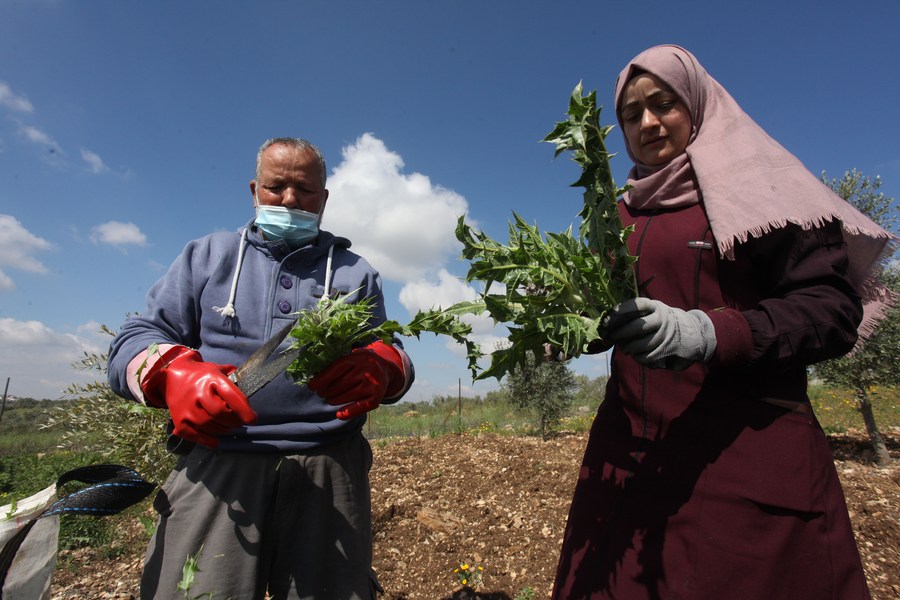
Two Middle-Eastern summer specialties are akoub, or tiny wild artichokes. Akoub is a spiky, edible plant found in a wide swath of the Middle East, from the mountains of Turkey down through the West Bank and Golan Heights to the Sinai Desert in Egypt. Akoub are akuvit hagalgal (the tumble thistle) in Hebrew and gundelia in English. Palestinians traditionally use the sturdy akoub stems and flower buds to make favorite dishes like stews, soups or fried eggs. It’s believed that akoub can treat many diseases from diabetes to bronchitis.

aqoub west bank qalqilia
Palestinian farmer Ziad Sawan (L) and his daughter Rana harvest the Akoub plants at their farm in Immatain village, east of the West Bank city Qalqilya, March 31, 2021. (Photo by Nidal Eshtayeh/Xinhua)

They’re very thorny and labor-intensive to clean, so they’re always expensive. But as a seasonal treat, they can’t be surpassed, with their unique, delicate flavor. Any prickles that remain after cleaning soften upon cooking.

Melokhia, or mulokhia (or jute), has started its brief season. Here’s our recipe for traditional melokhia soup. The leaves may be rinsed, patted dry, and hung up by their stems to dry for future soups.

jute leaves soup
Melokhia or melochia, known in English as jute. Makes a good Egyptian soup.

Herbs in season in May

Basil is back again. At the herb vendors, there are plenty of parsley, coriander leaf, chives, celery, and scallions. Still in evidence are sorrel, tarragon, wormwood, Swiss chard, spinach, leeks and lettuces. Mint continues especially lovely. Grape leaves for stuffing are now being sold in stacks. You may find bunches of lemon verbena for sale now.

basil in Karin Kloosterman's face, she is making pesto

Fresh ginger root is in every spice vendor’s and also at the herb stands. Ginger root freezes well and is easy to peel and grate. Just put the remainder right back in the freezer after use, because it gets mushy once thawed out.

Love Middle East spices as medicine? We have a guide here.

Foraging guide for May

The landscape is drying up, with winter’s juicy wild greens just a memory. But there is always something for the alert forager to bring home.

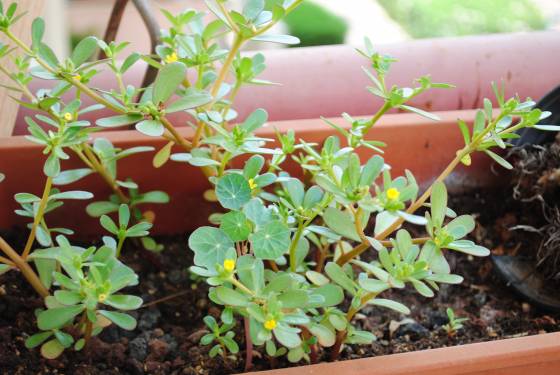
Purslane

Purslane, summer’s featured wild edible, has started to appear on the ground. It’s tender now, so if you come across a nice patch of it, bring it home for your salads.

purslane in your kitchen window grow herbs at home

Honeysuckle

Make honeysuckle wine? For a sip of sweetness and to revive childhood memories, pluck a few honeysuckle blossoms. Honeysuckle can be made into wine: if you are determined and have access to a large quantity of pesticide-free blossoms, you can find the recipe below in a video. To capture that elusive flavor more easily, just drop a handful into a jar, cover with sugar, and wait a week.  Rosemary is flowering, and it’s worth robbing the bees of a few blooms to flavor tea.

Dandelion

The dandelion of the Middle East is Taraxacum syriaca. It flowers sparsely and can only be found in hilly regions where winters are cold and consistently rainy. Dandelion is famous for liver support and as an effective diuretic. It’s also a natural superfood, loaded with minerals and vitamins.If you’re lucky enough to live where dandelions grow, pick the tender young leaves to marinate in vinaigrette before adding to salads.

Older, tougher leaves are quite bitter, but a few cooked with almost any soup gives a delicious, not-bitter flavor.

Dandelion roots are excellent in soups and stews. I used to make dandelion beer from the roots and leaves when I lived in the chilly north of Israel. It was good beer, too. There are recipes online like this one by Leda Meredith who once lived in Israel but who is now in Costa Rica.

Chicory

Chicory shares all of dandelion’s medicinal properties, but is difficult to pick. The leaves are tiny, and the root almost impossible to dig out of the hardened soil where the plant is most often found. The fluffy blue flowers are a joy to behold early in the morning, though, especially when you catch just the moment when all of them open spontaneously at the same time.

Bindweed

Bindweed, shown below, is the bane of farmers for its strong, thin vines that strangle crops in the fields, still produces beautiful pink and white flowers. Fill a vase with sprays of honeysuckle and bindweed for a wildflower bouquet to rest your eyes on.

image-honeysuckle-bindweed

Recipes for cooking in May

 Baba Ganoush

Stuffed Zucchini

Basil Pesto

Photos honeysuckle/bindweed bouquet by Miriam Kresh. This story is updated from the original and was edited in 2022 by Karin Kloosterman.