
Unrecyclable Biodegradable Plastic Bags Enforced in Gulf Country

plastic, biodegradable plastic, unrecyclable plastic, United Arab Emirates, Gulf Country, pollutionIn a well-meaning effort to rid Dubai, Abu Dhabi and other emirates from plastic bags, the United Arab Emirates government has banned the use of non-biodegradable plastic bags. Instead, it will be mandatory for business across all seven emirates to offer their clients the biodegradable variety starting 1 January, 2013. But critics worry that these bags, which are said to break down faster than conventional plastic bags, can’t be recycled.

The Ministry of Environment and Water announced that the new rules will be enforced starting 2013, though several firms have already made the switch to oxo-biodegradeable bags, according to The National.

This move comes after a succession of stories revealed the deleterious impact that plastic has on the environment. In addition to clogging waterways, hardened chunks of plastic have been found in the bellies of camels living in remote desert areas.

Mohammed Saleh Badri, director general of the Emirates Authority for Standardisation and Metrology (Esma) that is responsible for implementing the new policy told The National that the decision to switch to biodegradable plastic was informed by a series of consultations with experts.

Suppliers have been carefully vetted and certification will be given to only a select few who meet the agency’s stringent guidelines.

But Katharina Goeschl, chief administrative officer for Emirates Environment Technology that runs a plastics recycling plant in Al Ain, told the paper that the chemical properties of the new bags make it impossible to recycle them.

“What will happen is that they will be dumped in landfill sites, and although they will break down into ever smaller pieces they won’t completely degrade,” she said, adding that at least the old bags could be reused.

Daniella Dimitrova Russo, Co-founder and Executive Director, Plastic Pollution Coalition said that bioplastics will not solve the plastic pollution problem since they are still toxic, aren’t recyclable, and they don’t biodegrade as well as most companies have said.

After six months, Esma will review the efficacy of the program, which also aims to address the wider issue of disposable plastics in the United Arab Emirates.

Meanwhile, how about non-plastic, reusable grocery bags?

:: The National

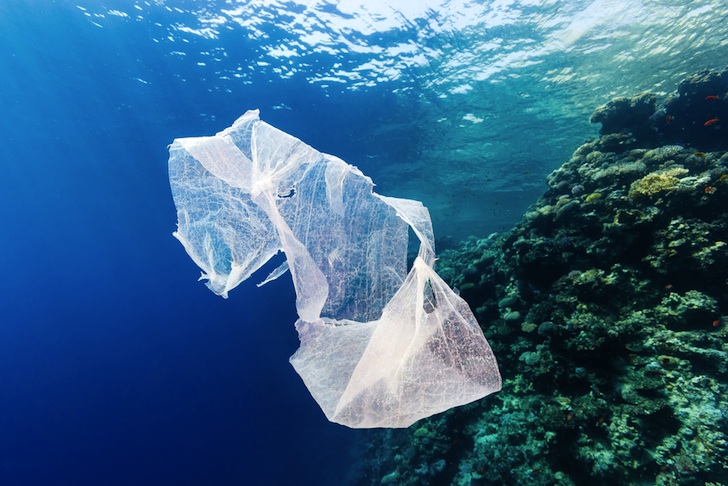
Image of drifting plastic bag, Shutterstock

Tafline Laylin
Tafline Laylinhttp://www.greenprophet.com
As a tour leader who led “eco-friendly” camping trips throughout North America, Tafline soon realized that she was instead leaving behind a trail of gas fumes, plastic bottles and Pringles. In fact, wherever she traveled – whether it was Viet Nam or South Africa or England – it became clear how inefficiently the mandate to re-think our consumer culture is reaching the general public. Born in Iran, raised in South Africa and the United States, she currently splits her time between Africa and the Middle East. Tafline can be reached at tafline (at) greenprophet (dot) com.
3 COMMENTS
  1. Dear Sirs,
    one of the solution is production of compostable bags what we could to offer from our company MIDAL doo -Novi Sad from Serbia, so that carbon from the earth is returned again to the earth by help of microorganisams.

    Best regards

    Dalibor

  2. I want to continue using plastic bags, but I would not mind them being biodegradable. As long as it is few month not few minutes.

  3. The impossible solution is to ban the production of all plastic everywhere. But since that can’t be done, and since the human population keeps growing, and since it would take 100 years for Nature to recover from our masses of pollution even if we stopped tomorrow, I guess we may as well get ready to go extinct, since that now seems inevitable.

Comments are closed.

Hot this week

The Fitness App Revolution: Building the Future of Wellness Through Strategic Development

In an era where smartphones are ubiquitous and health consciousness is at an all-time high, the fitness industry has undergone a radical digital transformation. Fitness applications have moved far beyond simple pedometers, evolving into comprehensive wellness platforms that serve as personal trainers, nutritionists, and community hubs right in our pockets.

A Brief History of Basil From India to Italy

Beloved, fortunate, sweet, and royal; an herb with a long and storied history in Asia and across the world. Called by many names, basil has featured in previous Green Prophet articles, so enjoy another serving, a brief history of basil.

How Renewable Energy is Revolutionizing the Way We Power Our World

Solar has become the star of the transition thanks to modular hardware and straightforward installation. It fits dense cities and remote towns alike. Many companies are turning to rooftop arrays and carport systems - and exploring commercial solar installation as a practical way to lock in future savings.

How does one start prepping?

Faced with an extreme winter storm this year, Americans wonder how to be prepared for catastrophe. Miriam has lived through wars in the Middle East - so she's prepared on giving you a guide to prepping.

Fishermen sue tire manufacturers on behalf of the salmon

A federal trial in San Francisco has brought US tire manufacturers, fishing groups, and environmental scientists into court over a chemical most drivers have never heard of — but which scientists say may be silently reshaping aquatic ecosystems.

Topics

The Fitness App Revolution: Building the Future of Wellness Through Strategic Development

In an era where smartphones are ubiquitous and health consciousness is at an all-time high, the fitness industry has undergone a radical digital transformation. Fitness applications have moved far beyond simple pedometers, evolving into comprehensive wellness platforms that serve as personal trainers, nutritionists, and community hubs right in our pockets.

A Brief History of Basil From India to Italy

Beloved, fortunate, sweet, and royal; an herb with a long and storied history in Asia and across the world. Called by many names, basil has featured in previous Green Prophet articles, so enjoy another serving, a brief history of basil.

How Renewable Energy is Revolutionizing the Way We Power Our World

Solar has become the star of the transition thanks to modular hardware and straightforward installation. It fits dense cities and remote towns alike. Many companies are turning to rooftop arrays and carport systems - and exploring commercial solar installation as a practical way to lock in future savings.

How does one start prepping?

Faced with an extreme winter storm this year, Americans wonder how to be prepared for catastrophe. Miriam has lived through wars in the Middle East - so she's prepared on giving you a guide to prepping.

Fishermen sue tire manufacturers on behalf of the salmon

A federal trial in San Francisco has brought US tire manufacturers, fishing groups, and environmental scientists into court over a chemical most drivers have never heard of — but which scientists say may be silently reshaping aquatic ecosystems.

Listening to Water: Tarek Atoui’s Next Work for Tate Modern

Born in Beirut, Lebanon in 1980 and now living in Paris, Atoui has spent years building instruments that don’t sit comfortably in concert halls. Many of them involve water, glass, and ceramics — materials that react to sound instead of simply producing it.

Leading Through a Dual-Energy Transition: Balancing Decarbonisation with Energy Security

Experience in one area of the energy industry isn't enough to guarantee readiness across all the others. That's where a structured program like an MBA in energy can come in. Today's advanced curricula explore energy economics, finance, policy, and strategic management alongside the technical subjects. And when pursuing an energy MBA online, professionals can skill up and retrain without having to step out of the labor market -- an important perk at a time when skilled professionals are already in short supply.

From Green Energy to Healthy Societies: Why old systems thinking is becoming relevant again

Across the Middle East and North Africa, large investments are being made in green hydrogen, renewable energy, water infrastructure and sustainability. Most of these efforts are discussed in the context of climate change, decarbonization and economic diversification. That framing is important, but it may not capture their full value.

Related Articles

Popular Categories