
The Ocean’s Hidden ‘Dark Web’ Is Being Fished Before Scientists Understand It

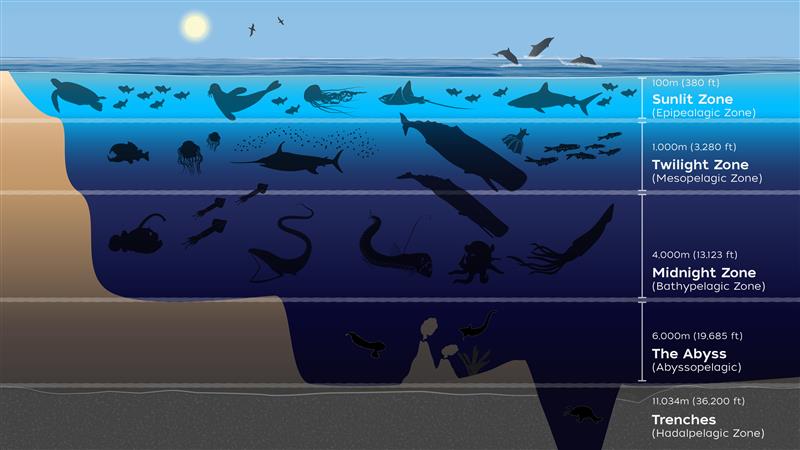
Woods Hole ocean zones explained

Deep below the ocean’s surface, in a dimly lit region known as the twilight zone, millions of fish are being caught every year. Scientists say the consequences are largely unknown.

The twilight zone, or mesopelagic zone, stretches from about 200 to 1,000 meters below the surface. It is home to species such as opahs, snake mackerels, and lancetfish that play an important but poorly understood role in ocean ecosystems.
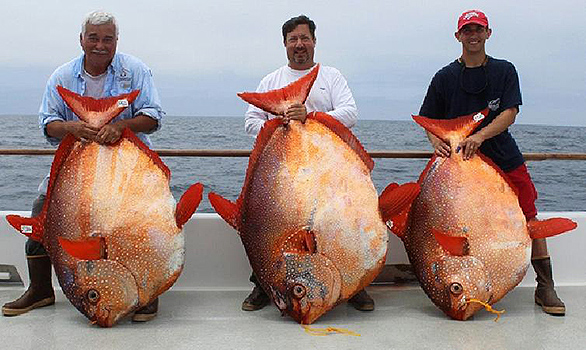
Opahs, via coral magazine

Researchers from America’s Woods Hole Oceanographic Institution (WHOI) recently warned that these fish form a marine “dark web” — a hidden network of mid-level predators and prey that helps connect ocean food chains and may contribute to regulating the planet’s carbon cycle. The term dark web refers to their largely unseen ecological role, not anything sinister.

“There is a huge swath of the open ocean that we thought was not yet fished,” said Martin Arostegui, a research associate at WHOI and lead author of the study. “But it turns out the tactics that different fisheries have used over the years have made the deep-water large fishes of this ecosystem more and more susceptible to being captured.”

The researchers found evidence that industrial fishing has been reaching into these ecosystems for decades, often without attracting much attention from scientists or policymakers. Many mesopelagic species are not covered by mandatory catch reporting, making it difficult to know exactly how many are being removed from the ocean. Chinese fishing boats are notorious for going out in the thousands, and trawling around what should be protected areas, like the Seychelles. There are currently no superpower or group of countries regulating China.

Over-fishing the Dark Web matters because twilight-zone fish do more than simply feed larger predators. They also move carbon and nutrients through the ocean as they migrate between deep and shallow waters.

“We know surprisingly little about these fishes despite their likely importance to ocean ecosystems,” said WHOI oceanographer Camrin Braun. “That knowledge gap makes it difficult to understand how fishing pressure may already be affecting food webs and ocean carbon storage.”

Scientists have estimated that mesopelagic fish make up one of the largest animal biomasses on Earth, although the true figure remains uncertain. They are also an important food source for tuna, swordfish, sharks, marine mammals, and seabirds. The concern is that large-scale harvesting could disrupt both marine food webs and the ocean’s ability to store carbon.

“This study highlights how much remains to be learned about life in the twilight zone and how urgently we need better monitoring and management,” Arostegui said. As interest grows in harvesting deep-ocean fish for fishmeal, aquaculture feed, and other products, researchers say understanding these hidden ecosystems should come before expanding fishing pressure.

The ocean’s twilight zone may be out of sight, but scientists warn that what happens there could have consequences that reach all the way to the surface. There are similar concerns about deep sea mining, an issue we have covered extensively on Green Prophet.

Karin Kloosterman
Karin Kloostermanhttp://www.greenprophet.com
Karin Kloosterman is an award-winning journalist, innovation strategist, and founder of Green Prophet, one of the Middle East’s pioneering sustainability platforms. She has ranked in the Top 10 of Verizon innovation competitions, participated in NASA-linked challenges, and spoken worldwide on climate, food security, and future resilience. With an IoT technology patent, features in Canada’s National Post, and leadership inside teams building next-generation agricultural and planetary systems — including Mars-farming concepts — Karin operates at the intersection of storytelling, science, and systems change. She doesn’t report on the future – she helps design it. Reach out directly to [email protected]

Read More

TRENDING

BMW partners with mineral miner SK tes to recycle electric batteries

BMW launched a pan-European partnership with SK tes, a company that can mine valuable minerals such as cobalt, nickel and lithium from used batteries before returning them to the value chain to make new batteries.

How To Become A Maritime Lawyer & What Do They Do?

Want to work for an oil company or a shipping company? Try a career in maritime law.

What is dark oxygen?

Something dark and metallic-like is pumping out large amounts of oxygen from the bottom of the Pacific Ocean, at depths where a lack of sunlight makes photosynthesis impossible, scientists have noticed. 

Norways pushes ahead with deep sea mining licenses

Norway decides to start offering deep sea mining licenses for the for the "green transition"

Norway getting sued by Swiss-NGO for deep sea mining

Norway is getting sued by a Swiss based group for deep sea mining.

Locals From Rishon Fight IKEA

Big Box stores are a pretty new concept in Israel, and thank God that not every Israeli city wants them in their backyard. A word from someone who has see the beautiful farmland around her hometown Newmarket, Ontario stripped and converted into vulgar strip malls of big box shops: they have no place in a healthy and sustainable town or city.

The Jewish National Fund Meets An Inconvenient Truth

According to the JNF, it has transformed thousands of acres of barren land into green forests in Israel. They state that each person emits about 23 tons of carbon per year, estimating that each tree planted can absorb one ton of carbon in its lifetime. That's a whole lot of trees you'd need to be planting. Could so many fit in Israel?

How to quiet noise from construction in your office

Streets need to be resurfaced in New York but the humming and grinding noise is unsettling. Noise is environmental pollution. 

EarthX and a blueprint for sustainable investing

Trammell S. Crow, a Dallas-based businessman and father of four, is focusing his efforts on impact investing, and media that focuses on saving the planet through EarthX.

Mining Afghanistan’s Mineral Discoveries Similar to Avatar

Now that American forces in Afghanistan are commemorating the longest period of any war that America has been involved in, including the 1965-73 Vietnam War, the recent discoveries of large and extremely valuable mineral and metal deposits may finally bring to light a reason to continue the presence of US fighting forces in this war torn and backward country.

From Pilot Plant to Global Stage: How Aduro Clean Technologies’ 2026 Expansion Signals a Turning Point for Chemical Recycling Investors Like Yazan Al Homsi

The company's Next Generation Process (NGP) Pilot Plant in London, Ontario, has officially moved into initial operating campaigns, generating the kind of structured, repeatable data that separates laboratory promise from commercial viability.

Nobul’s Regan McGee on Shareholder Value: “Complacency Is the Silent Killer” 

Why the governance framework designed to protect shareholders so...

Should You Invest in the Private Market?

startustartup Unlike public stock exchanges, which offer daily trading, strict...

Popular Categories