

Cell Phone Towers Can Help Predict the Next Big Flood

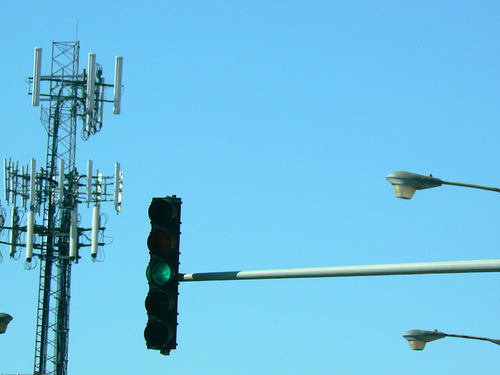
cell-phone-tower-image

Hurricane Katrina: Phone home –– If you have a cell phone tower planted somewhere near your home or your kid’s daycare, you’ll probably think they are evil, but new research finds that cell phone towers can give precious information to help us understand climate change patterns, and floods.

Though New Orleans residents were told to evacuate days before the arrival of Hurricane Katrina, no one could have predicted the real extent of the devastation.

Researchers from Tel Aviv University say they have found a novel and reliable way to help predict the intensity of the next big flood, using common cell phone towers. Their model, which analyzes cell phone signals, adds a critical component to weather forecasting never before available.

“By monitoring the specific and fluctuating atmospheric moisture around cell phone towers throughout America, we can cheaply, effectively and reliably provide a more accurate ‘critical moisture distribution’ level for fine-tuning model predictions of big floods,” says Prof. Pinhas Alpert, a geophysicist and head of Tel Aviv University‘s Porter School for Environmental Education.

Prof. Alpert and his co-researchers Prof. Hagit Messer Yaron and doctoral fellow Noam David reported on their research in the April 2009 Atmospheric Chemistry and Physics.

Information the weather girl can use

Cell phone towers emit radio waves that are diminished by moisture in the air, a factor that can be used to improve model warnings on flood levels. In addition, the researchers measured the rainfall distributions and were able to accurately estimate the size of impending floods before they struck. This was demonstrated in post-analysis of two case-studies of floods in the Judean Desert in Israel, where cell phone towers – and flash floods – are abundant.

Using real data measurements collected from the towers, the researchers demonstrated how microwave links in a cellular network correlated with surface station humidity measurements. The data provided by cell phone towers is the missing link weather forecasters need to improve the accuracy of flood forecasting. The microwave data used in this study was supplied by two cellular providers Cellcom and Pelephone in Israel.

Can texting save lives?

“Our method provides reliable measurement of moisture fields near the flood zone for the first time,” notes Prof. Alpert, who also works with NASA on developing models to study global warming weather patterns. This new tool, he says, can add to the bigger picture of understanding climate change patterns in general.

“Accurate predictions of flooding were difficult before because there haven’t been enough reliable measurements of moisture fields in remote locations,” Prof. Alpert adds. Using the signals collected from cell phone towers as they communicate with base stations and our handsets, weather forecasters will now have a crucial missing piece of information for flood prediction that they never had before. It will permit forecasters and residents alike to more accurately gauge the danger they face from an impending flood.

Because hundreds of thousands of cell phone towers are already in place, the Tel Aviv University invention can be adopted quickly. And cell phone companies are already collecting the data anyway, as Americans continue to ramp up their minutes of call time every month.

[image via benimoto]
Read More

1 COMMENT
  1. […] Professors Pinhas Alpert and Colin Price, lecturers at the Porter School of Environmental Studies’ International MA Program at Tel Aviv University, have predicted that increased flooding will result from global climate change. Alpert helped to pioneer the use of cellular phone networks for monitoring the amount and intensity of precipitation and water vapor – measurements which are virtually free of charge and can be used for studying global climate systems. […]

LEAVE A REPLY

Please enter your comment!
Please enter your name here

TRENDING

Desalination experts debunk Aqua Solaire, the floating desalination barge

AI makes it easy to dream, develop, and create images of what could be world-changing ideas, until the reality sets in. A new project making the rounds is Aqua Solaire, an allged French concept for a solar-powered desalination vessel designed to bring drinking water to coastal communities facing drought, storms, and infrastructure failures.

AI data centers are triggering panic, instead of cleantech opportunities

AI may unintentionally become the economic engine that finally modernizes America’s aging grid. California is experiencing a massive AI data center boom, ranking 3rd in the U.S. with 227 operating centers and 54 more in development as of April 2026, according to Stanford.

Abortion Pills, Plan B and Mifepristone and what the new US mail ban means

Abortion pills, often confused with Plan B (the morning-after pill), and historically referred to as RU486 (mifepristone), are part of a broader category of reproductive health medications that women have been using for decades. But they are not the same thing.

Baby teeth read like tree rings paint a picture of toxins in early life

A new study from the Icahn School of Medicine at Mount Sinai in New York offers a striking insight into how the environments we are born into can quietly shape our brains years later. By analyzing naturally shed baby teeth, the ones tucked under pillows for the tooth fairy, researchers have reconstructed a detailed timeline of exposure to environmental metals during pregnancy and early infancy.

SunZia comes online and America’s 11B, and largest renewable project begins wind power

The impact is already being felt. California has broken its wind generation record multiple times in recent weeks as SunZia begins feeding electricity into the grid. It’s a glimpse of what a renewable-powered future could look like when large-scale infrastructure finally comes online. Can we start saying goodbye to Saudi Aramco and Arabian Gulf oil? 

How to quiet noise from construction in your office

Streets need to be resurfaced in New York but the humming and grinding noise is unsettling. Noise is environmental pollution. 

EarthX and a blueprint for sustainable investing

Trammell S. Crow, a Dallas-based businessman and father of four, is focusing his efforts on impact investing, and media that focuses on saving the planet through EarthX.

Mining Afghanistan’s Mineral Discoveries Similar to Avatar

Now that American forces in Afghanistan are commemorating the longest period of any war that America has been involved in, including the 1965-73 Vietnam War, the recent discoveries of large and extremely valuable mineral and metal deposits may finally bring to light a reason to continue the presence of US fighting forces in this war torn and backward country.

From Pilot Plant to Global Stage: How Aduro Clean Technologies’ 2026 Expansion Signals a Turning Point for Chemical Recycling Investors Like Yazan Al Homsi

The company's Next Generation Process (NGP) Pilot Plant in London, Ontario, has officially moved into initial operating campaigns, generating the kind of structured, repeatable data that separates laboratory promise from commercial viability.

Nobul’s Regan McGee on Shareholder Value: “Complacency Is the Silent Killer” 

Why the governance framework designed to protect shareholders so...

Should You Invest in the Private Market?

startustartup Unlike public stock exchanges, which offer daily trading, strict...

How to build a 100-year-company

Kongō Gumi is a Japanese construction company, purportedly founded in 578 A.D., making it the world's oldest documented company. What can we learn about building sustainable businesses from them?

How AI Helps SaaS Companies Reduce Repetitive Customer Support Work

SaaS products are designed for large numbers of users with different levels of experience, and also in renewable energy.

Popular Categories