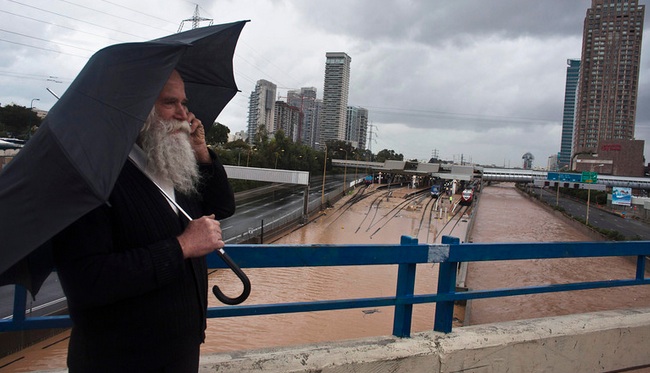

Tel Aviv University professors tell Green Prophet that it’s just a matter of time: Tel Aviv will flood again.
It’s warming up again this week in Israel, just after a series of storms last week that began with major flooding on the Mediterranean Coast and ended with Jerusalem of Gold turned to white after a serious snowstorm. Reports on the flooding of the Yarkon River, which shut down large sections of Tel Aviv for a day, including its major highway, have addressed the insufficient drainage system, but little has been made of the connection between climate change and severe weather events.
Professors Pinhas Alpert and Colin Price, lecturers at the Porter School of Environmental Studies’ International MA Program at Tel Aviv University, have predicted that increased flooding will result from global climate change. Alpert helped to pioneer the use of cellular phone networks for monitoring the amount and intensity of precipitation and water vapor – measurements which are virtually free of charge and can be used for studying global climate systems.
Prof. Colin Price, Head of the Department of Geophysical, Atmospheric and Planetary Sciences, researches the Earth’s changing climate and what impact it will have on global thunderstorms. He predicts that a relatively small change in global temperatures – a one degree rise – will result in a significant increase in lighting activity. He expects that in drier climates like Israel the storms may become fewer in number, but more intense with stronger and more rainfall and lightning.
This is precisely what happened last week in Israel, when the largest storm since 2003 hit the country and provided as much rain as certain cities see in an entire winter, according to the Israel Meteorological Service.
“Intense rainstorms in Israel can cause flash flooding, which causes increased runoff that doesn’t reach the aquifers,” says Price. “The water scarcity problem in this region is exacerbated when rainfall doesn’t recharge the groundwater supply and precious drinking water flows out to sea.”
Prof. Hudi Benayahu, a marine biologist and Head of the International MA Program at Tel Aviv University, is worried about the excess runoff which makes its way to the Mediterranean via coastal rivers and wadi spills, “The major problem with a storm event is the amount of pollution it carries to the sea in a comparatively short amount of time. Stormwater runoff carries toxins, heavy metals, oil, and litter and causes drastic changes in marine life as these pollutants take decades or more to break down.”
But it can’t all be bad, can it? The Sea of Galilee and Dead Sea are certainly filling up, providing much needed water to lakes that are essentially drying up. Prof. Benayahu points out another potential benefit of the cool stormwater – the cooling of the Mediterranean Sea.
This is important in light of the fact that during recent decades the region has experienced mild winters along with warmer summers and consequently minimum seawater temperatures have been above normal, by even more than two degrees. The warmer seawater temperature has affected the coastal life and led to dramatic changes in the marine life.
“The intriguing question,” says Benayahu, “is whether the recent storm will shift the environmental conditions along the eastern Mediterranean coast back to normal temperatures and if so, how will this affect the marine life there?”
Click here for more on the Porter School of Environmental Studies’ International MA program. This guest post was contributed by them.
Image of flooding in Tel Aviv via Hungeree