Ancient pollen tells story from under the Sea of Galilee

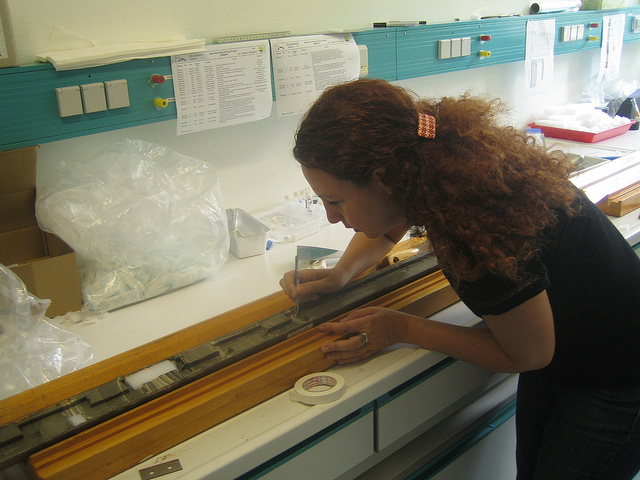
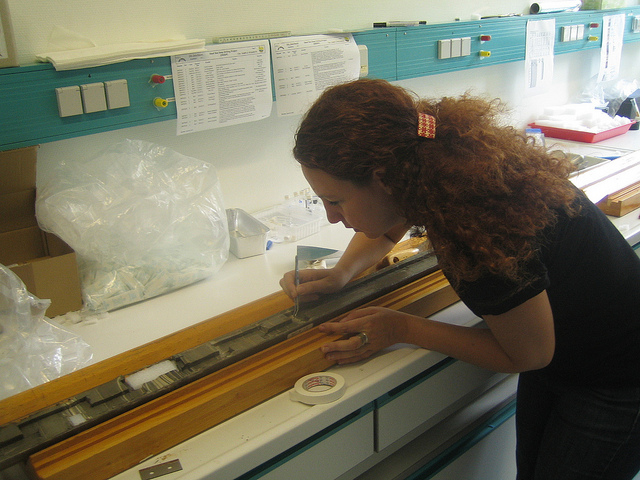
Dafna Langgut examining core samples from the Sea of GalileeLike rings on a tree, layers of pollen can tell researchers much about climate patterns unrecorded in the centuries before there was science.

New pollen samples dug out of the bottom of the Sea of Galilee (Lake Kinneret) by an Israeli scientific team suggest that a regional drought seems to have been the reason why prosperous societies –– Egyptian, Hittite and Mycenaean –– collapsed more than 3,000 years ago.

The recent study by Dafna Langgut and Prof. Israel Finkelstein of the Institute of Archaeology at Tel Aviv University (TAU); Prof. Thomas Litt from the University of Bonn, Germany; and Prof. Mordechai Stein from the Hebrew University appeared in the October issue of Tel Aviv: Journal of the Institute of Archaeology of Tel Aviv University.

‬The study explains short-term and cataclysmic climatic changes in the region. In addition, the new research opens up a new way for scientists to compare records and substantiate them.

Looking at pollen at the micro-scale of 40-year gaps, the researchers discovered a shift in vegetation that corresponds to a drought that heightened in the years between 1250 and 1100 BCE. This drought presumably could have created a snowball effect on trade, farming and societies themselves.

How pollen fells the mighty

What fascinates historians is the quick timescale in which these ancient centers of power disappeared from the world stage. “In a short period of time, the entire world of the Bronze Age crumbled,” says Finkelstein.

“The Hittite empire, Egypt of the Pharaohs, the Mycenaean culture in Greece, the copper-producing kingdom located on the island of Cyprus, the great trade emporium of Ugarit on the Syrian coast and the Canaanite city-states under Egyptian hegemony – all disappeared and only after a while were replaced by the territorial kingdoms of the Iron Age, including Israel and Judah.‬”

Finkelstein, a noted archeologist, is more pragmatic and prefers not to talk about the mysterious Sea Peoples who may have pillaged and stormed the empires in the region back then. (In fact he hung up the phone when I asked him the question: saying – “this interview is over”, when I was writing a piece for ISRAEL21c.) This is a theory suggested by his former student, Egyptologist Shirley Ben-Dor Evian. Neither is he willing to connect the Bible’s narratives to what he finds using the tools of archeology.

Pollen, however, provides scientific evidence. Using pollen records to understand the past is not a novel idea, even in Israel where Langgut, a palynologist (pollen expert), has used pollen findings to reconstruct ancient gardens.

The most enduring organic material

Langgut, who carried out the actual studies of 20-meter-long samples drilled from 300 meters down into the heart of the Sea of Galilee – Israel’s only inland lake — says that “pollen is the most enduring organic material in nature.”

She explains: “Pollen was driven to the Sea of Galilee by wind and river-streams, was deposited in the lake and was embedded in the under-water sediments. New sediments that are added annually create anaerobic conditions which help preserve the pollen particles. These particles tell us about the vegetation that grew in the vicinity of the lake in the past and therefore testify to the climatic conditions in the region.”

The lake, with its stories, sediments, and recovered ancient fishing boats and other artifacts, can reveal much about the factors that have shaped the land of Israel.

“The novelty [of the study] is mainly in the resolution, which concentrated on a short period of time with a good control of radiocarbon dating,” Finkelstein explains.

And, he adds, the study was unique because it made use of more than one record — pollen records, archeological and textual records.

Will work like that done at the Sea of Galilee be able to shed light on the political and societal effects of advanced climate change and the world droughts that are predicted for the next hundred years and beyond? Only time will tell.

Image above: Pollen expert Dafna Langgut examining core samples from the Sea of Galilee.  This story is reprinted from ISRAEL21c – www.israel21c.org

Karin Kloosterman
Karin Kloostermanhttp://www.greenprophet.com
Karin Kloosterman is an award-winning journalist, innovation strategist, and founder of Green Prophet, one of the Middle East’s pioneering sustainability platforms. She has ranked in the Top 10 of Verizon innovation competitions, participated in NASA-linked challenges, and spoken worldwide on climate, food security, and future resilience. With an IoT technology patent, features in Canada’s National Post, and leadership inside teams building next-generation agricultural and planetary systems — including Mars-farming concepts — Karin operates at the intersection of storytelling, science, and systems change. She doesn’t report on the future – she helps design it. Reach out directly to [email protected]
15 COMMENTS

Comments are closed.

Hot this week

How Renewable Energy is Revolutionizing the Way We Power Our World

Solar has become the star of the transition thanks to modular hardware and straightforward installation. It fits dense cities and remote towns alike. Many companies are turning to rooftop arrays and carport systems - and exploring commercial solar installation as a practical way to lock in future savings.

How does one start prepping?

Faced with an extreme winter storm this year, Americans wonder how to be prepared for catastrophe. Miriam has lived through wars in the Middle East - so she's prepared on giving you a guide to prepping.

Fishermen sue tire manufacturers on behalf of the salmon

A federal trial in San Francisco has brought US tire manufacturers, fishing groups, and environmental scientists into court over a chemical most drivers have never heard of — but which scientists say may be silently reshaping aquatic ecosystems.

Listening to Water: Tarek Atoui’s Next Work for Tate Modern

Born in Beirut, Lebanon in 1980 and now living in Paris, Atoui has spent years building instruments that don’t sit comfortably in concert halls. Many of them involve water, glass, and ceramics — materials that react to sound instead of simply producing it.

Leading Through a Dual-Energy Transition: Balancing Decarbonisation with Energy Security

Experience in one area of the energy industry isn't enough to guarantee readiness across all the others. That's where a structured program like an MBA in energy can come in. Today's advanced curricula explore energy economics, finance, policy, and strategic management alongside the technical subjects. And when pursuing an energy MBA online, professionals can skill up and retrain without having to step out of the labor market -- an important perk at a time when skilled professionals are already in short supply.

Topics

How Renewable Energy is Revolutionizing the Way We Power Our World

Solar has become the star of the transition thanks to modular hardware and straightforward installation. It fits dense cities and remote towns alike. Many companies are turning to rooftop arrays and carport systems - and exploring commercial solar installation as a practical way to lock in future savings.

How does one start prepping?

Faced with an extreme winter storm this year, Americans wonder how to be prepared for catastrophe. Miriam has lived through wars in the Middle East - so she's prepared on giving you a guide to prepping.

Fishermen sue tire manufacturers on behalf of the salmon

A federal trial in San Francisco has brought US tire manufacturers, fishing groups, and environmental scientists into court over a chemical most drivers have never heard of — but which scientists say may be silently reshaping aquatic ecosystems.

Listening to Water: Tarek Atoui’s Next Work for Tate Modern

Born in Beirut, Lebanon in 1980 and now living in Paris, Atoui has spent years building instruments that don’t sit comfortably in concert halls. Many of them involve water, glass, and ceramics — materials that react to sound instead of simply producing it.

Leading Through a Dual-Energy Transition: Balancing Decarbonisation with Energy Security

Experience in one area of the energy industry isn't enough to guarantee readiness across all the others. That's where a structured program like an MBA in energy can come in. Today's advanced curricula explore energy economics, finance, policy, and strategic management alongside the technical subjects. And when pursuing an energy MBA online, professionals can skill up and retrain without having to step out of the labor market -- an important perk at a time when skilled professionals are already in short supply.

From Green Energy to Healthy Societies: Why old systems thinking is becoming relevant again

Across the Middle East and North Africa, large investments are being made in green hydrogen, renewable energy, water infrastructure and sustainability. Most of these efforts are discussed in the context of climate change, decarbonization and economic diversification. That framing is important, but it may not capture their full value.

We saw peace – an interreligious encounter deep in our eyes

They came from Israel, Palestine, Jordan, Iraq, Yemen, Morocco, Tunisia, Lebanon, Egypt… There are Sunni Muslims, Shiite Muslims, Jews (Orthodox and Reform), Orthodox Christians, Coptic Christians, Protestant Christians, Druze, Baha'is, a Scientologist.

Can biochar reduce ‘Forever Chemicals’ in food if it’s used in farms?

Biochar is produced by heating organic material in a low-oxygen environment so it does not burn. This process, known as pyrolysis, transforms plant matter into a stable, carbon-rich material.

Related Articles

Popular Categories