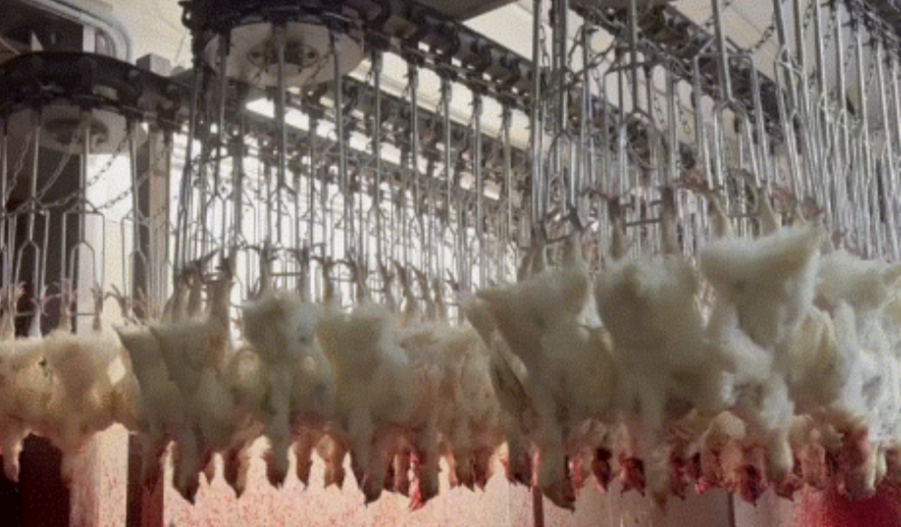

PETA is putting a $10,000 bounty on information from inside the American meat industry — and the offer raises an interesting question: when does paying people to expose wrongdoing become good public policy, and when does the money itself begin to complicate the truth?
Nicole Perreira from People for the Ethical Treatment of Animals, better known as PETA, sent Green Prophet details of the campaign this week, describing a nationwide effort to find meat-industry employees with firsthand knowledge of meat being repackaged, relabeled or otherwise misrepresented. This isn’t simply $10,000 for taking a disturbing photograph at work.
According to PETA, the reward is for credible information that ultimately leads to enforcement action by state or federal authorities against a meat company for misrepresenting its products. PETA is taking the campaign directly into American meat-producing regions including Harrisonburg, Virginia; Sioux City and Sioux Center, Iowa; Decatur, Alabama; and parts of California.
It is a fascinating proposition. On one hand, $10,000 is a powerful incentive for someone standing inside a slaughterhouse, packing plant or processing facility who knows something the public doesn’t. I started thinking if I had ever worked at a meat-packing house…
On the other, once you put a cash prize on incriminating evidence, it is reasonable to ask whether you have also created an incentive to go looking for wrongdoing — or to interpret ambiguous practices in the most damaging possible way.
Why PETA is offering the money

The immediate background is Farmer Focus, the Virginia chicken brand operated by Shenandoah Valley Organic. Green Prophet reported on the company earlier this year after PETA presented allegations involving its animal-welfare claims, wastewater practices and meat sourcing. Farmer Focus has marketed its chicken around ideas including traceability and animal welfare.
PETA says documents showed Shenandoah Valley Organic purchased more than 50,000 pounds of chicken from George’s Inc., a much larger conventional poultry producer. A whistleblower subsequently alleged that this chicken was repackaged and sold as Farmer Focus product.
PETA has taken the allegations to the Federal Trade Commission. That is significant, but it is also important to distinguish an allegation and regulatory complaint from a final regulatory finding that fraud occurred. PETA argues that the case suggests the problem could extend beyond one company.
For consumers, this matters because people willingly pay more for meat carrying words such as “humane,” “organic,” “animal welfare certified,” “pasture raised” or “traceable.” Those words don’t merely describe chicken. They create economic value in the hearts and minds of people.
If an ordinary industrial product can simply be put inside premium packaging, then the consumer isn’t merely being misled about chickens. The market for supposedly higher-welfare food stops functioning.
But should whistleblowers be paid?
At first glance, paying someone to report misconduct can sound ethically dubious. If someone witnesses fraud or animal cruelty, shouldn’t they report it because it is wrong, rather than because somebody has put $10,000 on the table? The real world is considerably messier. Think about who is working at a slaughterhouse.
A slaughterhouse employee may depend on the company for rent, health insurance and the food on their own family’s table. Reporting an employer can destroy workplace relationships and, despite legal protections that may apply in some circumstances, whistleblowers can face enormous personal and professional consequences.
Money can therefore compensate for risk rather than simply purchase a story. PETA did not invent this principle. The United States has long used financial rewards to encourage whistleblowers in areas ranging from government-contract fraud to securities violations of insider trading. Research into these programs has found that financial incentives can significantly increase reporting.
One peer-reviewed analysis of whistleblower reward systems notes that although critics often fear a flood of fabricated allegations, false reporting has not proved to be a major problem in several established American programs. The researchers argue that successful systems depend on verification, meaningful standards of proof and consequences for deliberately fabricated evidence. And what happens if employees set up a situation and frame their employees “for evidence”. It gets murky.
Related: the fall of Rodney McMullen
Other research has similarly found that monetary rewards increase people’s willingness to report misconduct. So the idea isn’t as radical as it sounds. Still, there is an important difference between a government whistleblower program which borders on communist-era practices, and an activist organization offering money to generate evidence against an industry it openly opposes.
PETA is not a neutral meat-industry regulator. Its stated position is that animals should not be eaten at all. That doesn’t mean evidence supplied to PETA is false. It does mean journalists, regulators and consumers should distinguish carefully between evidence, allegations, and PETA’s interpretation of that evidence.
Imagine a disgruntled employee with an old score to settle. Or an employee who sees something troubling without understanding the regulatory context. Or someone who captures the most shocking ten seconds of a complicated industrial process while leaving out what happened immediately before and afterward.
Those possibilities are precisely why PETA’s requirement that information result in government enforcement is important. The organization isn’t saying that an accusation alone earns $10,000. An outside authority still has to act.
There is another uncomfortable reality. Industrial animal agriculture mostly happens behind closed doors. Consumers standing at a refrigerated supermarket case cannot see how a chicken lived, how it died, where it was processed or whether the animal inside the package really corresponds to the pastoral language printed outside it.
Certification systems and regulators are supposed to bridge that information gap and sometimes insiders do it instead.
Insiders have produced important evidence not only in animal agriculture but in chemical companies (remember the farmer who took on Monsanto and lost?), pharmaceutical companies, banks, governments and practically every other industry in which the people on the inside know things the people on the outside cannot see.
If an employee can document fraud or mislabeling, if regulators independently examine the evidence, and if enforcement follows, the fact that the original whistleblower was paid does not make the underlying wrongdoing disappear. But the existence of a reward should also make journalists and regulators more careful, not less, about corroborating what they are shown.