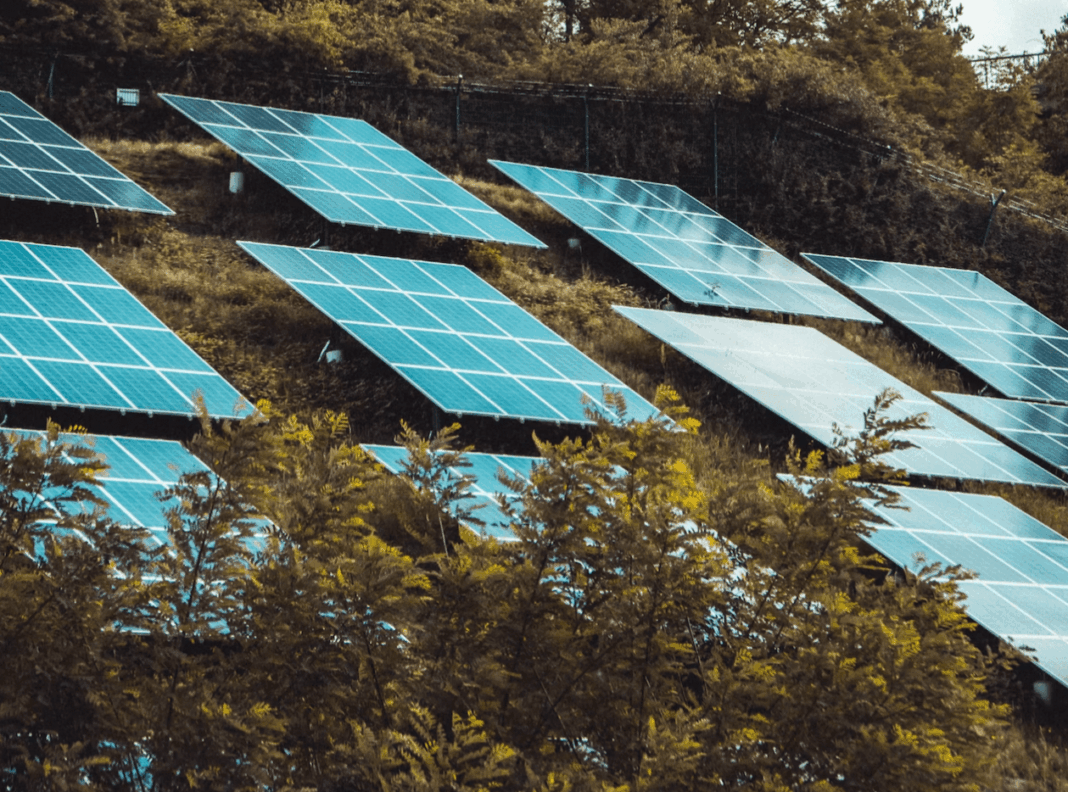
A solar electric car with solar panels from Lebanon

Lira car electric
The Lira electric car, via Xinhua

Hicham Husami from Lebanon has announced on Al-Manar TV (Hezbullah-Lebanon) that he has invented the Lira Ecological Car, the first car produced in an Arab country to run on electric and solar energy. It’s clunky and lacking slick design, but when people can’t afford the fuel to run their cars or diesel generators, it’s a godsend.

Husami said in a news clip translated by MEMRI that the car has a range of about 150 miles, and its fast-charge battery runs on solar panels. There are solar panels on the roof of the car as well. Due to the economic crisis which has led to an energy crisis, Lebanese are turning solar to run homes and small businesses to keep the power on.

“In order for this experiment to be successful, one should not drive it near the Central Bank building, so it will not skid and collapse,” he joked. 

Here is the transcript from the interview on TV:

Reporter: “At a time when the Lira [Lebanese Pound] has lost all its reputation and value, this place conceals a Lira of another kind — a Lira that cannot talk, but can drive using solar energy. Let us take a look.”

Hicham Husami, Lira electric car

Hicham Husami: “Despite the circumstances and the collapse of the Lebanese Pound, we invented the first car produced in the Arab world — in Lebanon — that operates on electric and solar energy. We have the honor to call it the Lebanese Lira.

Reporter: “It’s a solar car, called the Lira. In Lebanon, this is not a figment of imagination. It is a real project in progress. The man behind this car is an optimistic and determined Lebanese engineer.”

Husami: “I’m an industrialist. Because we are going through an economic crisis, we need new ideas that will revive this country, and will provide new job opportunities to our young men and women. We must not just wait for relief when the key to relief is in our hand.

“This car can drive you for 200 kilometers during the day without charging it. You can charge the batteries in half an hour. If you are in a place with no electricity and there is sunlight, the car recharges itself, through solar energy. Despite the crisis we are going through, we can stand on our feet. Lebanon is the first Arab country to produce solar cars.”

Reporter: “The idea of the Lira car is an honest manifestation of the Lebanese will to live and survive. In order for this experiment to be successful, one should not drive it near the Central Bank building, so it will not skid and collapse.”
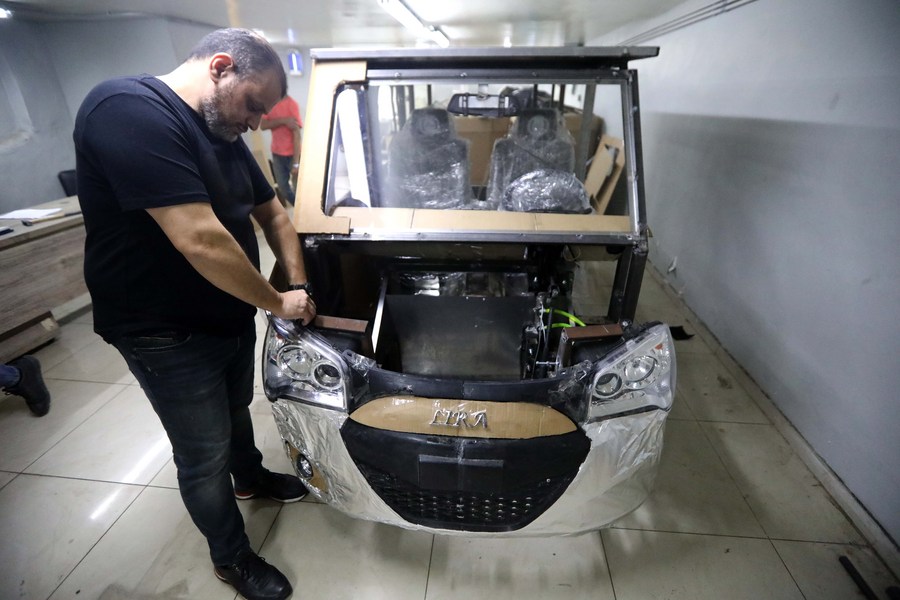
"It's a shame that the Lebanese can barely afford gasoline, and it's even more painful to see people suffering to access the commodity every now and then," Houssami said
Hussami, Lira’s electric car. Via Xinhua.

Late last year Husami was interviewed by the Chinese newspaper Xinhua, “It’s a shame that the Lebanese can barely afford gasoline, and it’s even more painful to see people suffering to access the commodity every now and then,” Hussami said

Despite Husami declaring he’s the first, the Middle East area does have a number of electric car ventures forthcoming in Oman (see Mays Motors), Saudi Arabia Ceer electric cars, and even Turkey’s Togg EV. Israel also has a transformer car

Mays Motors, an EV, all electric car/truck from Oman
Mays Motors, an EV, all electric car/truck? from Oman
Karin Kloosterman
Karin Kloostermanhttp://www.greenprophet.com
Karin Kloosterman is an award-winning journalist, innovation strategist, and founder of Green Prophet, one of the Middle East’s pioneering sustainability platforms. She has ranked in the Top 10 of Verizon innovation competitions, participated in NASA-linked challenges, and spoken worldwide on climate, food security, and future resilience. With an IoT technology patent, features in Canada’s National Post, and leadership inside teams building next-generation agricultural and planetary systems — including Mars-farming concepts — Karin operates at the intersection of storytelling, science, and systems change. She doesn’t report on the future – she helps design it. Reach out directly to [email protected]

Read More

TRENDING

Food system’s biggest waste may be the farmers we don’t see: Hugh Locke’s new book

Whole Earth Farming: Smallholders and the Great Regenerative Transformation by Hugh Locke is published by George Ronald in September 2026.

Artists warm up former Cold War radio headquarters in Berlin as PEOPLE Festival embraces collaboration and spontaneity

PEOPLE Festival returns to Berlin’s Funkhaus this October, bringing 180 musicians together for a week of collaboration, improvisation and more than 200 one-off performances.

Take your secrets and Bitcoin password offline in this code stitching workshop

Sophie Nadel turns data into something tactile, using embroidery and textiles to explore how we store, hide and understand information.

6 Ways Teletherapy Can Reduce Barriers to Accessing Mental Health Care

Teletherapy can make mental health care easier to access by reducing travel, scheduling and location barriers. Here are six ways virtual therapy can help people connect with professional support more easily.

Can You Work Closer to Home? What to Check Before Choosing a Shared Workspace

A coworking space within walking distance can cut commuting time and give you a reliable place to work, but distance alone does not make it useful. Test the internet, noise, privacy, desk setup, environmental claims and real cost before committing to a membership.

Scientists make lead-free perovskite solar cells that can weather the elements

Scientists have developed a “raincoat” for lead-free tin perovskite solar cells, helping them withstand air, moisture and heat while maintaining high efficiency.

The Essential Guide To Sustainability in Project Management

Sustainability is an approach where businesses and individuals balance the environmental, social, and economic aspects of a project such that current and future stakeholders are not overburdened with the impacts of the project in future.

Yerukim Forms a New Green Economy Where the Money is Really Green

The Yerukim members who pick up the recyclables get to keep the monetary reward, the public earns "green" bills that can be used in shops, and business owners get to be associated with environmentalism.

Choosing Riyadh over Dubai? What Investors Should Know

Saudi Arabia is deploying capital at unmatched scale to catalyze tourism and advanced industry while rewiring its power-and-water backbone. The investable frontier is widening—especially in renewables, grid storage, water efficiency/desal retrofits, and hospitality operating platforms. Prudent investors will insist on phased delivery, enforceable KPIs (energy, water, biodiversity), and RHQ/zone compliance—while pricing political-economy and reputational risks alongside growth upside.

Sell your cooking oil for biodiesel money

Want to make money on old french fry oil? Sell it.

Qatar Alternative Energy Summit Pairs Investors And Innovators

Alternative energy investors and innovators can meet n' greet in Doha, Qatar March 16 and 17.

Here’s How To Implement The Four Pillars Of Employee Engagement

If you throw a party for your work team and they are vegans, don't make it a barbecue. Know the sustainability values of your team to boost moral and retain good people.

Locals From Rishon Fight IKEA

Big Box stores are a pretty new concept in Israel, and thank God that not every Israeli city wants them in their backyard. A word from someone who has see the beautiful farmland around her hometown Newmarket, Ontario stripped and converted into vulgar strip malls of big box shops: they have no place in a healthy and sustainable town or city.

Popular Categories