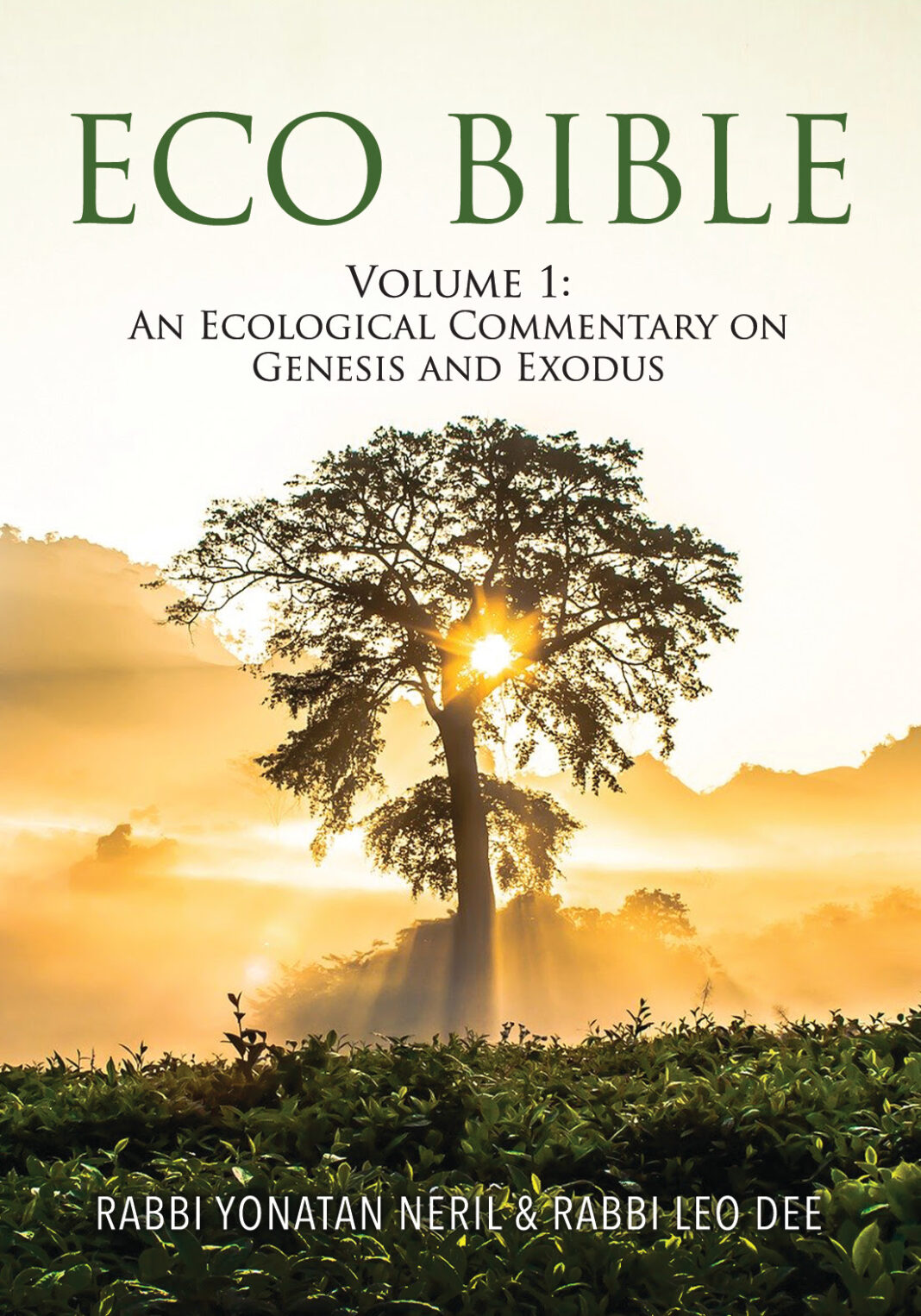


We met Eco-Rabbi Yonatan Neril a few times over the years, in Tel Aviv and also in Jerusalem at his interfaith events to inspire people to change the planet using faith-based ways. He’s co-authored a successful Eco-Bible which highlights monotheistic faith texts and practices from the Bible. He was recently at the COP27 in Sinai and is now in Davos, hoping to influence business leaders and climate change policy makers to apply faith-based messaging and principles into their practices. We interview Neril below. Green Prophet: Tell us a little about your journey to the COP and how you connected to the faith elements of climate change?
I attended the UN climate conference COP 27 in Sharm El Sheikh, Egypt. I came based on the belief that religious communities have a key role to play in addressing climate change and climate justice, which requires deep transformation within society. The question is, how can people of faith deeply engage to address the climate crisis?
Religion is the sleeping giant in the true story of climate action. Religious institutions have huge land holdings, media systems, educational systems, and billions of followers—many who are already very proactive in their communities on all kinds of issues. One thing I found amazing at the COP 27 was the coming together of people and clergy of many faiths. They found common cause so that the next generation can inherit a liveable, thriving and spiritually aware planet.
The knowledge is readily available about what changes are critically needed to diminish long-term harm to the planet. However, bringing about changes in action demands deeper changes in attitude, a change of heart. This has been the domain of religions for millennia. Religions are sources of inspiration for the transformation of heart and the ensuing changes of attitude and action. To support, challenge and inspire discussions during COP 27, ten interfaith climate events took place in Sharm El Sheik, Jerusalem, London, Rishikesh (India) and elsewhere that were heart-stirring, transformative and a moment of inspiration for religious communities and for humanity.
Religious leaders called for reexamining deep-seated attitudes and for identifying ways to transform these attitudes for the wellbeing of Earth, our common home.
What was the most meaningful element of your participation
I was profoundly honored to be the only rabbi present at the UN climate conference, COP27. This wasn’t a conference on some abstract academic theory. Rather, it was focused on achieving a sustainable and thriving future for all life on this planet.
One of the highlights of my time there was listening to the powerful words of the only imam who decided to be present at the conference, and to the only Orthodox Christian religious figure in attendance, Metropolitan Seraphim Kykotis.
I direct The Interfaith Center for Sustainable Development (ICSD), which together with partners The Peace Department and the Elijah Interfaith Institute, organized four multifaith climate events at COP 27 including in the press conference space in the Blue Zone. The events incorporated concrete examples of how religious communities are actively meeting the climate challenge, and featured concrete initiatives that translate the broader spiritual practices into action.
How has the experience influenced you?
My experience at COP27 is sinking in. Some 45,000 people were at the conference, including thousands from government delegations, and 650 lobbyists from the fossil fuel industry. I am digesting the fact that executives and lobbyists from the fossil fuel industry outnumbered clergy by a factor of about 10 to 1. What does that say about the organization and determination of fossil fuel executives, and about how religious figures are playing catchup?
There’s a prevalent view that political leaders, business leaders and scientists will solve the climate crisis and religion can just sit this one out. However, the ecological crisis is a spiritual crisis.
From what I saw, there were about 40 clergy (almost all Christian), and several indigenous spiritual leaders at COP27. The reason that there were so few religious figures or clergy among the 45,000 people at the UN climate conference is that many religious figures and clergy think religion doesn’t have anything to do with climate change. But if many religious people continue to view ecology as idolatry, we will bring on the next flood.
So the climate crisis is also a crisis within religion. My NGO, The Interfaith Center for Sustainable Development (ICSD), is engaged in a concerted effort to encourage clergy to speak and preach about religion and climate change once a month, via our Eco Preacher resource that Rev. Dr. Leah Schade writes. I also co-authored Eco Bible: an Ecological Commentary on the Hebrew Bible, which ICSD has distributed to hundreds of religious figures and clergy. And ICSD, in cooperation with the Anglican Church in Africa and the impact investment platform Gigawatt Global, is working on a Faith Inspired Renewable Energy Project to deploy solar fields to bring electricity to Africans, reduce indoor air pollution and deforestation, and curb climate change.The Guardian reported on a new analysis that revealed that “The oil and gas industry has delivered $2.8bn (£2.3bn) a day in pure profit for the last 50 years… The vast total captured by petrostates and fossil fuel companies since 1970 is $52tn, providing the power to ‘buy every politician, every syste’” and delay action on the climate crisis,” says Prof Aviel Verbruggen, the author of the analysis.
More oil and gas rigs are being built, as fossil fuel companies discover more gas underground and underneath the ocean floor, and political leaders warmly embrace these developments. One of the most powerful forces in modern society is indeed the fossil fuel industry. Yet another one of the most powerful forces are religious institutions combined. But if faith leaders and their organizations stay quiet about the fossil fuel industry’s dominance of our economy and future, we will all be pushed past the carbon budget at which point irreversible and catastrophic climate change becomes the legacy we leave our children and grandchildren.
So there’s a lot of work to be done among the 85% of people on Earth who identify with a religion—so that religion can be a vehicle for sustainable living.
Who inspired you the most there?
I was inspired by commitments by the Church of Sweden and the Church of Finland to be carbon neutral by 2030. Bishop Andreas Holmberg of Stockholm spoke at the events I organized about how his Diocese is taking serious strides for sustainability.
I was also inspired by religious figures speaking about hope in the face of the climate crisis. Some people have lost hope and think that there’s nothing we can do to avert catastrophe. But only God knows, and we have a deep responsibility to do our part. I believe that if we change course and live spiritually aware, sustainable lives, God will respond in kind.
If you could have one wish for the planet what would it be?
I wish that humanity as a species could live sustainably and at a much higher level of spiritual awareness.
Tell us about the 10 principles…
The Elijah Interfaith Institute and project partners brought together premier religious leaders from the world’s major religions to put forth a prophetic interreligious call to action: “Ten Universal Principles for Climate Justice.”
The first principle states: ” Creation is not our possession. The human person must recognize this and find his/her rightful place in relation to this fundamental fact. For some of us, this leads to a sense of gratitude for God’s gifts and for the gift of life itself, wherein humanity takes its rightful place as partner and co-creator, in advancing the life of all creation. For others, creation itself is sacred. Therefore: We recognize human responsibility to love and protect nature.”
The other principles can be viewed in short version on this page, and with practical actions on this page.
Any closing thoughts?
The awareness that we need to transition from fossil fuel to renewable energy, conservation and mindfulness in how we use energy is a spiritual awareness. That that shift needs to be promoted by religious figures; it’s not just something to be promoted by environmentalists or government negotiators.
We are pumping 34 billion tons of CO2 into the atmosphere each year, and we increase this amount each year. The carbon will stay in the atmosphere for 100 years, and continue to heat the planet as our children and grandchildren inherit the world that we leave them. So this is a legacy issue– about our legacy of love for our children. Let us give our children, grandchildren, and future generations the lasting gift that shows our deep and enduring love for them, so they can survive and thrive on this beautiful planet, God’s creation.