
Eviation’s all-electric passenger plane takes first test flight in the US 

electric commuter airplane, Eviation, Alice, test flight
Cheaper and more sustainable air travel is brought to you by Eviation, an Israeli-founded, American-led all-electric aircraft startup

An all-electric passenger airplane called Alice completed its test voyage last month, making environmentalists around the world very happy. It was a world first. The Israeli-American venture was founded by 3 Israelis, and the company Eviation is now run out of the United Sates. Its first trip was made at Moses Lake, Washington lifting off September 27 at 7:10 am from Grant County International Airport. 

The zero-emission plane flew for 8 minutes at 3500 feet. 

Test pilot Steve Crane steered the nine-passenger aircraft, which is powered by two 640-kilowatt electric motors over Eastern Washington’s high desert, a location like the Mojave Desert, often used for testing innovations in aviation.

Its new battery technology aims for regional travel between 150 to 250 miles, or one or two flight hours after a 30 minute charge. 

This new generation of all-electric aircraft has the power to transform communities by providing access to airports not currently used by commercial flights due to noise concerns or restricted operating hours. 

We’ve seen solar airplanes, the Solar Impulse, on a round the world flight, carrying one passenger. But this latest advance shows that zero emissions and clean energy flights are closer for commuters than ever before. Companies like United Airlines say they will be using solar airplanes by 2030 and Eviation has dozens of orders for its planes in the pipeline.

Crane explained that the short flight was meant as first in a series of “baby steps” for the test program. “Today was just about the initial envelope,” he told reporters. “For future tests, we’ll expand that envelope.”

Why Electric Propulsion is better than Piston Engines in Aircraft
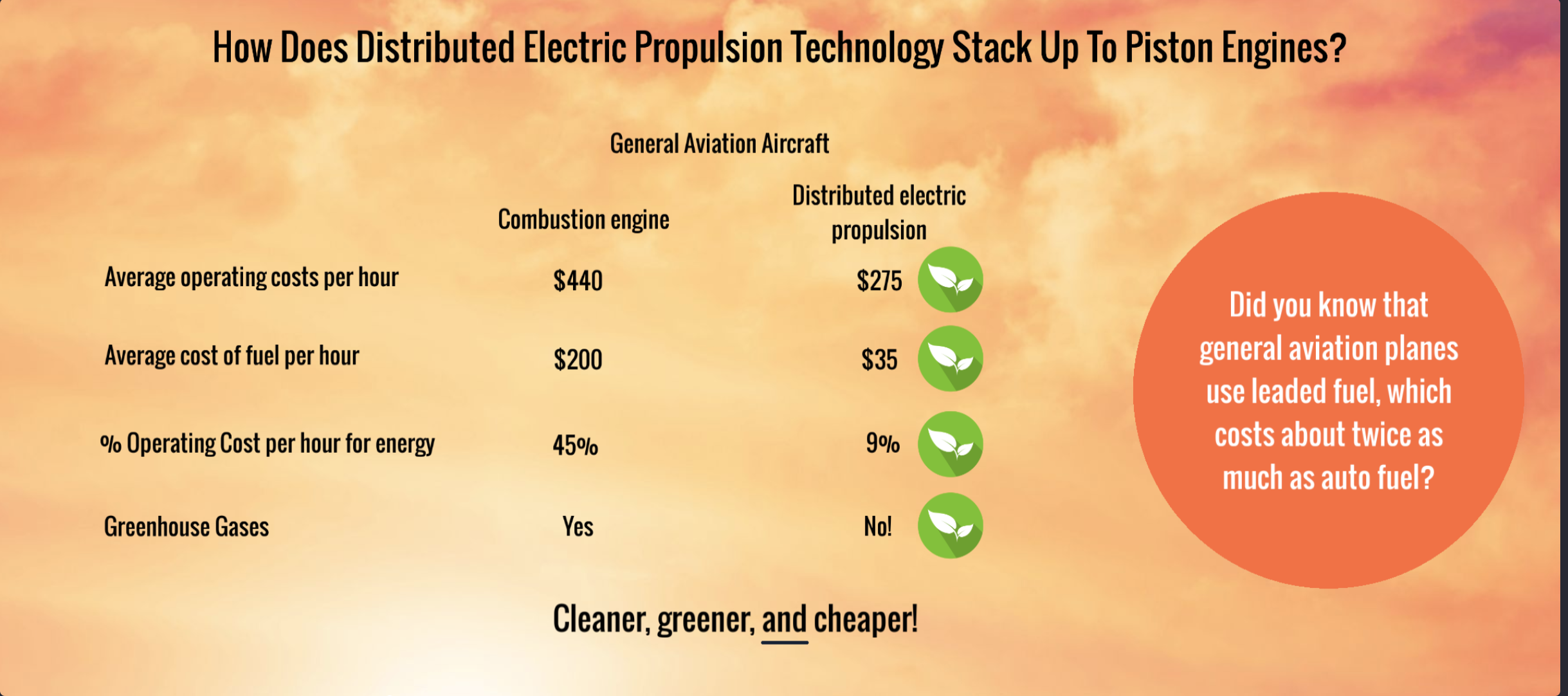
electric planes versus propulsion engines, NASA

NASA breaks down on their website why electric planes are more economical, reliable and better for the environment than leaded-fuel combustion engines. 

  • Electric Propulsion Technology costs less per hour
  • Electric uses less fuel per hour
  • Electric reduces operating costs
  • Electric engines don’t emit greenhouse gases

The Arlington, Wash.-based Eviation was founded by three Israeli entrepreneurs in 2015, Omer Bar-Yohay, Omri Regev and Aviv Tzidon, who know that innovating big, physical ideas should be done close to the market and not in the Middle East. Eviation joins companies like Boeing and Airbus hoping to make air travel less expensive by using advances in electric propulsion and battery technology. At least 200 million USD in investment has gone into the company so far.

The Alice aircraft named after Alice from “Alice in Wonderland” will be built for commuter, cargo and executive flights with a load limit of 2,500 to 2,600 pounds and a maximum speed of 260 knots (300 mph).

Alice will be available in three variants including a nine-passenger commuter, an elegant and sophisticated six-passenger executive cabin, and a cargo version. All 3 configurations support two crew members. The executive cabin and cargo variations will be identical to the commuter configuration, except for changes to the interior. (A sustainable upgrade for the Sheikh’s falcons?)

Alice’s first customers

eviation, alice, all electric passenger plane

Cape Air and Global Crossing Airlines, both US-based regional airlines, have already placed orders for 75 and 50 Alice aircraft respectively with DHL Express signed on as Eviation’s first cargo customer, with an order of 12 Alice eCargo planes.

DHL aims to establish the first electric express network, leading the way for a new era of zero-emissions air freight.

Germany-based EVIA AERO, which is developing a sustainable regional airline has put in an order for 25 all-electric commuter Alice aircraft. The airline intends to enter into service with Alice as its primary aircraft for point-to-point, sustainable regional travel within Germany, Denmark, Belgium, Austria and the Netherlands. 

What makes Alice go?

Excluding Tesla and Apple, Alice is built like the auto industry or cell phone industry: its machines are built and run by a number of individual parts from various manufacturers: two magni650 electric propulsion units from magniX, the only flight-proven electric propulsion systems at this scale. Other key suppliers include AVL (battery support), GKN (wings), Honeywell (advanced fly-by-wire system, flight controls and avionics), Multiplast (fuselage), Parker Aerospace (six technology systems), and Potez (doors).

The company plans on delivering its first aircraft by 2027. It is now working on its first FAA certified aircraft. 

::Eviation

Karin Kloosterman
Karin Kloostermanhttp://www.greenprophet.com
Karin Kloosterman is an award-winning journalist, innovation strategist, and founder of Green Prophet, one of the Middle East’s pioneering sustainability platforms. She has ranked in the Top 10 of Verizon innovation competitions, participated in NASA-linked challenges, and spoken worldwide on climate, food security, and future resilience. With an IoT technology patent, features in Canada’s National Post, and leadership inside teams building next-generation agricultural and planetary systems — including Mars-farming concepts — Karin operates at the intersection of storytelling, science, and systems change. She doesn’t report on the future – she helps design it. Reach out directly to [email protected]

Read More

TRENDING

One of the World’s Biggest Candy Companies Became a Leader in Cocoa Science

Most people know Mars for M&M's and Snickers. Few realize the company has spent four decades researching cocoa flavanols and sustainable cocoa science. After six days testing CocoaVia with pioneers of Toronto's raw food movement, Green Prophet explores the surprising story behind one of the world's most researched cocoa supplements.

Sustainable Manufacturing Frameworks Reducing Waste in Heavy Industry

Hydraulic systems are at the heart of heavy manufacturing, but poor maintenance can lead to fluid leaks, downtime, and unnecessary waste. By focusing on preventive maintenance, fluid monitoring, filtration, and early leak detection, industrial facilities can improve efficiency, reduce environmental impact, and strengthen sustainable manufacturing without major capital investments.

The Lost Art of Jewish Herbalism: How Plants, Memory and Diaspora Kept a Living Tradition Alive

Jewish herbalism is experiencing a revival as educators like Naomi Spector uncover centuries of plant knowledge preserved through the diaspora. Blending the wisdom of Maimonides, Ashkenazi and Sephardi traditions, and remedies passed from generation to generation, this forgotten ecological heritage reveals how Jewish communities adapted to new landscapes while keeping their cultural identity rooted in the natural world.

Finding Your Sea Legs Aboard the Neptun of Marstal

The Neptun of Marstal is more than a restored Danish sailing ship. Operated as a non-profit sail-training organization, it invites people of all ages to swap screens for sails, learn traditional seamanship and discover how caring for the sea begins by experiencing it firsthand. Along the way, strangers become crewmates, old maritime skills are kept alive, and the voyage offers a powerful lesson in environmental stewardship, cooperation and the enduring value of learning by doing.

Canada’s Beluga Rescue Is No Free Willy. Those Whales Will Never Go Home.

Six beluga whales have begun leaving Canada's shuttered Marineland, but they aren't returning to the wild. Here's why the park closed and where the whales are going.

The Essential Guide To Sustainability in Project Management

Sustainability is an approach where businesses and individuals balance the environmental, social, and economic aspects of a project such that current and future stakeholders are not overburdened with the impacts of the project in future.

Yerukim Forms a New Green Economy Where the Money is Really Green

The Yerukim members who pick up the recyclables get to keep the monetary reward, the public earns "green" bills that can be used in shops, and business owners get to be associated with environmentalism.

Choosing Riyadh over Dubai? What Investors Should Know

Saudi Arabia is deploying capital at unmatched scale to catalyze tourism and advanced industry while rewiring its power-and-water backbone. The investable frontier is widening—especially in renewables, grid storage, water efficiency/desal retrofits, and hospitality operating platforms. Prudent investors will insist on phased delivery, enforceable KPIs (energy, water, biodiversity), and RHQ/zone compliance—while pricing political-economy and reputational risks alongside growth upside.

Sell your cooking oil for biodiesel money

Want to make money on old french fry oil? Sell it.

Qatar Alternative Energy Summit Pairs Investors And Innovators

Alternative energy investors and innovators can meet n' greet in Doha, Qatar March 16 and 17.

Here’s How To Implement The Four Pillars Of Employee Engagement

If you throw a party for your work team and they are vegans, don't make it a barbecue. Know the sustainability values of your team to boost moral and retain good people.

Locals From Rishon Fight IKEA

Big Box stores are a pretty new concept in Israel, and thank God that not every Israeli city wants them in their backyard. A word from someone who has see the beautiful farmland around her hometown Newmarket, Ontario stripped and converted into vulgar strip malls of big box shops: they have no place in a healthy and sustainable town or city.

The Jewish National Fund Meets An Inconvenient Truth

According to the JNF, it has transformed thousands of acres of barren land into green forests in Israel. They state that each person emits about 23 tons of carbon per year, estimating that each tree planted can absorb one ton of carbon in its lifetime. That's a whole lot of trees you'd need to be planting. Could so many fit in Israel?

Popular Categories