
What’s the weirdest junk floating out at sea?

weird junk floating at sea

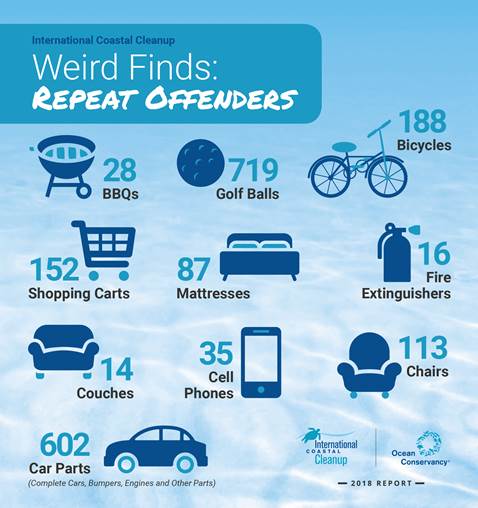
As the world prepares for the start of beach season, the Washington, DC-based Ocean Conservancy has released a series of infographics depicting some of the weird items collected during its 2017 International Coastal Cleanup.

“You would be amazed at what volunteers find every year along beaches and waterways,” said Allison Schutes, associate director of Ocean Conservancy’s Trash Free Seas® program. “No matter where you are in the world, chances are you’ll see plastic bottles, bottle caps, straws, packaging… then you get items where you just have to wonder, ‘how did this get here?’”

First launched in 1986 on a beach in Texas, the International Coastal Cleanup mobilizes hundreds of thousands of volunteers in more than 100 countries all over the world to remove trash from local beaches, waterways, and parks. In addition to removing trash, volunteers contribute to the world’s largest database on marine debris by logging each trash item using data cards or in real-time using Ocean Conservancy’s Clean Swell app. Scientists, researchers, industry leaders and policymakers rely on Ocean Conservancy’s Ocean Trash Index to inform policy solutions to the growing marine debris crisis.

In years past, volunteers have recovered wedding dresses, washing machines, mattresses, and more. Notable items this year included three hot tubs, a unicycle, an entire car, a paper shredder, and a children’s slide, among others.


Did this vintage dress end up in the sea?

plastic straws

“There’s this idea that the ocean is so vast that it can just swallow up anything,” said Nicholas Mallos, director of Ocean Conservancy’s Trash Free Seas® program. “But the reality is that trash, specifically plastics, can have a serious impact on ocean health.”

Every year, millions of tons of trash—including an estimated 8 million metric tons of plastic waste—flow into the ocean, entangling wildlife, polluting beaches, and costing coastal municipalities hundreds of millions of taxpayer dollars. Cigarette butts, plastic beverage bottles, food wrappers, plastic bottle caps and plastic straws are among the most-commonly collected items. They are also among the most deadly to wildlife like seabirds and sea turtles. Plastics—which never fully biodegrade but rather break up into smaller and smaller pieces called microplastics—are of particular concern. Scientists predict that without concerted global action, there could be one ton of plastic for every three tons of fin fish in the ocean by 2025.

“By highlighting what gets left behind on shorelines and river banks, we inspire people to take action for trash-free seas and identify trash items for which innovative solutions are most needed,” said Mr. Mallos.

Global peeps can do their part by deciding to skip the straw, carrying reusable water bottles and signing up for a beach or waterway cleanup. Governments and businesses also play a critical role in trash free seas, by ensuring their products are recyclable and working to improve waste management and collection in countries where the flow of plastic and trash into the ocean is greatest.

Final numbers for the 2017 International Coastal Cleanup, including how many items and pounds of trash were collected, the number of volunteers, and other data will be available to the public in June 2018.


Bhok Thompson
Bhok Thompsonhttp://www.greenprophet.com
Bhok Thompson is an “eco-tinkerer” who thrives at the intersection of sustainability, business, and cutting-edge technology. With a background in mechanical engineering and a deep fascination with renewable energy, Bhok has dedicated his career to developing innovative solutions that bridge environmental consciousness with profitability. A frequent contributor to Green Prophet, Bhok writes about futuristic green tech, urban sustainability, and the latest trends in eco-friendly startups. His passion for engineering meets his love for business as he mentors young entrepreneurs looking to create scalable, impact-driven companies. Beyond his work, Bhok is an avid collector of vintage mechanical watches, believing they represent an era of precision and craftsmanship that modern technology often overlooks. Reach out: [email protected]

Read More

LEAVE A REPLY

Please enter your comment!
Please enter your name here

TRENDING

Operational Integrity and Safety-Oriented Aviation Management in Contemporary Private Aviation: The Hera Flight Framework

The modern private aviation industry has undergone substantial structural...

Robot Monk Gabi Takes Vows in Seoul. What Would the Buddha Have Thought?

  How many of us looked twice when we saw...

8 Questions Families Should Ask Before Choosing Assisted Living

Few family decisions carry as much weight as choosing...

The fossil fuel problem hiding in your wardrobe

The fuel pumps don't lie. When oil prices spike,...

Australia’s $25 Billion AI Moment: Infrastructure Is the Easy Part

  Microsoft's record investment in Australia will build data centres....

How to quiet noise from construction in your office

Streets need to be resurfaced in New York but the humming and grinding noise is unsettling. Noise is environmental pollution. 

EarthX and a blueprint for sustainable investing

Trammell S. Crow, a Dallas-based businessman and father of four, is focusing his efforts on impact investing, and media that focuses on saving the planet through EarthX.

Mining Afghanistan’s Mineral Discoveries Similar to Avatar

Now that American forces in Afghanistan are commemorating the longest period of any war that America has been involved in, including the 1965-73 Vietnam War, the recent discoveries of large and extremely valuable mineral and metal deposits may finally bring to light a reason to continue the presence of US fighting forces in this war torn and backward country.

From Pilot Plant to Global Stage: How Aduro Clean Technologies’ 2026 Expansion Signals a Turning Point for Chemical Recycling Investors Like Yazan Al Homsi

The company's Next Generation Process (NGP) Pilot Plant in London, Ontario, has officially moved into initial operating campaigns, generating the kind of structured, repeatable data that separates laboratory promise from commercial viability.

Nobul’s Regan McGee on Shareholder Value: “Complacency Is the Silent Killer” 

Why the governance framework designed to protect shareholders so...

Should You Invest in the Private Market?

startustartup Unlike public stock exchanges, which offer daily trading, strict...

How to build a 100-year-company

Kongō Gumi is a Japanese construction company, purportedly founded in 578 A.D., making it the world's oldest documented company. What can we learn about building sustainable businesses from them?

How AI Helps SaaS Companies Reduce Repetitive Customer Support Work

SaaS products are designed for large numbers of users with different levels of experience, and also in renewable energy.

Popular Categories