
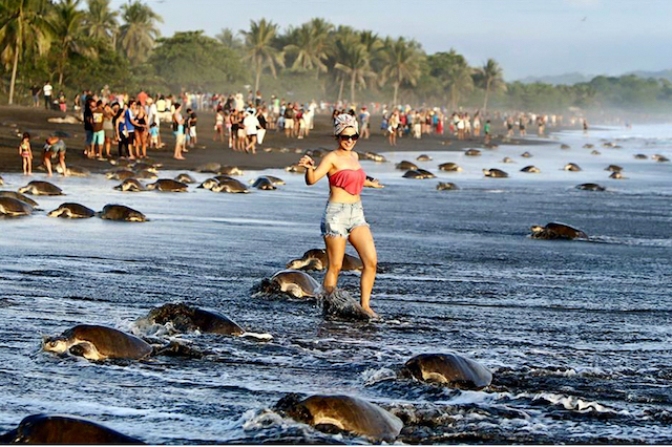

This story is not about the Middle East, although the images are a surreal reminder of what is happening on our Mediterranean shores – albeit with a different species. A world apart, both events are variations on an alarming theme that undermines our effectiveness in protecting this planet. Humans are losing connection with the natural world, and empathy for all living in it.
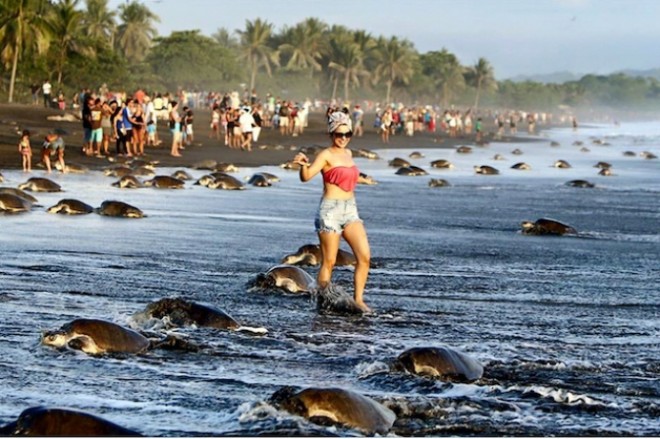
In Costa Rica this weekend, hundreds of tourists swarmed to Ostional Beach in canton Santa Cruz – most steered there by paid tour guides – to witness the migration of female sea turtles crawling from the water to lay their eggs in the sands of this national wildlife preserve. But instead of quietly observing the movements of one of Earth’s most ancient creatures, a mostly shirtless mob stormed the beach, completely disrupting protected habitat, preventing the animals from crossing the beachfront, and trampling vulnerable nests.
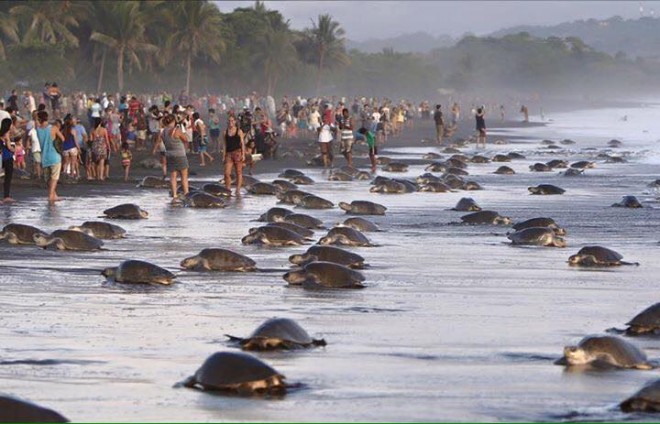
Local authorities were alerted, sending in three National Police officers to supplement the park’s two rangers, but they were unable to push back the crowd. The Tico Times reported that tourists splashed alongside the pregnant animals to pose for turtle selfies. Refuge administrator Carlos Hernández told the daily La Nación he had never before seen that many people on the beach. They touched the turtles, and more than a few parents set their children atop the turtles’ backs for impromptu rides and more photos.
Members of the SITRAMINAE, the workers union of the Ministry of Environment and Energy, pointed out that this particular arribada (the regular mass arrivals of the mothers-to-be) occurred over a weekend, when visitor population was high. Mother Nature also played a role in the human intrusion. The region registers its highest rainfall in September and October, causing rivers to swell and blocking beach access by humans. This year has been particularly dry, so tourists enjoyed front-row seats to the parade of pregnant reptiles.
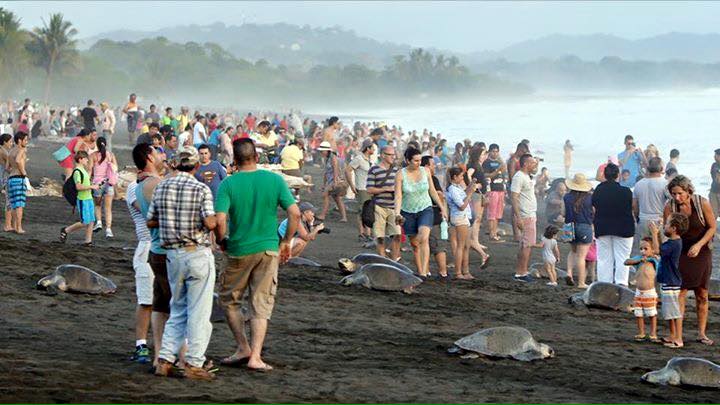
Seems this event isn’t singular. Marine conservationist Jonathon Miller-Weisberger of the Guaria de Osa eco-lodge in Costa Rica’s Osa Peninsula noted that this is simply an extreme example of a problem common around the world. He works with people visiting or living near nesting turtle populations to change how they interact with them. His organization, 4Biodiversity.org, teaches local youth how to protect these animals and preserve active nests. But his initiative is contradicted by government policy that permits harvesting turtle eggs.
You read that right. Public collection, and subsequent selling of turtle eggs from Ostional, has been legal since 1987. Blogger Diego Delfino wrote on Medium, “It is the only beach in Costa Rica where this practice is allowed, developed by community members as part of a comprehensive and sustainable model under the control and supervision of the UCR, MINAE and INCOPESCA SENASA.” The implication is that egg harvesting – which brings in needed income for a largely impoverished community – is systematic and controlled under the auspices of bona fide environmental agencies. But this week’s rave on the beach shows that “control” is flexible.
Delfino asserts that the biggest predators stalking sea turtles are sea turtles themselves. He says an estimated 93 percent of Ostional turtle eggs die from natural causes, including nest destruction by incoming turtles, attack by vultures and other species, and invasive larvae. He wrote, “With or without human intervention, the vast majority of eggs are lost.” Wouldn’t that be reason to step up protection of the remaining eggs?
Sea turtles have been around since the time of the dinosaurs. Found in warm and temperate waters throughout the world, they migrate between nesting and feeding grounds, some as far as 1400 miles, returning to the same nesting grounds where they were born.
Pregnant females come ashore and – using their back flippers – dig out nests in the beach where they bury their clutch of eggs (between 10-190 eggs, depending on species) and return to the ocean. Hatchlings may take a week to dig themselves out of the nest, emerging at night, and making their way to the sea. It’s a natural phenomenon over 100 million years old. The image below shows how it’s supposed to look. Not a bikini or selfie-stick in sight.

What is happening to us? Have we reached a tipping point where we no longer have real connection to nature? Have we lost all respect as to what holds this planet together? We fail to control our personal consumption, and generate unrecyclable waste at unprecedented volume. We commodify basic resources like clean water, while allowing environmentally catastrophic exploitation in pursuit of more fossil fuel. All the while tightening political boundaries, as if water and air and all planetary life respect lines on a map.
I grew up spending summers on a pristine barrier island in the Atlantic, six miles off the New Jersey mainland. It instilled a powerful and binary feeling towards nature, based equally on fear and respect. I was tipped to this story by a childhood pal with even stronger ties to that island. Peggy Messler Schaffer smartly summed things up, “Man has created artificial borders that separate them from the ‘others’, and hardship seems to have become a spectator sport.”
Agnostic me says God help us, because we clearly can’t help ourselves.
Images from SITRAMINAE Facebook page




Why is this so surprising. Humans don’t care about unborn children so why would they give a rats behind about unborn turtles.