
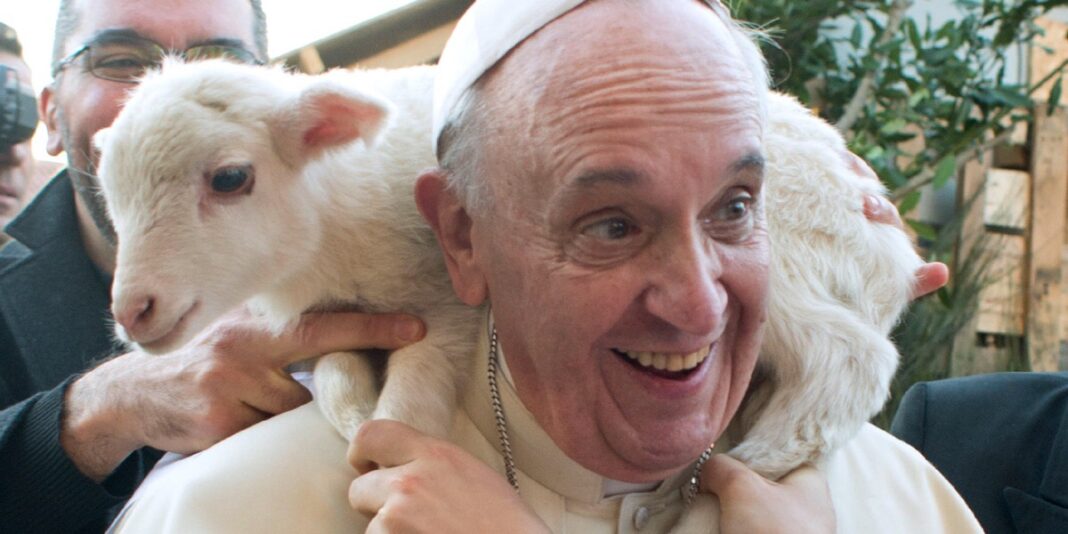

 Pope Francis has penned an official text on the environment, the product of a year’s worth of writing. Yesterday, an Italian news site leaked an early draft and Vatican officials cried foul. One, speaking to Bloomberg News on Monday, called the premature release of the papal encyclical a “heinous act”. The official release is on Thursday.
So why should this grab your attention?
The document Laudato Si (meaning Praised Be) is an “encyclical’, one of the most formal statements about Catholic doctrine that a pope can issue, and this one is the first of Francis’s tenure. It puts a papal high beam on environmental stewardship and climate change, specifically on its impact on human life. According to the draft leaked by L’Espresso, the pope says plainly that humans are responsible for degrading the environment.
“Numerous scientific studies indicate that the major part of global warming in recent decades is due to the high concentration of greenhouse gas…emitted above all because of human activity,” he wrote, according to L’Espresso. He continues that the heaviest impacts of climate change “will probably fall in the coming decades on developing countries. Many poor people live in areas particularly affected by phenomena related to heating, and their livelihoods strongly depend on natural reserves and so-called ecosystem services, such as agriculture, fisheries, and forestry.”
Climate change impacts developing countries with greater intensity that developed ones. The United Nations Climate Change Conference (COP 21) coming to Paris in December will also make this case, demonstrating that poor nations lack resources and infrastructure to mitigate flooding, drought, air temperature fluctuations, and resultant impacts to food security and shelter. Considering that almost 40 percent of the world’s 1.2 billion Roman Catholics live in South America, and with the faith booming in Sub-Saharan Africa, the correlation between global warming and his church is clear.
Of particular interest to the Middle East and North Africa, global warming will be felt keenly by imigrants and refugees. The Pop wrote, “Changing environmental conditions force them into a position of economic uncertainty in which they can’t sustain livelihoods.”
Francis’s papacy has consistently focused on human life and care for the poor. He made clear his views on poverty last spring via a less-formal-than-an-encyclical document called an apostolic exhortat, in which he linked environmental stewardship to the book of Genesis, “That human beings destroy the biological diversity in God’s creation; that human beings compromise the integrity of the earth and contribute to climate change, stripping the earth of its natural forests or destroying its wetlands; that human beings pollute the water, soil, air; all these are sins,” he writes.
The pontiff is not the first church leader to take a stance on sustainability. Last year, retired Archbishop Desmond Tutu was equally outspoken at the 2014 Climate Change Summit in New York City. Not everyone is happy with Francis embracing green. Criticism is loud in America, where many conservative voters and legislators deny that climate change exists. The Atlantic reported that former U.S. senator Rick Santorum – a 2016 presidential candidate and lifetime Catholic – advised the pope to “[leave] science to the scientists and [focus] on what we’re good at, which is theology and morality.”
Watch this space for more information after the official document release on Thursday.



Got news for you. Conservative voters and legislators do not deny climate change. They do, however, question whether carbon emissions is causing it. There are so many other factors at play here that to designate one potential problem as the only cause is ridiculous. Also, why focus so much on CO2 emissions when developers are deforesting cities and outlying areas at a rate that outpaces the trees’ ability to clean the air of CO2? Shouldn’t we be putting a stop to the cutting of old growth trees? And encouraging planting even more.
The Pope nailed it: We don’t have the luxury to get it wrong on climate change.