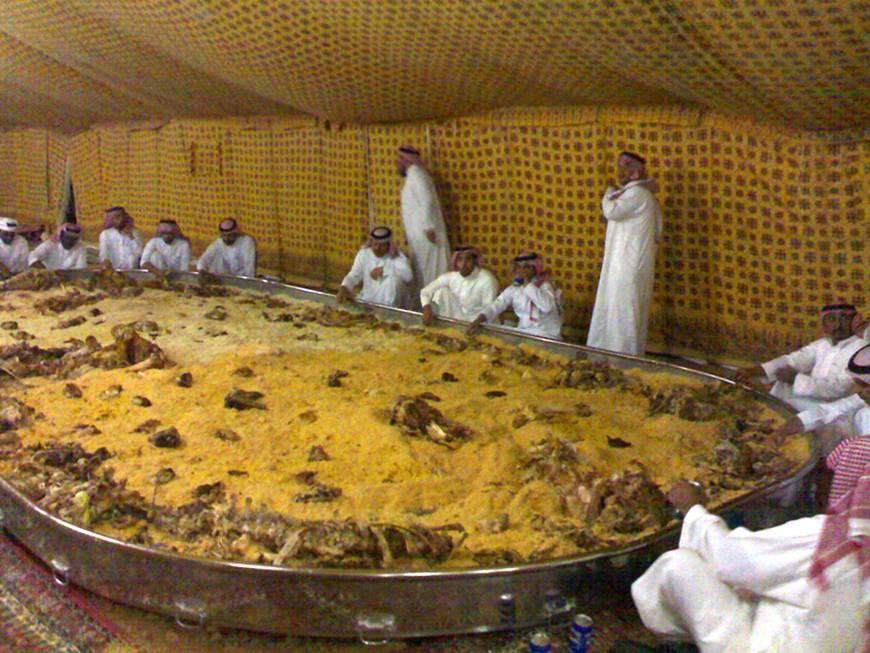
WASHINGTON — Inhabitants of the oil-exporting sheikhdoms and emirates of the Persian Gulf wolf down an average 3,700 calories a day —leading to the highest rates of obesity on Earth — even as at least 805 million people, one-ninth of the world’s population, go hungry.
Such huge disparities will ultimately lead to widespread unrest, warns Deborah Wheeler, a professor at the U.S. Naval Academy who specializes in Middle East politics.
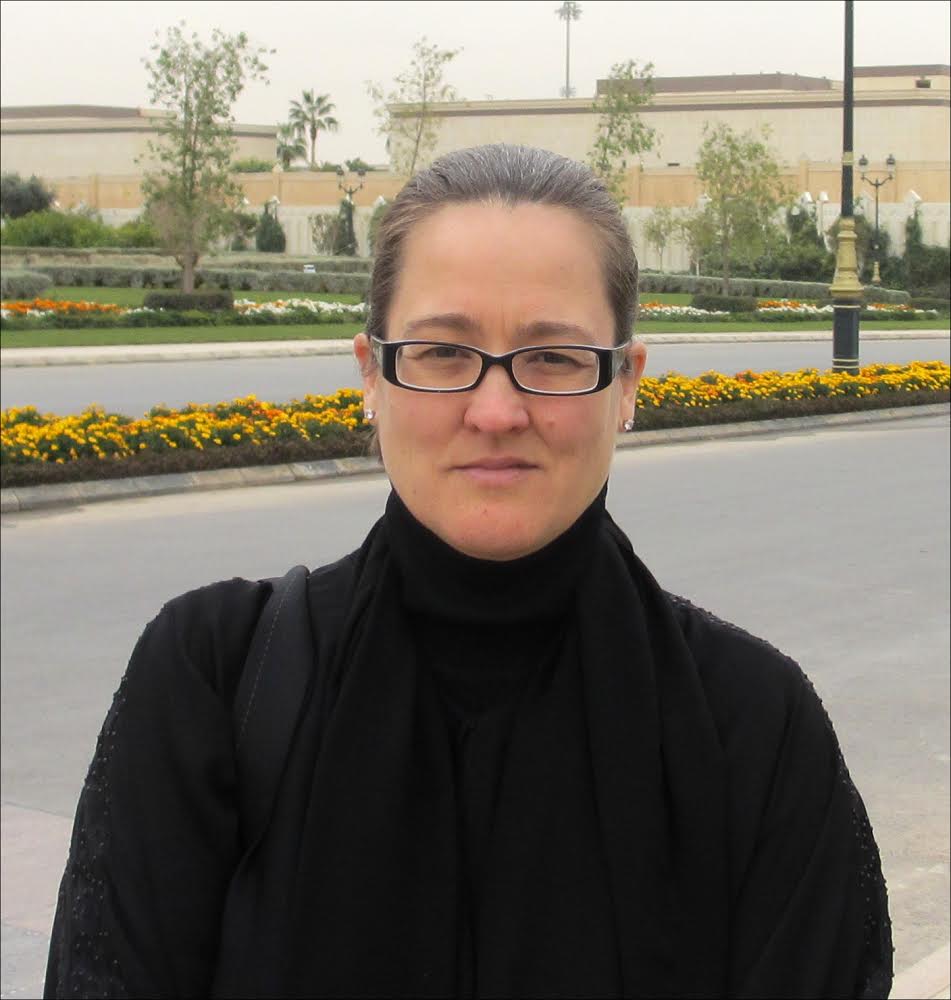
Wheeler (pictured below while on research in Kuwait) was one of a dozen experts meeting Oct. 16 at Virginia’s George Mason University, just outside Washington, for a summit on global food security and health.
“The United Nations says we will add two billion people by 2050 and an additional one billion by 2100, for a total world population of around 10 billion,” said GMU public policy professor Kenneth A. Reinert, a frequent consultant for the World Bank, the World Trade Organization and the U.S. Department of Commerce. “Approximately one billion of these additional individuals will reside in Africa, and another one billion in Asia. Both Africa and South Asia are currently basic goods-deprived environments.
Even worse, he said, “the majority of countries whose population growth is expected to be fastest in the future are precisely those showing inadequate food consumption and high levels of undernourishment.”
At the other extreme are a handful of small Arab states in the Persian Gulf that owe their mind-blowing wealth entirely to oil and gas. Qatar’s annual per-capita income exceeds $100,000, making that country’s 2.1 million inhabitants among the world’s wealthiest. Excluding migrant workers who form the vast majority of Qatar’s population, per-capita GDP jumps to nearly $690,000.
Oil rich but very food insecure
Yet Deborah Wheeler, a professor at the U.S. Naval Academy, sees dark clouds on the horizon.
“These countries depend more than 90 percent on the global food market to eat and drink,” she said. “Kuwait imports 98 percent of what it eats and drinks. It makes sense for them to import. But relying on that global market is becoming increasingly problematic.”
Wheeler, whose presentation at GMU was titled “Food Security and Gluttony in a Water Scarce Region: Lessons in Sustainability from the Arabian Gulf,” showed her audience a photo of the glitzy new Dean & DeLuca gourmet food emporium in Kuwait City. At 21,500 square feet, it’s the largest Dean & DeLuca franchise in the Middle East.

Another image was of the new Cheesecake Factory outlet at a Kuwait City mall.

“We’ve sent all our worst habits to the Gulf, and they are very happy to have them,” she said. “The Gulf countries are a perfect lab for studying non-communicable diseases. Diabetes is growing faster here than anywhere else on the planet, yet they’re in a water-scarce region — and it’s oil wealth that allows them to mask this problem.”
Wheeler, a political scientist, has done research in Kuwait, Oman, Qatar, Saudi Arabia, Jordan, Egypt, Tunisia, Syria, Morocco, Israel and the United Arab Emirates. She specializes in information technology diffusion and its impact on the Arab world, as well as gender issues and the Palestinian-Israeli conflict. She said that in Kuwait, 70 percent of the adult population, and 48 percent of all adolescents, are either overweight or obese.
Food insecurity could lead to radicalization
“As we know, as GDP goes up, consumption is transformed. These are rich countries and they eat like rich countries. The problem is, they don’t produce anything they eat,” she warned. “In spite of having all that oil wealth, which allows them to live way beyond their ecological footprints, we’re starting to see cracks. How did the Tunisian revolution start? A vegetable seller set himself on fire. That led to a transition.”
Wheeler added: “These countries are so fragile. As soon as they collapse, we’re going to see massive Islamization.”
RELATED: Gulf States land grab for food production in Africa
In fact, Kuwait, Qatar, Saudi Arabia and the United Arab Emirates rank in the bottom 10 percent of the world’s sustainable nations. All of these countries have seen population growth exceeding three times the global average, yet during the same time there’s been a rapid decline in the amount of available fresh water.
These countries are also among the biggest food wasters in the world, producing 150 million tons of municipal garbage a year. In addition, they release more carbon into the atmosphere on a per-capita basis than anyone else. Yet they don’t produce anything, which is why the Gulf Cooperation Council’s food import bill has jumped by 105 percent since 2010; experts estimate that the six GCC nations will spend a combined $53 billion a year on food by 2020.
“These people lead highly consumptive lifestyles that are ultimately dangerous to public health,” Wheeler said.
It’s no wonder diabetes is through the roof in Kuwait, Qatar and the UAE; citizens of the GCC nations consume an average 3,700 calories a day. They also have the world’s highest per-capita water consumption, even though their countries are among the driest on the planet.
“People are aware of the fact the cost of living is increasing rapidly. And what are their governments doing? They’re cutting subsidies. This leads to public protests in places where we don’t expect it,” she said, adding this is why Washington needs to be concerned. “Last summer while I was in Kuwait, there were public demonstrations in support of Islamic State. They’re upset with their government, and any movement that looks like it might sweep that existing government out of the way will get their support.”
Image of Sheikh Mohammed Bin Rashid Almaktoum from 965malls; top image of kabsa mandi from Saudi Arabia from UCAELI