Arab Gulf recycles paper, plastic, and cars!

UAE first car recycling plant

The United Arab Emirates (UAE) does everything big, including recycling, and this week they’ve officially opened their first plant dedicated to recycling cars! An estimated 11,000 UAE vehicles get scrapped every month.

Some simply reach their shelf-life, others are abandoned at airport parking lots and city back streets by debt-ridden expatriates and native boys who no longer can pay for their luxury toys.

Now all that automotive litter will be put to better use: “This is the only facility today that can deal with end-of-life vehicles in the country. We encourage insurance companies, dealers and government departments to use this service,” said Najib Faris, chief commercial officer of Bee’ah, the plant operator.

Dumped cars will be manually dismantled, then sliced and diced to allow valuable metals to be salvaged, and plastics, tires, upholstery, cables and mechanical parts to be recycled or refurbished within the Bee’ah compound.  Previously, old clunkers were sold to scrap dealers, who stripped off spare parts and sold the car carcasses on the international market.

Workers separate cables, which are sent to electronic waste traders, and foam cushions that can be recycled locally. Window glass is pulverized and used for landfill cover. The company aims to sell engines and transmissions to international companies that refurbish them.

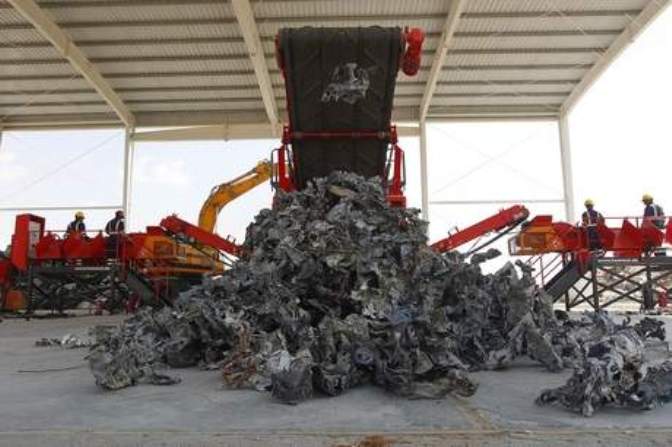
The facility began trial operations in October and has already processed about 350 old cars.  Its capacity is much greater;  Darker El Rabaya, director of waste processing at Bee’ah, told The National that its “shredder” (the equipment for processing car bodies) has a capacity of 60 vehicles an hour.

“Recycling consumes a lot less energy and a lot less water than producing virgin materials,” said Faris. It also diverts waste from landfills.

While the facility is now technically ready, a key issue for the next few months is to ensure a steady supply. As long as car dumping remains an Emirati epidemic, that ought not be a problem.

We’ve heard that some Emiratis prefer to just abandon unwanted cars, even Mercedes, Jags and BMWs at the airport, rather than get them scrapped. This initiative could change that.

Image of the Bee’ah “shredder” from The National

Read More

1 COMMENT

TRENDING

From Pilot Plant to Global Stage: How Aduro Clean Technologies’ 2026 Expansion Signals a Turning Point for Chemical Recycling Investors Like Yazan Al Homsi

The company's Next Generation Process (NGP) Pilot Plant in London, Ontario, has officially moved into initial operating campaigns, generating the kind of structured, repeatable data that separates laboratory promise from commercial viability.

Urban miner Sortera raises $45 million USD to pull aluminum from the scrap pile

Sortera Technologies, founded in 2020 by Nalin Kumar and Manuel Garcia, is emerging as a major U.S. circular-industry player. Led by CEO Michael Siemer, the company uses AI and advanced sensors to turn scrap metal into high-value aluminum alloys. Its new ~$45 million funding round signals investor appetite for industrial decarbonisation—where emissions cuts come not from PR-friendly solar installs, but from upgrading the materials that power EVs, solar frames, and construction.

Waste Reform from the Ground Up: How Trash Balers Are Helping Cities Rethink Sustainability

If you’ve ever watched a recycling truck weaving through city streets, you’ve seen the problem firsthand. Most of what we call “recycling” still depends on long-distance transportation and centralized sorting facilities. Those systems are energy-intensive and prone to contamination — the dreaded mix of wet food, plastic wrap, and paper that renders recyclables useless.

Scientists Crack the Code for Low-Cost, Low-Carbon Plastic Recycling

While enzymatic recycling offers hope for managing existing plastic waste, scientists and environmental advocates agree it must be paired with the development of bio-based plastics—materials made from renewable biological sources like corn starch, sugarcane, or algae. Unlike conventional plastics derived from fossil fuels, bio-based alternatives can dramatically reduce carbon emissions at the production stage and are often compatible with closed-loop recycling.

Regenx builds urban mines for the rarest of metals

Regenx from Canada has evolved the concept of mining: they are urban mining in the classic sense and pointing the way to cleaner and more sustainable ways of recovering minerals from industry.

Locals From Rishon Fight IKEA

Big Box stores are a pretty new concept in Israel, and thank God that not every Israeli city wants them in their backyard. A word from someone who has see the beautiful farmland around her hometown Newmarket, Ontario stripped and converted into vulgar strip malls of big box shops: they have no place in a healthy and sustainable town or city.

The Jewish National Fund Meets An Inconvenient Truth

According to the JNF, it has transformed thousands of acres of barren land into green forests in Israel. They state that each person emits about 23 tons of carbon per year, estimating that each tree planted can absorb one ton of carbon in its lifetime. That's a whole lot of trees you'd need to be planting. Could so many fit in Israel?

How to quiet noise from construction in your office

Streets need to be resurfaced in New York but the humming and grinding noise is unsettling. Noise is environmental pollution. 

EarthX and a blueprint for sustainable investing

Trammell S. Crow, a Dallas-based businessman and father of four, is focusing his efforts on impact investing, and media that focuses on saving the planet through EarthX.

Mining Afghanistan’s Mineral Discoveries Similar to Avatar

Now that American forces in Afghanistan are commemorating the longest period of any war that America has been involved in, including the 1965-73 Vietnam War, the recent discoveries of large and extremely valuable mineral and metal deposits may finally bring to light a reason to continue the presence of US fighting forces in this war torn and backward country.

From Pilot Plant to Global Stage: How Aduro Clean Technologies’ 2026 Expansion Signals a Turning Point for Chemical Recycling Investors Like Yazan Al Homsi

The company's Next Generation Process (NGP) Pilot Plant in London, Ontario, has officially moved into initial operating campaigns, generating the kind of structured, repeatable data that separates laboratory promise from commercial viability.

Nobul’s Regan McGee on Shareholder Value: “Complacency Is the Silent Killer” 

Why the governance framework designed to protect shareholders so...

Should You Invest in the Private Market?

startustartup Unlike public stock exchanges, which offer daily trading, strict...

Popular Categories