
 Fourteen picturesque Druze communities huddle in the shelter of Israel’s Galilee mountains. Although they flow freely in and out of Israeli society, the Druze stay close to home, marrying only other Druze and adhering to an Islam-based religion that they don’t discuss with outsiders. I have often wanted to know more about the Druze, to talk to their women and taste their food. But It never seemed possible to establish a contact with them.
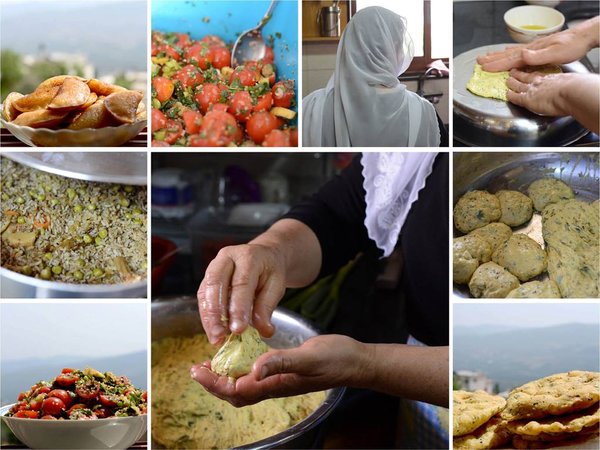
Then I discovered a tour that brings outsiders like me to their homes, and indeed into their very kitchens. Paul Nirens, originally Australian and a long-time resident of the Galilee, organizes charming culinary workshops with Arab and Druze families, through his Galileat project. The families welcome paying visitors into their homes – or in my case, into their small restaurant – for classes where they teach, hands-on, how to cook a variety of traditional dishes.
Together with another group, I finally got to enjoy the authentic Druze cuisine. Under the watchful eyes of our hosts, we cooked most of a traditional meal, and then sat down to eat it. It wasn’t surprising, given the rural lifestyle, that Druze cuisine is based on vegetables grown in their own gardens, like baba ganoush, and home-pickled olives, and tahini. (Here are 8 delicious ways to enjoy tahini).
Our hostess wore the traditional long black dress and covered her hair with a light scarf. Her husband was on hand to answer questions about Druze life and society. I learned that traditional Druze women are not allowed to drive, and that both sexes observe strict modesty laws. Druze don’t eat pork, seafood or insects, nor do their laws allow alcohol.
However, I also learned that there there are those who live by a more liberal point of view. Some Druze women drive, work outside the community, and even own businesses. For the women who teach cooking, the workshops are a step towards financial independence or easing of a strained family budget. A surprise benefit is a new self-esteem.
“I do this as a business, clearly,” says Nirens. “But I get a sort of “added value” out of seeing how the women have suddenly developed a sense of empowerment through their ability to earn money. It never occurred to them that they have something to offer to people outside their village; that they have important skills. The fact that people come and find them interesting, that they can teach things that otherwise these people couldn’t learn, is very important. That, and the respect they gain.”
 Nirens adds, “I could make the workshops cheaper by paying the families less. They would accept that because they need the income. But then I wouldn’t sleep at night. I’ve been told I over-pay, but I believe I’m only paying what’s fair. And visitors get a fantastic, totally authentic cultural experience lasting three hours, with a great meal at the end.”
I can testify to that. In fact, I can personally testify to the deliciousness of the typical dishes because the Galileat workshop I attended was, surprisingly, kosher and under the supervision of the regional rabbinical council. It is the only workshop that is kosher in the Galileat project. As a kosher-keeper, I wouldn’t have been able to enjoy the experience half so much if I hadn’t been able to partake of the hearty, aromatic cooking. Although I confess that I cooked less and photographed more.
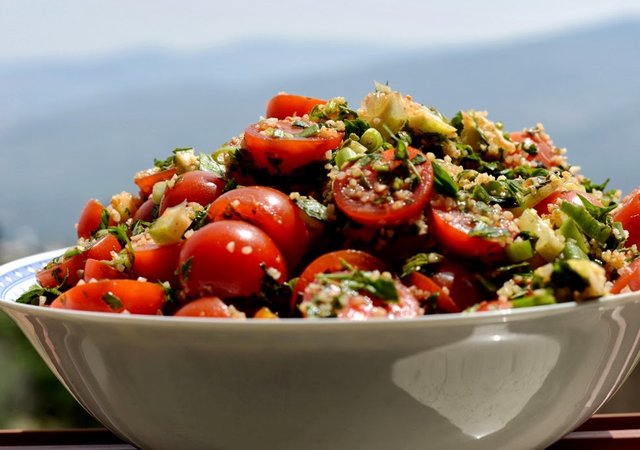
The recipe below reflects the home gardens and use of available products that come so naturally to the Druze. It’s a herby twist on tabuleh that features brilliant red cherry tomatoes. Enjoy!
Cherry Tomato Tabuleh Recipe
Ingredients:
1/2 kg cherry tomatoes
6 spring onions
I lemon
1/2 bunch fresh parsley (about 1 cup, chopped)
1/2 cup fresh mint, chopped
3 tablespoons fine burghul
1/2 teaspoon sweet paprika
Optional: 1/4 teaspoon hot paprika
1/2 cup freshly squeezed lemon juice
1/4 cup good olive oil
Slice cherry tomatoes in half. Finely chop spring onions and mix with tomatoes. Chop parsley and mint as finely as possible. Add to tomatoes. Dice lemon into small pieces, with rind and add to tomatoes.
Soak burghul for at least 15 minutes in lightly salted water. When burghul is soft, add to salad. Mix well.
Sprinkle paprika into salad mixture. Add lemon juice and olive oil. Correct flavors with salt and black pepper. Mix well.
The salad should be prepared at least 30 minutes before serving.
Serve at room temperature.
Our hint: Freeze and thaw the lemon ahead of time: it will soften and be easier to cut.
You’ll enjoy these additional Middle Eastern recipes from Green Prophet:
All photos courtesy of Paul Nirens.



You’re welcome, Tafline, and thank *you.*
Wonderful post Miriam! Thank you so much.