

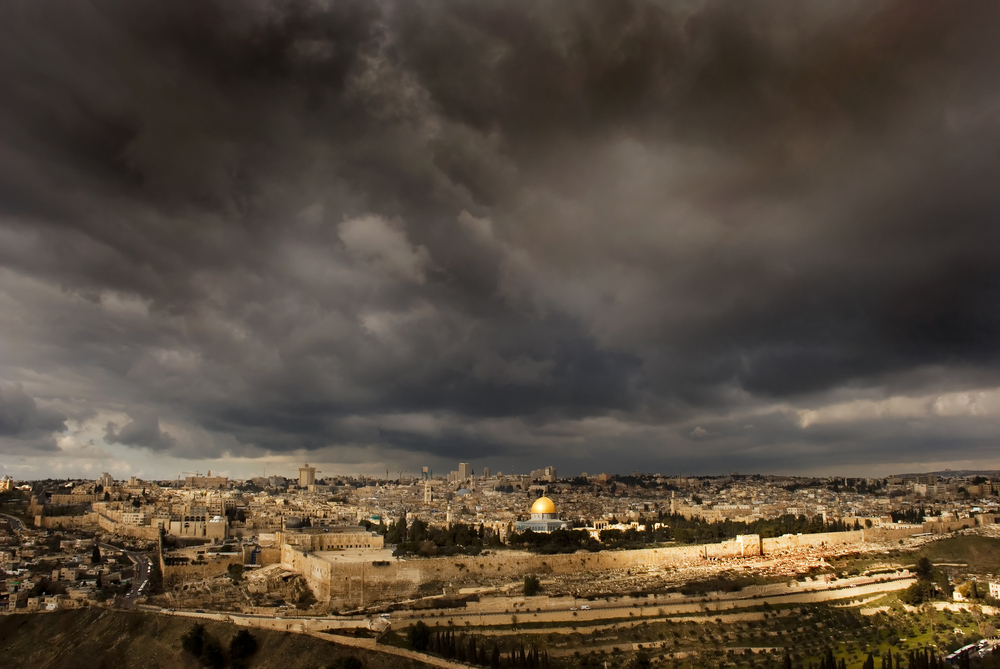
 Imagine trash and sewage filling six Olympic-size pools. Can you smell it? Now drain them into Kidron Valley which separates East and West Jerusalem, abutting their holiest sites. It’s a revolting image and annual reality: those pools are fantasy, but the waste is not.
A team of pollution-weary Palestinians and Israelis are injecting environmental education into East Jerusalem schools, teaching young Palestinians new “green” habits. They’re achieving cooperation in a region where even garbage is a political flashpoint.
The idea sprouted four years ago as a part of the Kidron Valley clean-up strategy. A planned sewage treatment plant was mothballed after political squabbling, but a team of Israelis and Palestinians are trying to resurrect the project.
They see a wider environmental mandate, with education at the top of their agenda, and launched green programs at ten schools with lessons in recycling and rainwater harvesting. Al Afaq Boys School and the Sur Baher Girls School, the first to participate, eagerly adopted environmentalism.
“In traditional Palestinian culture, no one threw anything out, they’d reuse it. With new technology it became easier to throw away,” said Khaled Abu Khaff, a manager at Only Green, the first enviro-education center in East Jerusalem and a volunteer at Al Afaq.
Plastic litter covers the approach to Al Afaq, but stops at the school gates. Interior grounds are litter-free. The campus boasts solar panels and rainwater harvesting barrels. Student Mohammed helped build a sculpture of Earth from recycled materials, proudly displayed at the school entrance. He says the projects taught him new ideas, “I’ve learned to save and take care of the things.”
Sur Baher students learn to make soap and toothpaste from natural ingredients, and science teacher Zoubaida Salman teaches them to build simple electrical circuits, too. They run an organic garden and maintain rainwater harvesting barrels, donated by US-based Water Resources Action Project. The barrels supplied 50% of the school’s water needs in 2011 and 2012.
Ideally, the students would take the behavior home, but when asked, only a few admit they have.
Israeli lawyers and project leaders Richard Laster and Dani Livney work to identify others open to localized green initiatives, which are funded in partnership with Only Green, Friends of the Earth Middle East, and Water Resources Action Project.
“We saw that there was much that needed doing. Alot of garbage; not much planning, if at all; and sewage,” Livney told The Christian Science Monitor. “We felt the place to start would be environmental education, to change people’s mindsets.”
Teachers try to involve parents in activities, such as collecting home trash for reuse in school crafts. “At the beginning of the course the parents say, ‘You want us to collect trash?’” said teacher Hazar Khatteb. “But now they understand.”
In 2009, the Association of Civil Rights in Israel reported that the Jerusalem municipality provided 15,000 people in Sur Baher and neighboring Umm Tuba with only 104 trash bins. Regional waste collection and recycling is in its infancy.
Back at Al Afaq, the boys plan to turn a courtyard into a lab for recycling, rainwater harvesting and solar and wind energy projects, financed by a $15,000 donation from the US Embassy in Tel Aviv and US Consulate in Jerusalem. They hoped to start a program for visits by other Arab schoolchildren last April, but some of their equipment was vandalized in December, delaying the plan.
That vandalism could be evidence of community resentment from some who say inequity between East and West Jerusalem is a more important issue than environmental stewardship. Abu Khaff says people complain about poor roads, not trash.
He said, “This type of [environmental] knowledge is not the top priority, but step by step we are changing that.”
Image of Old Jerusalem from Shutterstock


[…] Palestinian Schoolkids Green-Up Jerusalem's Holy Valley Sur Baher students learn to make soap and toothpaste from natural ingredients, and science teacher Zoubaida Salman teaches them to build simple electrical circuits, too. They run an organic garden and maintain rainwater harvesting barrels, donated by … Read more on Green Prophet […]