Film Review: ‘The Blessed Tree’ – An Interfaith Meeting Under The Shade of Nature

the-blessed-tree-islam-natureUnder a solitary tree in the desert, a young Prophet Muhammed met with the Christian monk Bahira. This documentary charts the importance of this chance meeting.

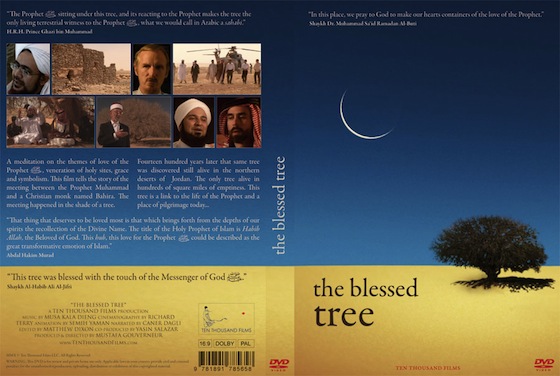
The Blessed Tree is a short and beautifully-filmed documentary which tells the story of a chance encounter between a Christian monk named Bahira and the young Prophet Muhammed (pbuh) under a tree in the desert. As well as drawing light on this important meeting, the documentary focuses on the belief that the very tree which witnessed this event is alive today in the Jordanian desert. It also captures a gathering of some of the most important Islamic scholars under that tree and their interpretation of the lessons the incident has to offer the modern world.

Starting with a commentary from the King Abdullah of Jordan about the first time he visited the ‘Blessed Tree’ and the importance of the meeting of Prophet Muhammed with the monk Bahira, the documentary takes you straight into the subject matter. Prince Ghazi bin Muhammad from Jordan explains how the tree was re-discovered after his late uncle, King Hussein, put him to work in the Royal Archives after returning from Cambridge University. It was there that researchers discovered numerous references to the tree, and a forgotten inventory made by King Abdullah I of the holy sites in Jordan.

This takes us to a tree near Safawi in Jordan where the young Muhammed (SAW) is believed to have met with Bahira whilst travelling from Saudi with his uncle Abu Talib to modern-day Syria for trade. The trade route they would have taken across the Arabian desert means that the likely location of the meeting would have been the Jordanian desert. The meeting is particularly important as it was the first time that the Prophet Muhammed (pbuh) was recognised as a prophet by the spiritual monk. After meeting Muhammed (SAW), Bahira the hermit monk tells Abu Talib to take good care of him and protect him from his enemies as he would be prophet for the end of time.

Prince Ghazi remarks: “The Prophet sitting under this tree, and its reacting to the Prophet makes the tree the only living terrestrial witness to the Prophet, what we would call in Arabic a sahabi.” Whilst those in the film seem convinced that the tree in the Jordanian desert is the tree from story, I am sure there are those who may need a bit more convincing. Either way, it’s great to learn more about the incident and the important place of nature in the life of the Prophet Muhammed as well as the emergence of Islam. ‘The Blessed Tree’ has beautiful footage of the Jordanian desert where the tree is located as well as interviews with some of the most famous Islamic scholars of our time and a great soundtrack.
There is, in a sense, a vertical dimension that goes through our heart vertically through our head and up to Heaven. The line of transcendence. This is the inner tree. The roots of it are actually the roots of the Divine reality in our hearts. For most human beings this tree has dried up because they are not aware of its roots. It is virtually there but not actually; and the spiritual life means the reviving of this tree within us by sinking the roots of the Divine once again in our hearts.”
Prof. Seyyed Hossein Nasr

The only downfall of the film is that it can a little repetitive with the scholars recalling the same incident. It’s also a huge shame that the film didn’t take the opportunity to explore the interfaith nature of incident and bring in Christian figures to contemplate the chance meeting. The symbolism of the tree is also left unexplored and none of the scholars (well, not in the film anyway) look at the place of nature in the life of the Prophet more broadly. Overall, a good 6 out of 10.

You can purchase the The Blessed Tree DVD from One Thousand Films or download a HD digital version for half the price at $9.85.

For more on Islam and the environment see:

How Islam Could Tackle Water Scarcity

What can Islam do for the Environment? Lots, Actually…

Islam’s Environmentally Friendly Architecture – Where Did It Go?
Arwa Aburawa
Arwa Aburawahttp://www.greenprophet.com
Arwa is a Muslim freelance writer who is interested in everything climate change related and how Islam can inspire more people to care for their planet and take active steps to save it while we can. She is endlessly suspicious of all politicians and their ceaseless meetings, especially as they make normal people believe that they are not part of the solution when they are the ONLY solution. Her Indian auntie is her model eco-warrier, and when Arwa is not busy helping out in the neighborhood alleyway garden, swap shopping or attempting fusion vegetarian dishes- with mixed success, she’d like to add- she can be found sipping on foraged nettle tea.

Read More

TRENDING

The Christ’s thorn (sidr tree) is also a well-known folk medicine

Christ’s thorn jujube (Ziziphus spina-christi) also known as the sidr tree is a real, identifiable tree native to the Middle East, and it appears—directly or indirectly—in Islam, Judaism, and later Christian tradition. The connections between the three faiths are not theological agreements but overlapping uses, names, and symbolic associations rooted in the same landscape.

Sustainable Architect Ronak Roshan on the Politics Behind the Houston Ismaili Center

Roshan’s reflection situates the Houston Ismaili Center within a broader discussion about architecture as diplomacy — where aesthetics, faith, and geopolitics intersect. Her words challenge readers to question whether “green” design and grand symbolism can coexist without transparency and accountability.

Can Muslims be buried at sea?

The world’s most wanted terrorist, Osama bin Laden, was given the ultimate green burial. Read more on how Muslims bury the deceased at land and sea.

The Orange Economy: How Religion and AI Are Shaping Innovation

Looking toward the future faith, creativity and technology will often intersect. The pathway from “prophet” to “profit” will not always be clear. However, creativity, at times fueled by faith, will help spur greater creativity where-in new technologies will allow the visionaries of the future to unlock new possibilities for collaboration, innovation, and mutual understanding more quickly than ever.

Meet Vita Sapien’s founder Guy Lane

Vita is very different from the normal sort of religion we are familiar with as it doesn't hold a position on the existence of God/s or an eternal soul. Instead, it is a nature-based religion devoted to our Living Planet.

Yerukim Forms a New Green Economy Where the Money is Really Green

The Yerukim members who pick up the recyclables get to keep the monetary reward, the public earns "green" bills that can be used in shops, and business owners get to be associated with environmentalism.

Choosing Riyadh over Dubai? What Investors Should Know

Saudi Arabia is deploying capital at unmatched scale to catalyze tourism and advanced industry while rewiring its power-and-water backbone. The investable frontier is widening—especially in renewables, grid storage, water efficiency/desal retrofits, and hospitality operating platforms. Prudent investors will insist on phased delivery, enforceable KPIs (energy, water, biodiversity), and RHQ/zone compliance—while pricing political-economy and reputational risks alongside growth upside.

Sell your cooking oil for biodiesel money

Want to make money on old french fry oil? Sell it.

Qatar Alternative Energy Summit Pairs Investors And Innovators

Alternative energy investors and innovators can meet n' greet in Doha, Qatar March 16 and 17.

Here’s How To Implement The Four Pillars Of Employee Engagement

If you throw a party for your work team and they are vegans, don't make it a barbecue. Know the sustainability values of your team to boost moral and retain good people.

Locals From Rishon Fight IKEA

Big Box stores are a pretty new concept in Israel, and thank God that not every Israeli city wants them in their backyard. A word from someone who has see the beautiful farmland around her hometown Newmarket, Ontario stripped and converted into vulgar strip malls of big box shops: they have no place in a healthy and sustainable town or city.

The Jewish National Fund Meets An Inconvenient Truth

According to the JNF, it has transformed thousands of acres of barren land into green forests in Israel. They state that each person emits about 23 tons of carbon per year, estimating that each tree planted can absorb one ton of carbon in its lifetime. That's a whole lot of trees you'd need to be planting. Could so many fit in Israel?

How to quiet noise from construction in your office

Streets need to be resurfaced in New York but the humming and grinding noise is unsettling. Noise is environmental pollution. 

Popular Categories