
How Arab World Buildings Use Energy (Infographic)

energy, buildings, Carboun, data, IEA, World Bank, Arab WorldTunisian buildings are the most energy intense in the Arab world. 

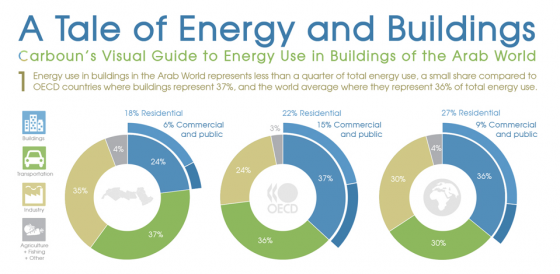
Carboun has released a powerful infographic which details how energy is consumed in the Middle East. Using data received from personal contributions, the World Bank and the International Energy Agency, founder Karim Elgendy has mapped out energy use by country in each of the following sectors: buildings, food production, industry and transportation. An architect and sustainability consultant based in London, Elgendy also breaks down how “resource-rich” and “resource-poor” countries consume energy differently. The results may surprise you.

Tunisia’s dubious win

Tunisian buildings consume more energy than any other Arab world country – about 43 percent of the country’s overall energy consumption. This is higher than the OECD (Organisation for Economic Co-operation and Development) average, which is about 37%. Lebanon, Algeria and Jordan follow close behind.

On the whole, buildings in the Arab world, which includes Maghreb countries, account for 1% less overall energy consumption than OECD countries combined, which seems contrary to popular thought. Turkey and Israel are the only countries from the Middle East -North African region that are members of the OECD economic group.

Also, buildings in the United Arab Emirates and Qatar are on the lowest end of the energy consumption spectrum, which comes as a surprise since the oil-producing countries are so frequently blamed for being the biggest power hogs because of subsidies.

This doesn’t mean they aren’t using a lot of energy, however, it just means that a greater proportion of it is being spent elsewhere.

In Qatar, commercial and residential buildings only use about 10% of the country’s overall energy, but industry accounts for roughly half of the country’s overall energy consumption.

Rich countries versus poor countries

Elgendy claims that resource-rich and resource-poor countries use energy very differently. In Saudi, for example, a resource-rich country, the oil and desalination industries usurp a greater percentage of energy whereas in resource-poor Egypt, food production dominates instead.

Likewise, in resource-rich countries, commercial buildings consume more energy than residential buildings, whereas the opposite is true for resource-poor countries.

Riadh Bhar, who is an Ecofys consultant in Germany, wrote of the infographic: “Really nice graphics… I´m not 100% sure if they are that reliable. It´s not that easy to find good statistics in the region.”

It’s true. Finding good data is difficult, but Carboun is helping to lead us out of the dark.

Tafline Laylin
Tafline Laylinhttp://www.greenprophet.com
As a tour leader who led “eco-friendly” camping trips throughout North America, Tafline soon realized that she was instead leaving behind a trail of gas fumes, plastic bottles and Pringles. In fact, wherever she traveled – whether it was Viet Nam or South Africa or England – it became clear how inefficiently the mandate to re-think our consumer culture is reaching the general public. Born in Iran, raised in South Africa and the United States, she currently splits her time between Africa and the Middle East. Tafline can be reached at tafline (at) greenprophet (dot) com.

Read More

TRENDING

The Hidden Components Powering the Renewable Energy Revolution

A rooftop solar system looks simple: panels, an inverter, a battery and a few cables. But beneath that simplicity lies a bill of materials thousands of lines long, where tiny current sensors, magnetic cores, gate drivers, capacitors and connectors quietly determine efficiency, safety and lifespan. These overlooked components—not the solar panels themselves—are why today's residential solar systems are smaller, smarter and far more reliable than those of a decade ago.

Sustainable Manufacturing Frameworks Reducing Waste in Heavy Industry

Hydraulic systems are at the heart of heavy manufacturing, but poor maintenance can lead to fluid leaks, downtime, and unnecessary waste. By focusing on preventive maintenance, fluid monitoring, filtration, and early leak detection, industrial facilities can improve efficiency, reduce environmental impact, and strengthen sustainable manufacturing without major capital investments.

Mona Khalil, Orange House Project founder, sea turtle protector killed in Lebanon

Mona Khalil spent decades protecting Lebanon's sea turtles and coastal ecosystems. Her death in the ongoing conflict between Israel and Hezbollah shines a light on a broader environmental tragedy unfolding across northern Israel and southern Lebanon. From damaged wetlands and disrupted bird migrations to threatened seed banks and endangered wildlife, the region's ecosystems are becoming casualties of a war with no clear end in sight.

Saving Gourmet Wild Plants For The Future

Think of truffles, a gourmet wild food. The European...

Middle-Eastern spices and natural medicine (A through C)

In the Middle East, aromatic traditional foods are regarded...

The Essential Guide To Sustainability in Project Management

Sustainability is an approach where businesses and individuals balance the environmental, social, and economic aspects of a project such that current and future stakeholders are not overburdened with the impacts of the project in future.

Yerukim Forms a New Green Economy Where the Money is Really Green

The Yerukim members who pick up the recyclables get to keep the monetary reward, the public earns "green" bills that can be used in shops, and business owners get to be associated with environmentalism.

Choosing Riyadh over Dubai? What Investors Should Know

Saudi Arabia is deploying capital at unmatched scale to catalyze tourism and advanced industry while rewiring its power-and-water backbone. The investable frontier is widening—especially in renewables, grid storage, water efficiency/desal retrofits, and hospitality operating platforms. Prudent investors will insist on phased delivery, enforceable KPIs (energy, water, biodiversity), and RHQ/zone compliance—while pricing political-economy and reputational risks alongside growth upside.

Sell your cooking oil for biodiesel money

Want to make money on old french fry oil? Sell it.

Qatar Alternative Energy Summit Pairs Investors And Innovators

Alternative energy investors and innovators can meet n' greet in Doha, Qatar March 16 and 17.

Here’s How To Implement The Four Pillars Of Employee Engagement

If you throw a party for your work team and they are vegans, don't make it a barbecue. Know the sustainability values of your team to boost moral and retain good people.

Locals From Rishon Fight IKEA

Big Box stores are a pretty new concept in Israel, and thank God that not every Israeli city wants them in their backyard. A word from someone who has see the beautiful farmland around her hometown Newmarket, Ontario stripped and converted into vulgar strip malls of big box shops: they have no place in a healthy and sustainable town or city.

The Jewish National Fund Meets An Inconvenient Truth

According to the JNF, it has transformed thousands of acres of barren land into green forests in Israel. They state that each person emits about 23 tons of carbon per year, estimating that each tree planted can absorb one ton of carbon in its lifetime. That's a whole lot of trees you'd need to be planting. Could so many fit in Israel?

Popular Categories