Mutant Fukushima Butterflies Should Discourage Middle East Nuclear

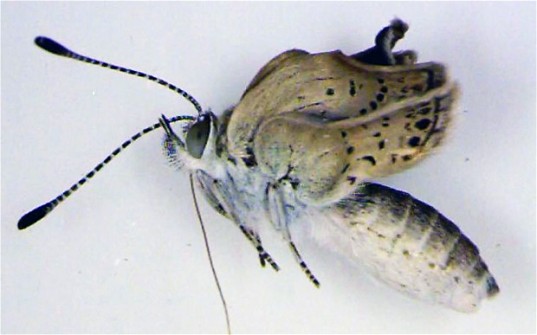
mutant butterfly, Fukushima, nuclear power, Middle East, earthquakesResearchers who collected and studied 100 pale grass blue butterflies from the Fukushima prefecture following last year’s nuclear meltdown have discovered serious mutations resulting from exposure to radiation. The butterflies, which were collected two months after the March, 2011 earthquake and tsunami caused the worst nuclear disaster since Chernobyl, had abnormalities in their legs, antennae and abdomens, as well as dents in their eyes. Some of them had broken or wrinkled wings and changes in wing size and markings.

Hit the jump to learn more about the study published in Scientific Reports if you need more convincing that nuclear power in earthquake-prone areas of the Middle East are an especially bad idea.

CNN reports that 12% of the pale grass blue butterflies collected in May, 2011 showed abnormalities as a result of radiation exposure. After the butterflies mated, 18% of the offspring had mutations of some kind.

And when mated with butterflies that were nowhere near Fukushima throughout the nuclear disaster, the percentage of mutations rose to 34%.

“[This indicates] that the mutations were being passed on through genes to offspring at high rates even when one of the parent butterflies was healthy,” according to CNN.

Another 200 butterflies were collected from the Fukushima prefecture in September,2011 to get a sense of how those butterflies fared. It turns out that 28% of them had many of the mutations described above and 52% of their offspring had morphed in some way. Many died before reaching maturity.

“The study indicated that second-generation butterflies, the ones collected in September, likely saw higher numbers of mutations because they were exposed to the radiation either as larvae or earlier than adult butterflies first collected,” according to CNN.

Scientists claim that butterflies are especially sensitive to radiation so it’s crucial to sample other species to gain a concise understanding of how the Fukushima disaster has impacted the surrounding ecosystem. Joji Otaki, an associate professor at the University of the Ryukyus in Okinawa, told Japan Times that humans are more tolerant to radiation.

Which means we shouldn’t expect to see human babies born with wrinkled wings just yet. Still, do we really want to risk building nuclear power plants in Turkey, or Iran, both of which countries regularly experience devastating earthquakes?

:: CNN
Tafline Laylin
Tafline Laylinhttp://www.greenprophet.com
As a tour leader who led “eco-friendly” camping trips throughout North America, Tafline soon realized that she was instead leaving behind a trail of gas fumes, plastic bottles and Pringles. In fact, wherever she traveled – whether it was Viet Nam or South Africa or England – it became clear how inefficiently the mandate to re-think our consumer culture is reaching the general public. Born in Iran, raised in South Africa and the United States, she currently splits her time between Africa and the Middle East. Tafline can be reached at tafline (at) greenprophet (dot) com.

Read More

TRENDING

Saving Gourmet Wild Plants For The Future

Think of truffles, a gourmet wild food. The European...

Middle-Eastern spices and natural medicine (A through C)

In the Middle East, aromatic traditional foods are regarded...

Iran’s water mafia and thirst for war leaves the country on brink of being dry

Iran’s Lake Urmia, once the Middle East’s largest saltwater lake, has shrunk by 90 percent due to mismanagement, dams, and drought. As Tehran pours billions into foreign conflicts, water activists face repression at home. The crisis mirrors Syria’s drought-driven unrest, showing how water scarcity can destabilize entire regions.

Bringing back the farm after a nuclear meltdown

Since the 1990’s scientists in Ukraine and overseas have been saying that the land can be safely used again despite contamination by radiocaesium and radiostrontium. But political complexities have meant that the land remains officially abandoned. That hasn’t stopped a few farmers taking matters into their own hands and beginning unofficial production in some areas. The new study has confirmed that the farmers were right – crops can be grown safely in most areas.

Creamy Eggplant Soup Recipe

Eggplant seems an unlikely soup ingredient. But blended with vegetable stock, herbs, and cream, the shiny purple vegetable makes a creamy soup full of Middle-Eastern flavors.

Yerukim Forms a New Green Economy Where the Money is Really Green

The Yerukim members who pick up the recyclables get to keep the monetary reward, the public earns "green" bills that can be used in shops, and business owners get to be associated with environmentalism.

Choosing Riyadh over Dubai? What Investors Should Know

Saudi Arabia is deploying capital at unmatched scale to catalyze tourism and advanced industry while rewiring its power-and-water backbone. The investable frontier is widening—especially in renewables, grid storage, water efficiency/desal retrofits, and hospitality operating platforms. Prudent investors will insist on phased delivery, enforceable KPIs (energy, water, biodiversity), and RHQ/zone compliance—while pricing political-economy and reputational risks alongside growth upside.

Sell your cooking oil for biodiesel money

Want to make money on old french fry oil? Sell it.

Qatar Alternative Energy Summit Pairs Investors And Innovators

Alternative energy investors and innovators can meet n' greet in Doha, Qatar March 16 and 17.

Here’s How To Implement The Four Pillars Of Employee Engagement

If you throw a party for your work team and they are vegans, don't make it a barbecue. Know the sustainability values of your team to boost moral and retain good people.

Locals From Rishon Fight IKEA

Big Box stores are a pretty new concept in Israel, and thank God that not every Israeli city wants them in their backyard. A word from someone who has see the beautiful farmland around her hometown Newmarket, Ontario stripped and converted into vulgar strip malls of big box shops: they have no place in a healthy and sustainable town or city.

The Jewish National Fund Meets An Inconvenient Truth

According to the JNF, it has transformed thousands of acres of barren land into green forests in Israel. They state that each person emits about 23 tons of carbon per year, estimating that each tree planted can absorb one ton of carbon in its lifetime. That's a whole lot of trees you'd need to be planting. Could so many fit in Israel?

How to quiet noise from construction in your office

Streets need to be resurfaced in New York but the humming and grinding noise is unsettling. Noise is environmental pollution. 

Popular Categories