Saudis Again Refute BBCs Claims of Arsenic-Contaminated Zamzam Water

zam zam water saudi arabiaMore questions than answers in new Saudi refutation of BBCs slam on its holy waters

In May, we covered the BBC claim that imported Zamzam holy waters from a sacred well at Mecca being sold in some Muslim bookshops in London was  contaminated with dangerous levels of arsenic.

Association of Public Analysts President Dr Duncan Campbell was quoted as saying “The water is poisonous, particularly because of the high levels of arsenic, which is carcinogen. [sic] I would not recommend drinking this water.”

But is the Saudi government getting a bum rap on the safety of its holy water? 

Although Ridiculously Simple Technology Can Save Millions from Arsenic Poisoning – arsenic can harm the liver and kidney and cause cancer at higher levels than the 10 micrograms per litre permitted by the WHO.

Fahd Turkistani, adviser to the Presidency for Meteorology and Environment, said the BBC Report focused on bottled water supplied not by the Presidency of the Two Holy Mosques Affairs, but by unscrupulous individuals.

“Zamzam water contamination could have been caused by illegal workers who sell it from unsterlised containers at Makkah Gates. The Saudi Government has banned the sale of such water,” Mr Turkistani said.

Perhaps even more definitively, Saudi Arabia simply does not export its Zamzam water. So what is in the London muslim bookstores cannot be the officially sanctioned Zamzam.

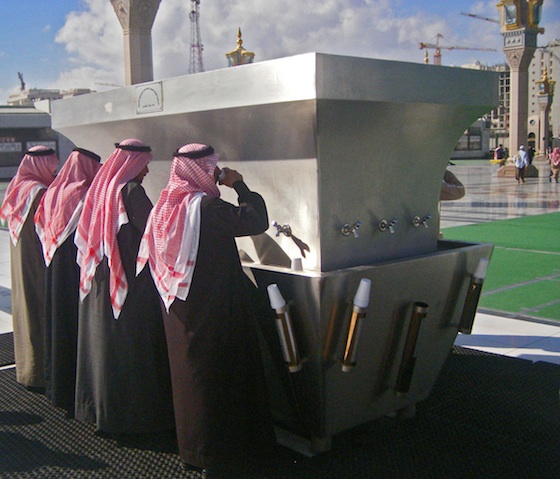
The King Abdullah Zamzam Water Complex was built just last year in Mecca. It supplies 200,000 bottles a day from the Zamzam well, within the Masjid Al Haram, about 20 metres East of the Kaaba. But it does not export its water.

In a document refuting the claim by the BBC, Saudi Arabia undertook an independent study to find definitive results on different water samples, including Zamzam water. King Fahd University for Petroleum and Mineral Resources (KFUPM) conducted tests on Zamzam water using the latest laser spectrum disintegration technology, and gauged part-per-million levels of harmful materials.

They found that it contains “no harmful substances, including arsenic”. But the refutation goes on to claim that the amount of arsenic in Zamzam water is “much lower” than the 10 micrograms per litre permitted by the WHO.

And then, even more disconcertingly, the paper quotes Fahd Turkistani, adviser to the Presidency for Meteorology and Environment as saying “ultraviolet rays are applied to kill harmful bacteria.”

But this raises more questions than it answers. The most cursory google search for approved treatment methodologies for arsenic in water does not include the use of ultra-violet rays. Nor is arsenic “bacteria.”

Of course, it is possible that these are translation errors in the document in English, not exactly what Turkistani was saying. But for these reasons, the refutation is not entirely reassuring.

:: BBC Report

::Saudi Refutation

Read more on Zam Zam Water
Zam Zam Holy Water in Mecca is Contaminated
Plastic Removes Arsenic
Saudi Options Narrow With Peak Water

Read More

1 COMMENT

TRENDING

Health Canada approves lab grown milk

Canada's approval of animal-free dairy proteins marks a milestone for precision fermentation and the growing alternative-protein industry. Will consumers embrace milk made without cows?

A visit to Amirim, Israel’s first all-vegetarian village in the Galilee

Just 15 kilometers from Tzfat there is a moshav that was founded in the late 50s that was ideologically influenced by organic, vegetarian and vegan principles. My hostess at Ohn-Bar, the tzimmer where I stayed, explained that the people of Amirim were among the pioneers of Israel’s strong vegetarian movement.

Can Scientists Predict Coral Bleaching Before It Happens?

Now researchers at the Woods Hole Oceanographic Institution (WHOI) in the US say they have developed a way to predict coral bleaching five to six months before it occurs, potentially giving reef managers enough time to intervene and save vulnerable corals.

AC Water Uses: How to Reuse Air Conditioner Condensate Water for Plants, Cleaning and Water Conservation

That means the water dripping from your air conditioner may already be usable for gardening, cleaning, flushing toilets, topping up humidifiers, or cooling systems — instead of disappearing into the sewer. A new study. Is it safe?

Hormuz 2026 Conflict Poses an Energy and Food Security Dilemma in a Warming World

As tensions rise in one of the world’s most critical maritime chokepoints, the ripple effects go far beyond oil—touching food systems, climate pressures, and regional stability

Yerukim Forms a New Green Economy Where the Money is Really Green

The Yerukim members who pick up the recyclables get to keep the monetary reward, the public earns "green" bills that can be used in shops, and business owners get to be associated with environmentalism.

Choosing Riyadh over Dubai? What Investors Should Know

Saudi Arabia is deploying capital at unmatched scale to catalyze tourism and advanced industry while rewiring its power-and-water backbone. The investable frontier is widening—especially in renewables, grid storage, water efficiency/desal retrofits, and hospitality operating platforms. Prudent investors will insist on phased delivery, enforceable KPIs (energy, water, biodiversity), and RHQ/zone compliance—while pricing political-economy and reputational risks alongside growth upside.

Sell your cooking oil for biodiesel money

Want to make money on old french fry oil? Sell it.

Qatar Alternative Energy Summit Pairs Investors And Innovators

Alternative energy investors and innovators can meet n' greet in Doha, Qatar March 16 and 17.

Here’s How To Implement The Four Pillars Of Employee Engagement

If you throw a party for your work team and they are vegans, don't make it a barbecue. Know the sustainability values of your team to boost moral and retain good people.

Locals From Rishon Fight IKEA

Big Box stores are a pretty new concept in Israel, and thank God that not every Israeli city wants them in their backyard. A word from someone who has see the beautiful farmland around her hometown Newmarket, Ontario stripped and converted into vulgar strip malls of big box shops: they have no place in a healthy and sustainable town or city.

The Jewish National Fund Meets An Inconvenient Truth

According to the JNF, it has transformed thousands of acres of barren land into green forests in Israel. They state that each person emits about 23 tons of carbon per year, estimating that each tree planted can absorb one ton of carbon in its lifetime. That's a whole lot of trees you'd need to be planting. Could so many fit in Israel?

How to quiet noise from construction in your office

Streets need to be resurfaced in New York but the humming and grinding noise is unsettling. Noise is environmental pollution. 

Popular Categories