Miriam pointed out the perils of eating in front of the computer. Now, discover the cues that keep you munching when you’ve really had enough.
Last week I lunched with a friend at an inexpensive Indian restaurant. We ordered the platter for two. Attractively arranged on a round platter were spiced rice, spoonfuls of chutneys, a bowl of pureed lentils in the middle (and here are 10 ways to eat lentils) – and about five small portions of different cooked vegetables grouped around it. Instead of chappati bread, there was half a local Iraqi flatbread for each. With a pitcher of ice-cold water on the table , we didn’t feel the need to buy a Coke or a beer. I wondered if there would be enough to satisfy both of us since portions were small, but to my surprise, we even left a little over.
On our way out, I remarked to my friend, “Funny. We just had the sort of meal we ate when we were hard-up students, but we ‘re satisfied, no complaints. Yet we’ve both complained loudly enough about seriously fancy places with huge portions.”
“The difference,” said my friend wisely, “is lowered expectations.”
We eat with our eyes, not with our stomachs, says Dr. Brian Wanski, director of the Food and Brand Lab at Cornell University. If you want to control your food intake, become aware of expectations and suggestion, factors that influence how much you’ll eat and even convince you of what you’re tasting.
At Wanski’s site, you’ll find a series of eye-opening videos. Some are about 5 minutes long and some under 2 minutes. They’re worth watching, in spite of the inevitable sales promotions for Wanski’s book. (I haven’t read the book and so can’t comment, but assume it’s in line with the sensible articles and videos on the site.)
I especially enjoyed the first video, where three guests joined the Wanski family for dinner. Mrs. Wanski, a gourmet cook, served the food and gave out a menu describing each dish with all the fashionable gourmet adjectives. The guests murmured appreciatively over the “juicy garlic chicken” (a heated-up roasted chicken from the deli; “potato quenelles (spoonfuls of potato puree from a box) and bundles of vegetables cunningly tied with a chive (standard frozen vegetables). They were good natured enough to enjoy the joke when the Wanskis revealed how suggestion had tricked them into “tasting” high-end gourmet food.
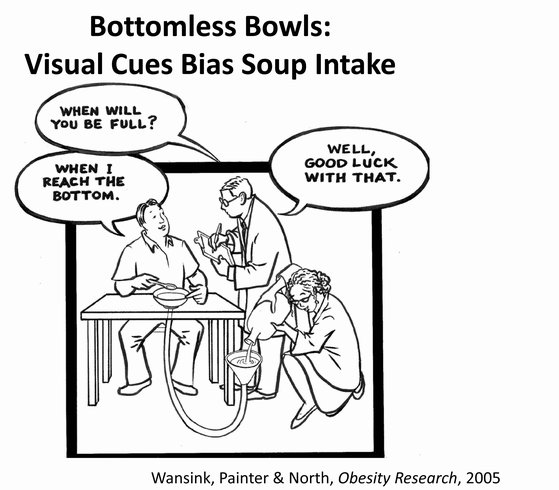
As a hostess, I always say that as much food as you put on the table, that’s how much people will eat. It was fun to see that confirmed by a filmed study. Participants at the Food and Brand lab sat down in front of full soup bowls. The bowls were attached by a hose to a tank full of soup discreetly placed under the table so that they never emptied. And the participants never stopped spooning up soup, eating way past the point when they should have been satisfied. Asked if they weren’t full, they said No, there’s still soup in the bowl.
The lesson? Stop eating when you feel full. Trust your body’s clues and don’t rely on your eyes to guide your eating.
It all makes me wonder how much the food industry manipulates our food behavior. Are we persuaded into tasting what someone else wants us to – eating more than what’s good for us? So how can we take control?
According to Dr. Wanski, these simple choices will help:
- Use smaller plates. The same satisfactory amount of food looks skimpy on a big plate. That makes you load more food on. And use a bigger fork! The bigger the mouthful you scoop up, the more satisfied you’ll feel, with less need to keep the fork moving.
- Slow down your eating pace -use chopsticks.
- Drink out of a tall, skinny glass. As with the large plate, a squat glass makes the same cocktail or wine portion look less.
- Serve snacks in a reasonably sized bowl. Don’t keep dipping into a bottomless bag of chips or carton of ice cream.
- Make nosh less accessible. Move the cookies or candy jar to an uncomfortable distance from your work place.
- Change your serving habits at the table. Plate the food in the kitchen, instead of serving family style. There will be less reaching for seconds and thirds.
And this from me. Eat consciously. Enjoy your food, taking time to appreciate flavors and textures. Meditate a minute on where the food came from and how it will become part of you. Give thanks.
More thought-provoking posts from Green Prophet on sustainable food and responsible eating:
- 7 Gulf Fish That Are OK To Eat
- Eating the Whole Animal: Lamb’s Testicles
- Why Don’t Consumers Make Healthy Food Choices?
Miriam also writes a food blog.