

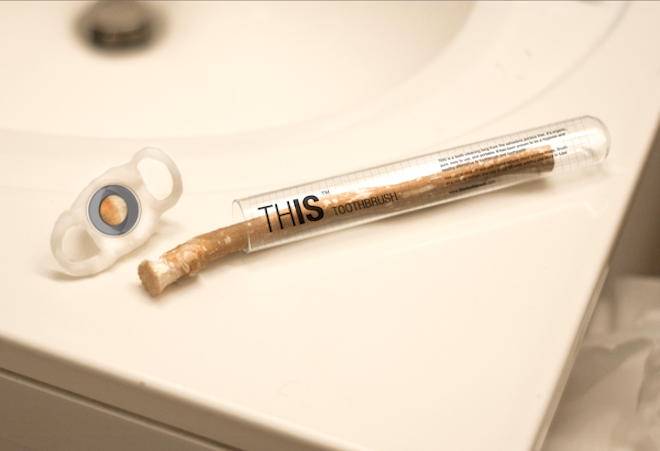

‘THIS Miswak’ complete with cutting cap could soon be in supermarkets
Oral hygiene is no stranger to the Islamic lifestyle. Self-improvement and cleanliness is part of the Muslim creed and its implementation is connected to increasing spirituality. In Muslim culture, a natural toothbrush called a miswak, was in use long before any plastic toothbrush had been designed – even the Greeks and Romans had twiggy toothbrushes. Finding a miswak stick in any Middle Eastern country and particularly Muslim communities is not that difficult; it costs next-to-nothing, and is the most organic toothbrush that doesn’t require toothpaste nor harbour bacteria as a regular synthetic toothbrush would.
However, this miswak stick is not a common eco-practice amongst European and Western countries. Lebanon Graphic Designer, Leen Sadder, developed a novel ‘THIS Miswak’ stick as part of her design class, which with the right marketing, we feel could soon be on supermarket shelves.
Zaufishan got in touch with Leen to ask why she designed the miswak and whether it contributes to environment sustainability.
Thank you Leen for sharing your eco-product with Green Prophet. First up, tell us a bit about yourself.
I grew up in Beirut, Lebanon where I attended the American Community School and later pursued a four-year bachelor’s degree in Graphic Design at the American University of Beirut (AUB). After graduation, I worked at a design studio for a year before moving to New York City to attend the Designer as Author/Entrepreneur program at the School of Visual Arts, where I am currently in my second semester. While I am a trained graphic designer, I consider myself more of a design thinker and am constantly looking for new ways to affect change through design.
What lead to the creation of ‘THIS Miswak’ toothbrush? Had you heard of such a ‘clean’ product before?
THIS toothbrush began as a project for Allan Chochinov’s 3D Design class at SVA. In our first class he asked us to redesign whatever we threw out next. For me it happened to be an empty tube of toothpaste. I began with an exploration of the history of toothpaste, its relationship to the toothbrush, the different features, and the human habits related to it. At one point I was obsessed with the ritual of squeezing the toothpaste tube and many of my early sketches iterated that.

Leen’s early sketches for a more functional miswak storage
After moving on with those I was doing some more research and discovered the miswak, which I had seen and heard of before but had not thought about as a possible solution. The more research I did, the more I found out how beneficial it is and the more interested I got in trying to promote it to a wider audience.
What was funny was that I had no idea how I was going to actually get my hands on one of them- but I soon learned that in NYC, anything is possible. A few minutes after deciding to go with the direction, I left my studio and walked into a copy place nearby – I had remembered it was run by a Pakistani couple. I went in with a picture of the miswak and five minutes later was walking out with two brand new ones that the woman had happened to have with her in her purse as well as the address, name and phone number of the place down the street that sells them. I could not believe how lucky I had been and decided then that it was a sign to continue on with the project.

What inspires you to design and create?
I have always had a strong passion for design as well as community, and I think my work tends to reflect parts of my cultural background – so I would definitely say that Beirut inspires me. I would say what inspires me most, though, is people. I am constantly fascinated by the people I meet, and one of my favorite pastimes is sitting in a crowded area and just watching as people rush by, trying to guess where they are going and what their lives are like. Over the past year I have come to realize the power of design in changing the way the world works, the way people behave, and the way we think. It is so much more than creating a logo or a poster or an animation- it is about communication and power, and that involves making sure you are directing your ideas towards the right audience, and listening to them as well. It also means finding out how and why people behave the way that they do, and coming up with solutions to problems that arise from that.

THIS Miswak incorporates a snipping device in the cap – like a cigar cutter, to expose new, clean “bristles”
Has the miswak been marketed towards or sold in Muslim communities, particularly Middle Eastern regions? Do you think it should?
From what I know, the miswak has not been particularly marketed in the Middle East. I know that there have been products that incorporate the miswak flavor into toothpaste, as well as miswak holders – but other than that I think the miswak is known as more of a tradition and is the kind of knowledge passed on from older generations to younger ones. It is almost impossible to separate the miswak from its religious connotation and I think that is probably why there has not been much of a marketing strategy related to it. Whether there should be or not is still a question – I think more conclusive studies would need to be conducted to find out how and by whom the miswak is being used in order to find out if there is a need to market it at all.
How, in your opinion, can the miswak toothbrush help the environment?
The beautiful thing about the miswak is its purity. The way it protects its bristles with the outer covering is a natural design wonder. The use of the miswak would undoubtedly cut down on the excessive use of plastic and chemicals, obviously helping to protect the environment. While I was breaking down the different components of commercial toothpaste, I could not understand the purpose of the box toothpaste is packaged in. Shampoo isn’t sold in a box, and neither are most household or beauty products- so how come toothpaste comes in a box? I thought maybe it was a storing issue, or a hygiene issue- but felt that there had to be a better way to solve both those problems. One of my early sketches was a toothpaste tube with a hole in the top so it could hang in-store without having to waste the excess material on the box. This idea returned later in the design of the miswak package, which has a hole in the cap in order to display the product without having to use additional material.

The miswak’s plastic wrapping is a familiar image for consumers – but contradicts renewability
And what about the plastic packaging? That’s not environmentally friendly.
I think it is important that I tackle the issue that arose when the project was traveling the blogosphere – and that is the ‘plastic’ packaging of the miswak. It started many debates that were quite interesting but were a result of assumptions (on behalf of readers and bloggers) and miscommunication (on my behalf). So I would like to take this opportunity to clarify a few points:
I completely, entirely agree with everyone who had a problem with the plastic packaging of a supposedly sustainable product. The fact of the matter is that I never realized that it was going to spread once I put it up on my portfolio, so it never occurred to me to address the issue in the description of the project. When my professor pointed out the problem in class, it was really the first time I had even thought of the material I had used for my prototype – mainly because I had been focusing so much on the functionality of the product and not on researching different materials within the two weeks we had to complete the project. I had also happened to have just purchased a DIY plastic molding material that I was excited to use in my prototype to indicate what the cap could look like aesthetically. I did not mean to indicate that if it were a real product, it would be made of plastic but of course, I cannot expect people to know that – so I was actually pleased to see the reactions it got. It showed that people were really thinking about the solution at hand and were critical in judging whether or not it was beneficial to the environment.
Most importantly, I would like to clarify that if THIS toothbrush were to be developed into a real product, the first thing I would do is research possible sustainable materials, reduction of the packaging, or even an entire re-packaging of the product itself if needed. I would steer clear from using any material that would harm the environment or use excess material, while still maintaining the look and feel of the packaging concept.
Do you think non-miswak users will convert their toothbrush to become hardcore miswak users?
I’m still unsure about whether non-miswak users would replace their toothbrush and toothpaste. One of the most difficult things to do is to change people’s behaviors – especially when it is one that has resided for so long. The positive reactions I received with regards to THIS certainly showed that there was an interest in giving it a try. I think it would probably be a very specific audience – one that is both environmentally and culturally aware of the features of the miswak.
On a commercial front, Is the miswak economically viable?
I have not gotten into the details of the viability of the product. However, I do think that with the right packaging and material that it could be developed into a very affordable and viable product due to the nature and availability of the Miswak itself. Again, this would have to be studied separately.

THIS Miswak billboards with variations of a print campaign
We see the great prototype advertisements for THIS Miswak. Was the miswak difficult to market to non-Muslim audiences?
Since it is still a student project and has not been tested with a real audience, it is difficult to understand the results. However, based on the amount of blog posts, tweets and project views (almost 14,000 so far!), I think it’s safe to say that there is a general interest in it – mainly because it looks so out of place. I think non-Muslims are interested in trying it out to see if it could really replace their toothbrush and toothpaste, and with enough scientific proof and ease-of-use, it could become a mainstream product in the realm of sustainable products today.
We love hearing about similar eco projects and designs so what, if any, other projects have you been involved in and created?
You can check out more of my work at http://www.behance.net/LSadder
Great! We will. As a creative person designing for change, what 3 top tips would you give to fellow designers who are developing ethical or environmentally friendly products?
1. Know your audience.
2. Research, research, research.
3. Be accountable for your decisions and their consequences.
Lastly, what have you yourself learnt from the conception and creation of THIS Miswak?
This project has taught me so much; mainly though it has reaffirmed to me the power of design and communication. It has shown me how fast something can spiral out of control and how interested people are in the unknown. It has also taught me to be careful in communicating my work to the world – and that blogs are awesome!
Leen Sadder
SVA Graduate Student, MFA Design
New York City
Thank you for sharing your product and thought process Leen, you’re a great eco-designer and inspiration – we need more visionaries like yourself!
More on living life lean and green!
Miswak Is Nature’s Twiggy Toothbrush
Are You An Eco-Sexual
Black Cumin: Islam’s Miracle Cure Seed
Cambridge To Build Europe’s First Eco-Mosque
Are Superfoods For Real, Or Just A Marketing Device?


Where can i find it in NYC?
where can we get this toothbrush in india.please reply.Or is there a facility to buy this tootbrush in india through online.Iam living in the city of cochin,kerala,india.Is this toothbrush available in cochin.
Where do I Buy one from???
Try religious Islamic stores.
How can I buy one – desparately needing one actually 🙂
please contact me or put leen in contact with me
I’d certainly give the miswak a try if I could get hold of it. Maybe people could buy their first miswak in the plastic tube and use it for storage (to put in a handbag to take to work etc) then get refills in some eco-friendly material.
Excellent idea, hope to see it in local supermarkets soon! One thing though, cleaning one’s teeth with a twig is not a religion or culture specific (“Muslim culture”) practice. I remember that in Indian ancient literature (going back some 3000 years, predating even Greek usage) using a neem twig for that purpose is mentioned several times. It is still quite a common practice in rural Indian sub-continent, and maybe other parts of Asia too.